


Uber Clone
Introduction
The transportation sector has experienced a revolution with the arrival of mobility applications such as Uber, which have completely transformed the way people move around cities. In this context, a concept has emerged that is in high demand among entrepreneurs and technology companies: the Uber Clone, a technological solution that replicates the main functionalities of the Uber app with a personalized design and new capabilities adapted to the needs of each market.
In this article, we analyze in depth what an Uber Clone is, how it works, what its main components are, the steps for its development, and the business opportunities it offers in the current market.
What is an Uber Clone?
An Uber Clone is a functional replica of the Uber application, designed to offer on-demand transportation services. It is not simply a matter of copying an app, but of recreating its business model, adapting it to other geographical areas, specific niches or particular needs.
An Uber Clone allows:
Connect users who need transportation with available drivers.
Manage online payments securely.
Provide real-time vehicle tracking.
Apply dynamic fares based on demand.
Manage user and driver profiles.
Main Features of an Uber Clone
An Uber clone should include, at a minimum, the following functional components:
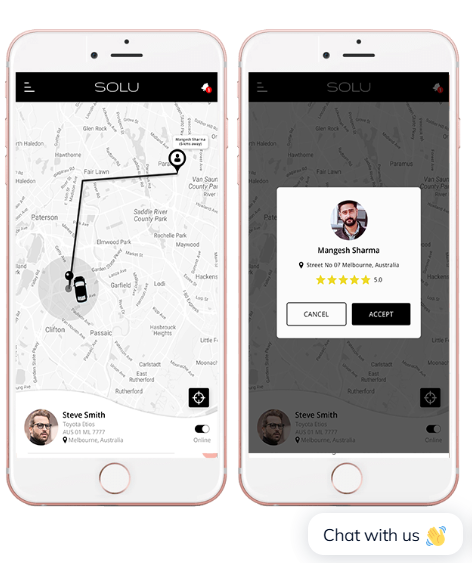
1. Passenger app
Registration/login.
Interactive map to see available drivers.
Trip request with a specific destination.
Fare estimation.
Real-time tracking.
Integrated payment (card, digital wallet, cash).
Driver and trip rating.
2. Driver app
Registration and identity/documentation verification.
Enable/disable availability.
Receive and accept trip requests.
GPS navigation to destination.
Trip history.
Revenue and statistics.
3. Admin panel
User and driver management.
Real-time monitoring of trips.
Control of rates and commissions.
Usage and revenue statistics.
Complaints management and customer support.
Common Technologies Used
To develop a professional Uber Clone, it is important to choose the right technologies:
Mobile Frontend: React Native, Flutter or Swift (iOS) / Kotlin (Android).
Backend: Node.js, Laravel, Django.
Database: PostgreSQL, MongoDB.
Geolocation: Google Maps API, Mapbox.
Payment Gateways: Stripe, PayPal, Braintree.
Authentication: OAuth 2.0, Firebase Authentication.
Conclusion
An Uber Clone is not simply a copy of a successful application: it is an opportunity to venture into a constantly evolving sector, applying technology to improve urban mobility. With a good development team, a clear vision of the market and strategic execution, it is possible to create a competitive, innovative and profitable platform.
Whether you are thinking of launching your own transport company or if you want to offer a technological solution to third parties, an Uber Clone can be the starting point for a successful initiative.

 Arabic
 Français
 Español
 Português
 Deutsch
 Türkçe
 Dutch
Dutch
 Italiano
 Russian
 Romaian