


Understanding the Engineering Behind Double Cone Blenders
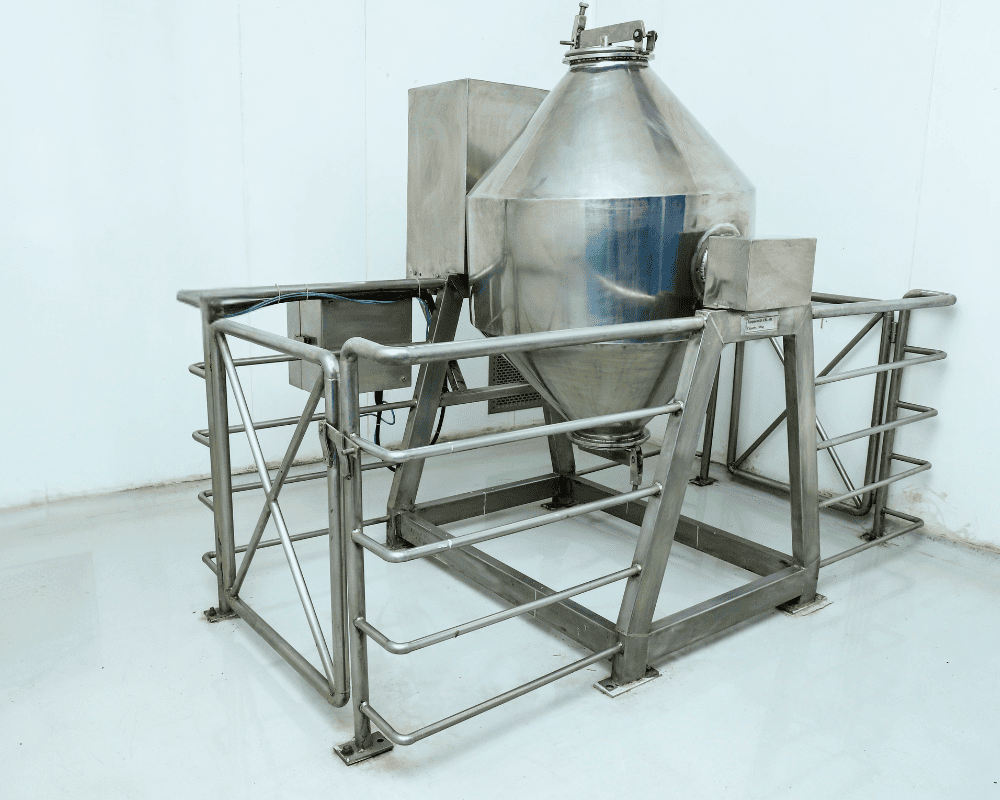
In modern manufacturing environments—particularly in the pharmaceutical, chemical, and food processing sectors—efficient and uniform blending of dry materials is a critical process. Among the equipment used, the Double Cone Blender stands out for its simplicity, reliability, and effectiveness in handling free-flowing powders and granules.
What Is a Double Cone Blender?
A Double Cone Blender is a type of industrial mixer used primarily for homogenizing dry solids. Its unique conical geometry allows for bi-directional tumbling, which facilitates the intermixing of material layers and provides uniform distribution of components without localized heating or degradation.
This design ensures a low-shear mixing environment, making it suitable for blending fragile or heat-sensitive materials.
Technical Design and Operation
The blender comprises two conical sections joined at a central cylindrical shell. The assembly is mounted on a rotating axis, usually at 45 degrees, and driven by a motor. The slow, gentle rotation of the unit causes the powder bed to continuously cascade and mix, eliminating dead spots and ensuring a uniform blend.
Key technical features may include:
-
Jacketed construction for optional heating or cooling
-
Vacuum compatibility for moisture-sensitive applications
-
Automated discharge valve systems
-
Integration with control panels or PLC systems
Applications Across Industries
The Double Cone Blender is not a one-size-fits-all solution but can be customized for a variety of industries:
-
Pharmaceuticals: Blending active ingredients with excipients
-
Chemicals: Mixing fine powders, catalysts, or colorants
-
Nutraceuticals: Combining herbal extracts or dietary supplements
-
Food Processing: Mixing powdered flavors or nutritional additives
Its closed-system architecture also makes it ideal for cleanroom installations and environments requiring minimal contamination risk.
Advantages of Using Double Cone Blenders
-
Uniform blending with minimal segregation
-
Scalability from laboratory to production-scale units
-
Low maintenance due to fewer moving parts
-
Versatility across different batch sizes and material types
-
Reduced energy consumption compared to high-shear mixers
When to Choose a Double Cone Blender
This equipment is best suited when:
-
Material flowability is excellent
-
Fragile particles need gentle handling
-
Batch integrity is crucial
-
Cross-contamination must be avoided
For manufacturers aiming to improve process efficiency and product quality, investing in a double cone blending system can yield substantial long-term benefits.

 Arabic
 Français
 Español
 Português
 Deutsch
 Türkçe
 Dutch
Dutch
 Italiano
 Russian
 Romaian