


Near Field Communication Market
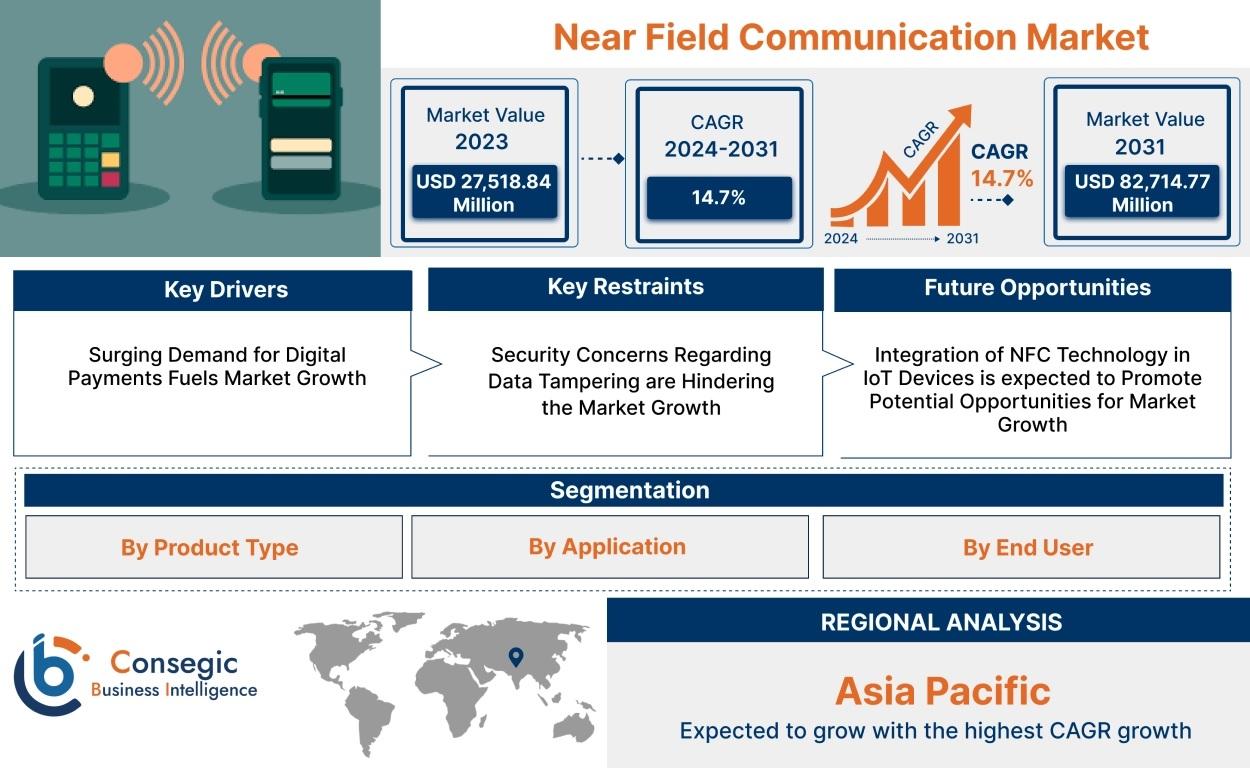
Near Field Communication Market Overview
The NFC market is a dynamic and rapidly expanding sector, with its value projected to grow significantly in the coming years. This growth is largely driven by the increasing adoption of contactless technologies and the widespread integration of NFC chips into smartphones, tablets, and wearables. The market is primarily comprised of hardware, including NFC chips, antennas, and readers, which form the foundation of NFC-enabled devices. The software and services segment, which includes payment platforms and data management solutions, is also growing rapidly, as companies seek to build comprehensive ecosystems around NFC technology. The market is also characterized by a high degree of competition, with major semiconductor companies and technology giants vying for market share through continuous innovation in security, chip efficiency, and application development.
Near Field Communication Market Size
Near Field Communication Market size is estimated to reach over USD 82,714.77 Million by 2031 from a value of USD 27,518.84 Million in 2023 and is projected to grow by USD 31,086.93 Million in 2024, growing at a CAGR of 14.7% from 2024 to 2031.
Near Field Communication Market Drivers
The growth of the NFC market is propelled by several powerful factors:
- Surge in Contactless Payments: The global shift toward contactless payment solutions is the most significant driver. The convenience, speed, and security of tap-to-pay services offered by mobile wallets like Apple Pay and Google Pay have made NFC a ubiquitous technology in retail and banking. The COVID-19 pandemic further accelerated this trend, as consumers sought hygienic, touch-free transaction methods.
- Widespread Adoption of NFC-Enabled Devices: The rapid increase in smartphone penetration and the growing popularity of wearables, such as smartwatches and fitness trackers, are key market drivers. Nearly all modern smartphones and an increasing number of wearable devices are equipped with NFC chips, which expands the potential for NFC applications beyond just payments, including access control, device pairing, and health monitoring.
- Expansion of IoT and Smart City Initiatives: NFC's low-power consumption and close-proximity characteristics make it an ideal technology for the Internet of Things (IoT). In smart homes, it can be used for device pairing and control, while in smart cities, NFC can facilitate seamless public transport ticketing, loyalty programs, and interactive advertising on smart posters.
- Enhanced Security and Authentication: NFC technology offers a high degree of security, particularly when integrated with secure elements and biometric authentication. The use of NFC for secure data transfer, digital keys for vehicles and buildings, and product authentication in supply chain management is a major driver, as industries seek robust solutions to prevent fraud and enhance security.
Near Field Communication Market Restraints
Despite the strong growth drivers, the NFC market faces several significant challenges:
- Competition from Alternative Technologies: The NFC market faces competition from other wireless technologies, such as Bluetooth and QR codes. While NFC offers a unique combination of convenience and security for specific use cases, these alternatives can be more cost-effective for certain applications or offer a longer range, which can limit the adoption of NFC in some segments.
- Technical Limitations of Short-Range Communication: The very feature that defines NFC, its short range, can also be a restraint. The need for devices to be in very close proximity (4 cm or less) can be inconvenient for applications that require communication over a longer distance. This limitation can make NFC less suitable for certain IoT and data-transfer applications compared to technologies like Wi-Fi or Bluetooth.
- Interoperability and Standardization Issues: While there are standardized protocols for NFC, inconsistencies in implementation across different devices and platforms can lead to interoperability issues. This can hinder a seamless user experience and complicate the development of universal NFC applications, which can act as a restraint on widespread adoption.
Near Field Communication Market Opportunities
The market presents several significant opportunities for future growth and innovation:
- Expansion into Healthcare and Automotive Sectors: The healthcare industry is an emerging opportunity for NFC. It can be used for patient identification, secure access to medical records, and contactless monitoring of patient vitals. In the automotive sector, NFC is being used for digital car keys, in-car infotainment, and secure pairing with smartphones, which is a key area for future growth.
- Development of NFC for Industrial IoT and Asset Tracking: The use of NFC tags and readers for industrial asset management is a major opportunity. NFC can be used to track inventory, authenticate products, and manage logistics, which can significantly improve supply chain efficiency and reduce counterfeiting.
- Integration with Biometrics and AI: The integration of biometric authentication (fingerprint, facial recognition) with NFC enhances security for payments and identity access, boosting consumer trust. Furthermore, the use of AI to analyze data from NFC-enabled interactions can provide valuable insights for businesses, from optimizing retail layouts to personalizing customer experiences.
- Growth in Smart Packaging and Interactive Marketing: NFC tags embedded in product packaging can transform traditional retail. Consumers can tap their smartphones on a product to access detailed information, watch a video, or receive a coupon. This form of "smart packaging" creates a new layer of consumer engagement and presents a significant opportunity for market growth.
Near Field Communication Market Key Players
The NFC market is highly competitive and is comprised of a mix of global semiconductor manufacturers and technology giants. Some of the key players are:
-
- Apple Inc. (US)
- Samsung Electronics Co., Ltd. (South Korea)
- US Research Nanomaterials, Inc. (US)
- NXP Semiconductors N.V. (Netherlands)
- Infineon Technologies AG (Germany)
- STMicroelectronics N.V. (Switzerland)
- Broadcom Inc. (US)
- Google LLC (US)
- Sony Corporation (Japan)
- Visa Inc. (US)
- Mastercard Incorporated (US)
- American Express Company (US)
- Huawei Technologies Co., Ltd. (China)
- Qualcomm Incorporated (US)
Near Field Communication Market Segmentation
The NFC market is segmented in several ways to provide a detailed view of its structure and applications:
- By Product Type: Smartphone, Wearable Devices, POS Terminal, Smart Cards, Others
- By Application: Payment, Access Control, Marketing, Others
- By End-User: Retail, Transportation, Healthcare, Financial Services, Hospitality, Others
Near Field Communication Market Regional Analysis
The global NFC market's growth and consumption patterns vary across different regions:
- North America: North America holds the largest market share, driven by a high level of technological adoption, the presence of major technology companies, and a strong consumer demand for contactless payments. The region's robust digital infrastructure and established financial systems are key drivers.
- Asia-Pacific: The Asia-Pacific region is the fastest-growing market. This growth is fueled by rapid urbanization, a massive manufacturing base, and government initiatives promoting cashless transactions and smart city projects in countries like China and India.
- Europe: Europe is a significant and mature market, with a strong focus on secure digital payments and the widespread adoption of NFC for public transport and mobile ticketing. The region's regulatory environment and consumer trust in contactless technology are key drivers.
- Latin America, Middle East, and Africa (LAMEA): These are emerging markets with significant potential. The demand for NFC is increasing as countries in these regions invest in modernizing their financial and transportation infrastructure to improve convenience and efficiency.
Near Field Communication Market Recent Developments
Recent developments in the NFC market are focused on innovation, enhanced security, and expanded capabilities:
- Integration with Biometric Authentication: A major recent trend is the increased integration of NFC with biometric technologies, such as fingerprint and facial recognition. This enhances the security of NFC transactions, making them even more robust for high-value payments and secure access applications.
- Focus on NFC-based Wireless Charging: The development of NFC-based wireless charging (NFC WLC) is a significant new trend. This technology allows for low-power wireless charging of small devices like earbuds and smart pens, leveraging the existing NFC infrastructure for both data transfer and power, which creates a dual-functionality that is particularly beneficial for small, portable electronics.
- Strategic Partnerships and Acquisitions: The market is seeing an increase in strategic partnerships and acquisitions as companies seek to expand their product portfolios and gain a competitive edge. For example, a major semiconductor company might acquire a specialized NFC tag manufacturer to offer an end-to-end solution for industrial applications.
- Expansion in Automotive and Industrial Sectors: There is a growing focus on developing new NFC applications for the automotive and industrial sectors. This includes the use of NFC for digital car keys that can be shared securely via a smartphone and the use of NFC tags for asset tracking and maintenance in industrial settings, which are key areas of future growth.
Contact us:
Consegic Business intelligence Pvt Ltd.
Contact no.: +1–252–552–1404
Email: sales@consegicbusinessintelligence.com

 English
 Arabic
 Français
 Español
 Português
 Deutsch
 Türkçe
 Dutch
Dutch
 Italiano
 Romaian