


Decentralized Compute & Privacy: The Rise of Proof Devices
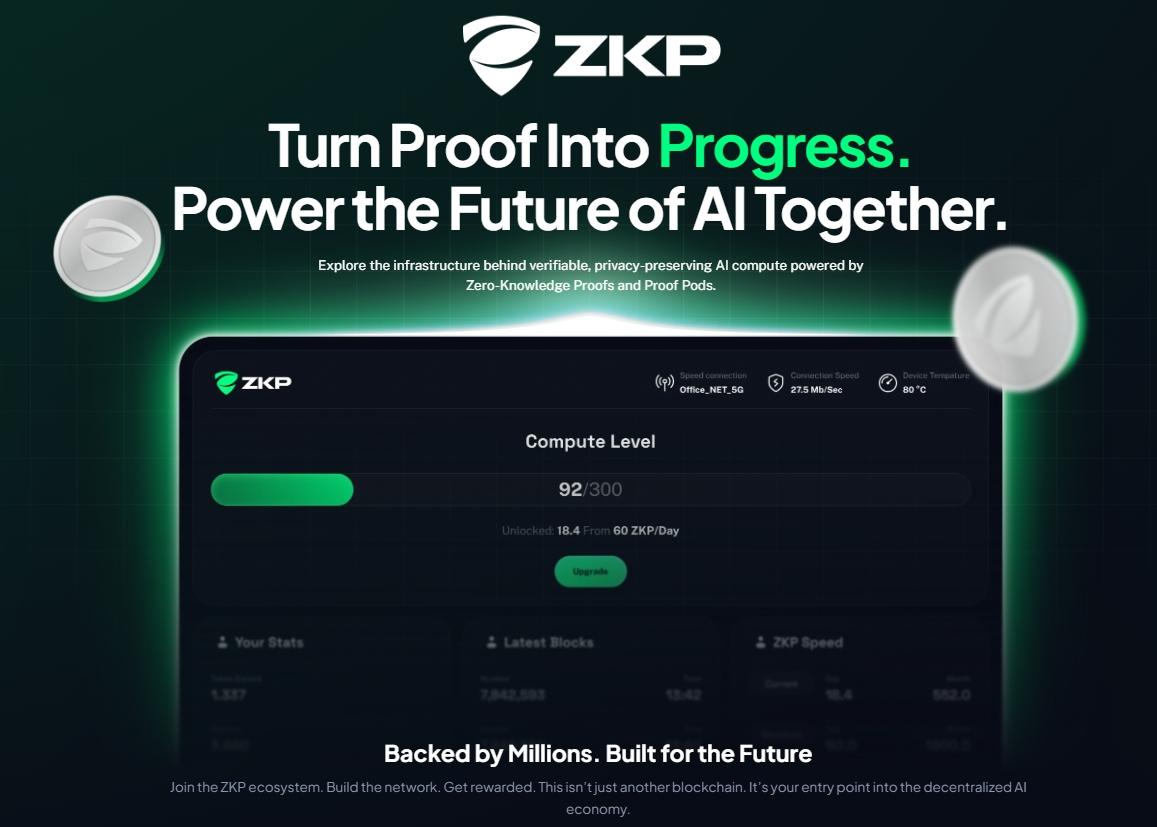
In an era where personal data often feels like currency, a new paradigm is emerging one that promises to combine the computational power of AI with cryptographic privacy. Imagine networks of devices that process information, contribute to shared models, and validate outcomes without ever revealing your raw data. That’s the ambition behind a next-gen architecture centered on proof devices and cryptographic validation.
When we speak of zkp crypto, we refer to systems that embed zero-knowledge proof capabilities into their core. These systems allow any participant, whether individual or organization, to demonstrate correct computation or data contribution without exposing their secrets. In effect, zkp crypto enables trust without surveillance—validation without revealing the underlying inputs.
Why We Need Proof Devices Now?
The Data Paradox in AI
AI systems thrive on data. The more high-quality and diverse the data, the better predictions, insights, and models we can build. Yet, most individuals and institutions hesitate to share sensitive datasets because of:
-
Privacy risks and exposure
-
Regulatory compliance (GDPR, CCPA, etc.)
-
Lack of trust in how data will be used
-
Fear of losing competitive advantage
Current architectures often force a trade-off: either you centralize data and lose control, or you keep data siloed and limit collaboration.
Proof devices offer a middle path. They act as trusted “eyes” in the system, verifying computations or contributions without ever seeing the raw inputs. In doing so, they enable collaboration across domains without data ever leaving its owner’s control.
Core Components of a Proof-Centric Network
A robust system built around proof devices typically comprises:
-
Proof Devices (Pods, Nodes, Edge Appliances)
These are dedicated hardware or software endpoints that perform cryptographic proofs on local data or computations. They submit validity proofs rather than raw datasets. -
Verification & Consensus Layer
A protocol ensures that proofs submitted by devices follow agreed criteria. Nodes validate them, and consensus mechanisms reward correct behavior. -
Zero-Knowledge Infrastructure
Internally, the system adopts zk-SNARKs, zk-STARKs, or other proof protocols to generate efficient, verifiable proofs. This layer ensures that no extra knowledge is leaked. -
Smart Contract / Application Layer
Above the proof system, developers deploy AI workloads, dApps, or APIs that only accept validated proofs. That way, the system knows computations are correct—even if it never saw the inputs. -
Off-Chain Storage & Oracles
Large datasets may sit off-chain (e.g. IPFS, decentralized storage). Proof devices reference them through integrity proofs (Merkle roots, hash commitments) without bulk transfers.
When combined, these layers form a privacy-first, modular, and scalable architecture for decentralized AI.
Use Cases: Where Proof Devices Help the Most
Healthcare & Life Sciences
Hospitals, research labs, and biotech firms often need to collaborate on sensitive datasets patient records, genomic data, clinical trials—without violating privacy laws. Proof devices let them compute joint results (e.g. disease risk models, statistical associations) without exposing individual-level data.
Cross-Company Model Sharing
Competing firms may each hold proprietary datasets but see benefit in building joint models (e.g. in manufacturing, robotics, agriculture). Proof-based systems enable them to collaborate: each contributes data, a global model is trained, and each sees outputs—but no one sees the raw data of others.
Privacy-Aware Public AI
Government institutions or public services using AI (e.g. welfare analysis, scheduling, predictive modeling) can use proof devices so that external auditors verify correctness or fairness of AI decisions without needing access to all citizen-level inputs.
Tokenized Data Incentives
Individuals might choose to run proof devices at home (edge appliances) that locally process signals, usage, or telemetry, then submit only validation proofs to higher-level AI systems. They earn rewards or tokens proportional to their validated contributions without ever sharing raw usage logs.
Technical Challenges & Mitigations
Proof Generation Cost
Zero-knowledge proofs even modern ones are computationally heavy. Generating them for complex AI workloads (deep networks, massive matrices) is nontrivial. Solutions include hardware acceleration (FPGAs, ASICs), incremental proving, partitioning workloads, or hybrid proof + TEEs.
Throughput & Latency
A network of proof devices must balance:
-
high throughput (many proofs per second)
-
low latency (fast user experiences)
-
verification cost (validators shouldn’t be overwhelmed)
Optimizations include proof batching, layer-2 schemes, and pipeline verification.
Developer Usability
Cryptographic complexity can block adoption. To overcome this, the ecosystem must provide high-level SDKs, domain-specific abstractions, and libraries that hide low-level math. A friendly developer experience drives wider innovation.
Incentive Design & Security
The economic system must reward honest nodes, penalize bad actors, and avoid centralization. Staking, slashing, reputation systems, or bonded proofs may help. Proper cryptographic audits and open protocols increase trust.
Onboarding Legacy Systems
Integrating with existing platforms (enterprise systems, cloud workflows) raises friction. Hybrid bridges wrappers that convert existing workloads into proof-compatible modules can smooth migration.
How to Kickstart Adoption?
-
Pilot Projects in Sensitive Sectors
Start with domains where privacy is nonnegotiable—healthcare, finance, identity systems. Demonstrate real benefits and build trust. -
Open Source Tooling & Community Engagement
Release cryptographic libraries, mapping tools, and developer kits under permissive licenses to catalyze adoption by researchers, engineers, and institutions. -
Partnerships With Research Institutions
Bring in academia and labs to help refine proof constructions, test new algorithms, and explore new use cases. -
Hardware Incentive Programs
Encourage manufacturers to build proof-optimized chips, or distribute early “proof devices” as developer kits to seed the network. -
Transparent Governance & Auditing
Use public audits, bug bounties, and community governance (e.g. decentralized decision-making) to build credibility and prevent manipulation.
Future Visions: 2026–2030 and Beyond
-
Proof-Optimized Processors
Expect dedicated silicon, FPGA designs, or co-processors that dramatically accelerate proof generation. -
Streaming or Dynamic Proofs
Proof systems that adapt to real-time data, online learning, or continuous streams will emerge, reducing cost for evolving models. -
Interoperable Proof Layers
Bridges between proof networks, blockchains, and AI ecosystems will let different systems share validated results seamlessly. -
Privacy Reputation Scores
Using cryptographic attestations, contributors may gain reputational metrics indicating reliability without revealing identity. -
Mainstreaming
As proof-based systems prove their value (lower risk, higher trust), more enterprises, governments, and platforms may adopt them as default infrastructure rather than niche.
Conclusion: Trust Through Proof, Not Exposure
We stand at a crossroads in digital infrastructure. On one side lies the older model of centralizing data, hoping it stays safe and getting richer by hoarding information. On the other lies a future where collaboration, AI, and cryptography converge to empower individuals and institutions alike without sacrificing control.
Proof devices, cryptographic validation, and privacy-first architectures are not just academic curiosities. They offer a pragmatic path forward for how we compute, collaborate, and trust in the coming decades.
By modular design, open tooling, careful incentive structures, and real-world pilots, the vision of a decentralized, encrypted AI ecosystem becomes achievable. The goal isn’t simply to encrypt more it’s to build systems where privacy is baked in, incentives are aligned, and trust is derived from proof rather than promises.

 English
 Arabic
 Français
 Español
 Português
 Deutsch
 Dutch
Dutch
 Italiano
 Russian
 Romaian