


What is video annotation?
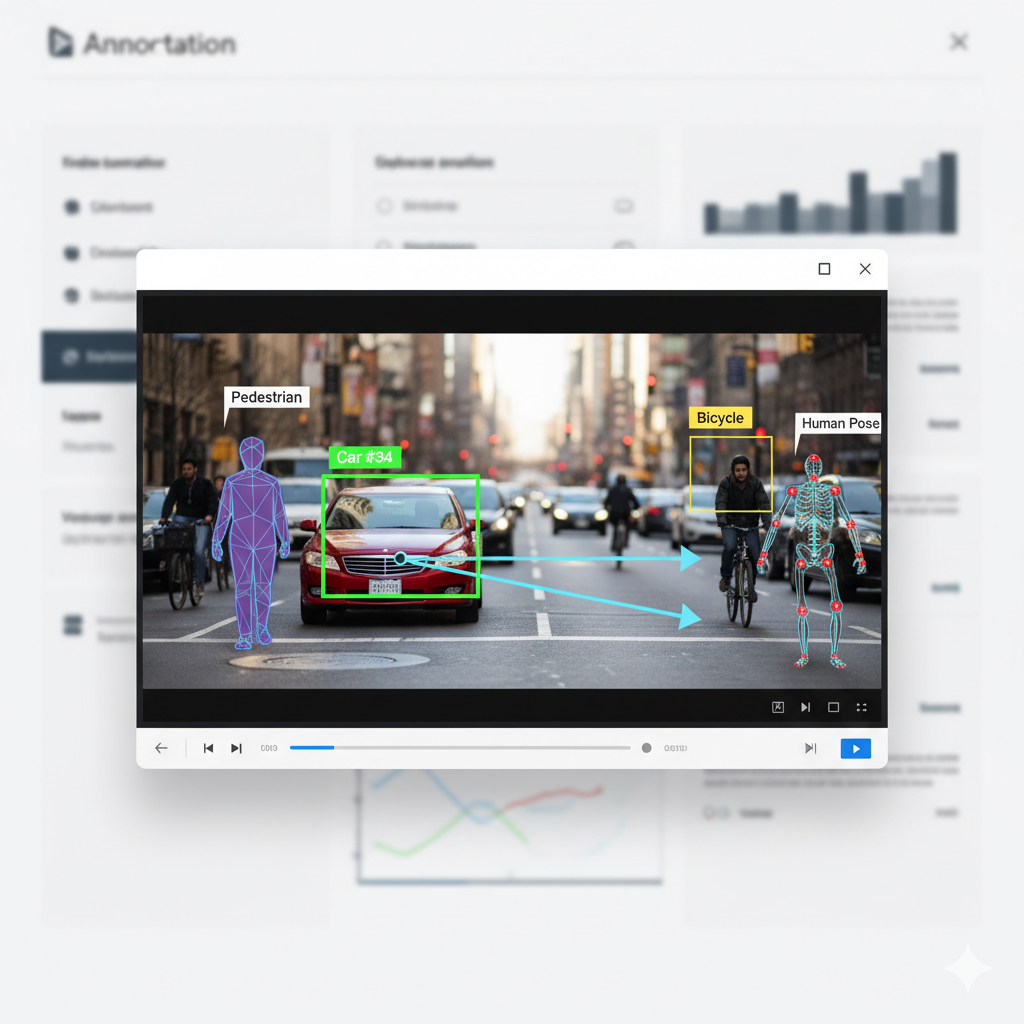
Video annotation is the process of tagging or labeling objects, actions, and events within video footage to create ground truth data for training computer vision and machine learning models.
This process is critical for developing AI applications like autonomous vehicles, security systems, and content moderation tools. Instead of labeling a single image, video annotation involves labeling a continuous sequence of frames, which captures the element of motion and temporal context.
Key annotation techniques include:
-
Bounding Boxes: Drawing boxes around objects in each relevant frame (e.g., cars, pedestrians).
-
Polygons/Segmentation: Tracing the precise outline of an object for pixel-level accuracy.
-
Keypoint Annotation: Marking specific points on an object's joints or features, often for tracking human pose or facial expressions.
-
Tracking: Assigning a unique ID to a labeled object and ensuring that ID follows the object throughout the video frames, which is vital for understanding movement and action.
High-quality video annotation is demanding due to the volume of data (many frames per second) and the need for temporal consistency across those frames.

 English
 Arabic
 Français
 Español
 Português
 Deutsch
 Türkçe
 Dutch
Dutch
 Italiano
 Russian