


Why AI Must Learn to Reason: Inside the Emerging RaaS Revolution
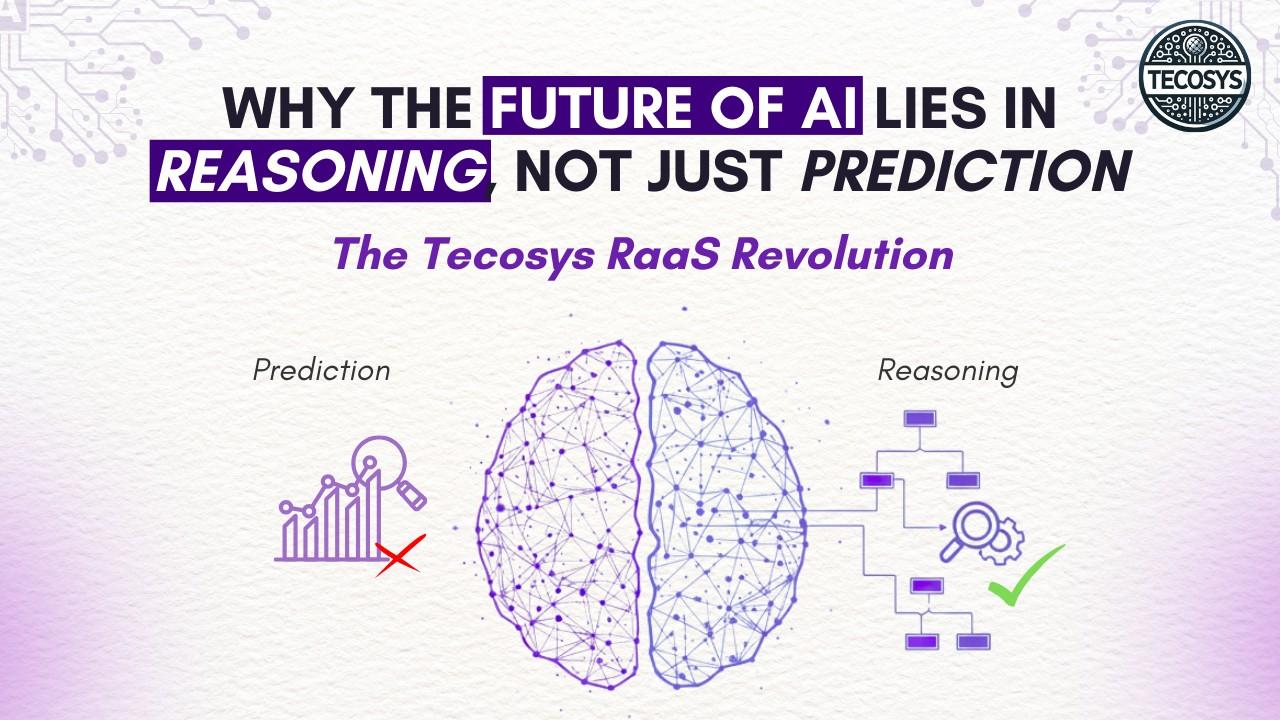
For decades, Artificial Intelligence has evolved from rule-based systems to highly advanced predictive models capable of anticipating consumer behavior, forecasting stock trends, and assisting in clinical risk analysis. When John McCarthy introduced the term Artificial Intelligence in 1956, the vision was never limited to machine prediction. It was about machines that could think, reason, and understand — much like humans. Early pioneers such as Marvin Minsky believed that AI would one day explain and justify its own decisions.
Predictive AI has undoubtedly transformed industries. Yet prediction alone is no longer enough.
Today’s enterprise challenges require systems that not only tell us what might happen but also why it is happening and what should be done next. As AI becomes central to critical decision-making, organizations increasingly demand systems that are transparent, interpretable, and compliant with regulatory frameworks.
This is where the next chapter of AI is emerging:
the transition from predictive intelligence to reasoning intelligence.
Why Prediction Isn’t Enough Anymore
Most modern AI systems operate as powerful statistical engines. They analyze historical patterns, detect correlations, and forecast outcomes. But these systems often behave like black boxes — highly accurate yet opaque. In industries such as healthcare, BFSI, and logistics, this lack of transparency poses operational and ethical challenges.
Companies can no longer rely solely on predictions when decisions must be auditable, explainable, and aligned with real-world reasoning.
From Prediction to Reasoning: A New AI Paradigm
The emerging model of AI reasoning introduces abilities that predictive systems traditionally lack:
1. Logical Planning
Reasoning AI can anticipate actions instead of simply reacting. It evaluates possibilities, constraints, and outcomes before recommending a path forward.
2. Task Decomposition
Complex problems are broken into smaller, structured components — similar to how humans approach multifaceted decisions.
3. Verification Before Action
Instead of generating outputs blindly, reasoning layers can independently verify results, cross-check logic, and ensure alignment with rules or domain knowledge.
4. Cognitive Memory
Context is retained rather than forgotten. This allows AI systems to understand continuity, maintain histories, and reduce hallucination-driven errors.
Together, these elements shift AI from being a pattern-recognizer to becoming a context-aware decision partner.
Reasoning-as-a-Service: A Logical Evolution in AI Architecture
As enterprises experiment with integrating reasoning capabilities, a new architectural concept has emerged:
Reasoning-as-a-Service (RaaS).
RaaS functions as a reasoning layer that can sit atop:
-
Large Language Models
-
Enterprise applications
-
Analytics platforms
-
Edge devices
Its purpose is simple yet transformative:
to add explainability, verification, and cognition to existing AI workflows.
Rather than replacing predictive systems, RaaS complements them by turning data-driven predictions into transparent, rational, and traceable decisions.
Where Reasoning Makes a Difference: Industry Transformations
Healthcare
Reasoning systems can justify diagnoses, verify clinical logic, analyze patient histories, and ensure that clinical decisions follow medical reasoning rather than statistical shortcuts.
BFSI
Financial institutions can move beyond correlations toward verifiable fraud detection, compliant decision-making, and transparent risk assessments.
Logistics & Supply Chain
Instead of predicting disruptions, reasoning AI can evaluate why routes fail, how constraints impact delivery, and which decisions ensure resilience.
Blockchain & Web3
Smart contracts and decentralized systems benefit from a layer of human-like logic that verifies conditions before action, improving trust and clarity.
Across sectors, the core advantage is the same:
reasoning connects data with meaning.
Explainability, Cost Efficiency, and Responsible AI
Three major enterprise challenges align closely with reasoning-driven AI:
1. Cognitive Search
Search evolves from keyword-matching to context-understanding. Reasoning helps systems interpret intent, infer deeper meaning, and surface more accurate insights.
2. AI Cost Optimization
By reducing unnecessary model calls and improving response efficiency, reasoning engines can lower operational costs — sometimes dramatically.
3. Transparent and Trustworthy AI
Audit-ready reasoning paths enable organizations to understand, justify, and validate decisions. This is critical for regulatory compliance in high-stakes domains.
Reasoning, therefore, is not a luxury — it is becoming a prerequisite for responsible AI deployment.
A Shift in Philosophy: From Data to Understanding
The next era of AI isn’t defined by larger models or more data.
It is defined by the ability to reason about information, not just process it.
This shift represents a deeper philosophy:
AI should not only predict outcomes — it should understand their meaning.
Reasoning intelligence bridges the gap between automation and cognition, enabling systems that can think more like humans while maintaining the precision and scale of machines.
The Future of AI: Completing Prediction with Reasoning
It’s important to understand: reasoning doesn’t replace prediction.
Instead, it completes it.
Predictive models excel at identifying what might occur.
Reasoning systems explain why it might occur and what should happen next.
In a world that demands transparency, compliance, and accountability, the future of AI inevitably moves toward systems that can:
-
Validate their own outputs
-
Justify their decisions
-
Adapt to changing contexts
-
Operate with memory and semantic understanding
This is the direction in which enterprise intelligence is heading — an evolution that brings AI one step closer to real cognitive capability.
The Next Era of AI Is Rational, Transparent, and Context-Aware
As industries become more dependent on AI-driven decisions, the demand for systems that can explain, verify, and justify their outputs will only grow. Reasoning technologies represent a foundational shift — not in how much AI can compute, but in how intelligently it can think.
If you’d like to explore how modern reasoning frameworks are being adopted across industries, you can visit:
· Tecosys reasoning architecture and cognitive AI frameworks
· Nutaan AI operational and automation tools powered by reasoning intelligence
If you’re interested in discussing AI reasoning trends, integrations, or research insights: Book a conversation: Calendly

 English
 Arabic
 Français
 Español
 Português
 Deutsch
 Türkçe
 Dutch
Dutch
 Italiano
 Russian