


How Reliability Leaders Balance Stability and Speed in Tech
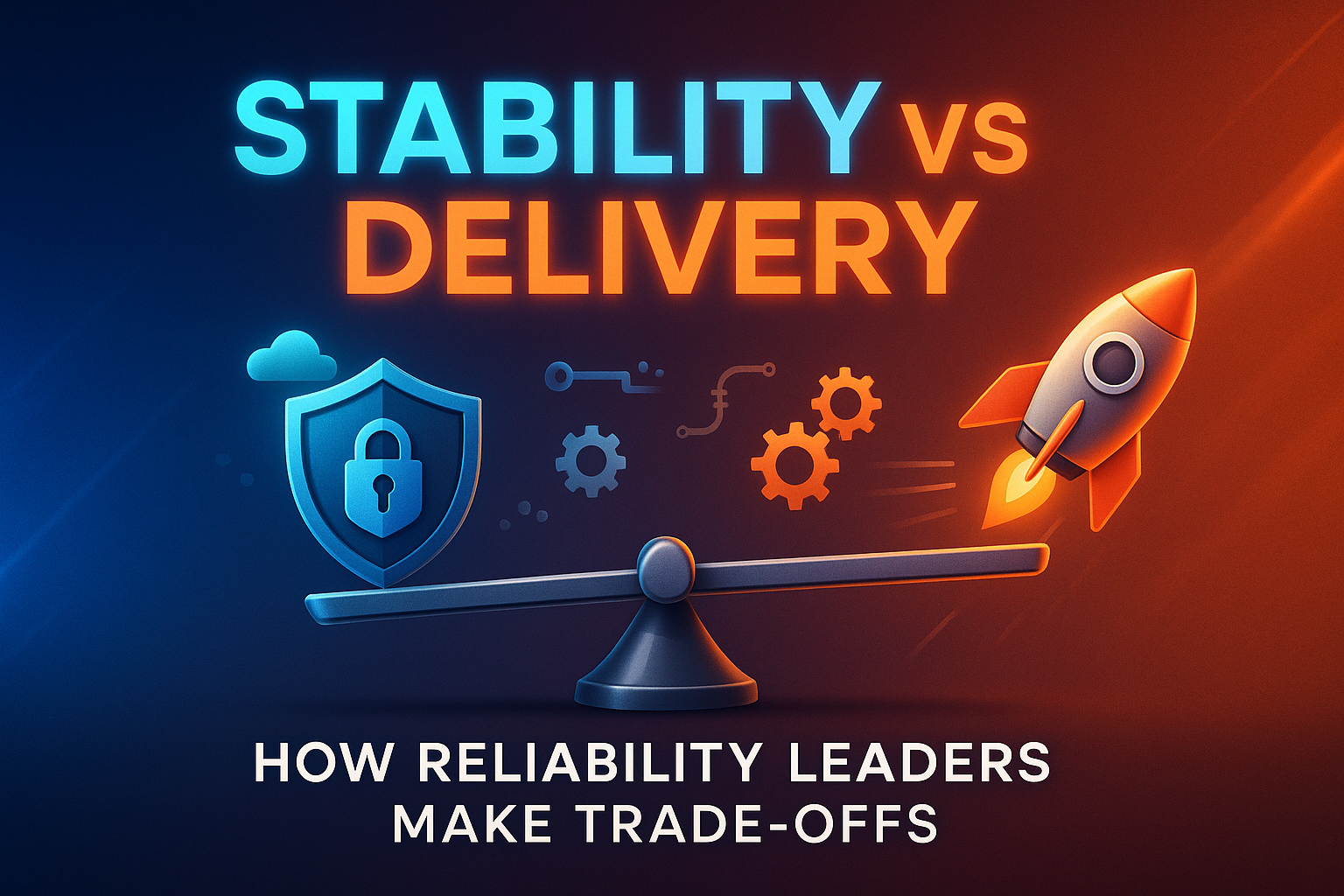
In the fast-paced world of software, teams are under constant pressure to deliver new features quickly. But every release carries a risk — a bug, downtime, or performance hiccup. That’s where reliability leaders step in. Their job? Make smart trade-offs between stability and delivery, ensuring systems stay reliable while innovation doesn’t stall.
Want to learn how to excel in SRE leadership and build next-gen reliability skills? Check out our complete guide here: SRE Lead
The Dilemma: Speed vs Stability
Every tech team faces the classic tension: ship fast or stay safe. Push too quickly, and users may encounter outages. Move too slowly, and competitors get ahead. Reliability leaders bridge this gap. They ask the right questions before a release:
-
How risky is this change?
-
What’s the potential impact on users?
-
Do we have safeguards in place?
Using measurable metrics like Service Level Objectives (SLOs), Mean Time to Recovery (MTTR), and error budgets, they quantify risk and guide decision-making.
Leveraging Error Budgets for Smarter Releases
One of the most powerful tools in a reliability leader’s toolkit is the error budget. Think of it as a “risk allowance” for a system — how much unreliability is acceptable in a given time frame.
-
If the system is within its budget, teams can safely release new features.
-
If the budget is exhausted, focus shifts to fixing reliability issues before rolling out more changes.
This approach ensures innovation doesn’t come at the expense of trust, creating a healthy balance between speed and system integrity.
Risk Assessment: Making Data-Driven Decisions
Before approving a release, reliability leaders perform a detailed risk assessment:
-
What’s the likelihood of a failure?
-
How badly could it affect users or revenue?
-
What mitigation strategies are in place?
By prioritizing high-impact risks and aligning with product and operations teams, they make informed, data-driven decisions that keep the business moving forward without compromising reliability.
Automation and Observability: The Unsung Heroes
Automation and observability are game-changers. Automated testing, CI/CD pipelines, and monitoring systems allow teams to deliver faster with fewer mistakes. Real-time observability tools give leaders insight into system performance, helping them spot issues before they affect users.
With the right systems in place, reliability leaders can focus on strategic decision-making instead of firefighting.
SRE Certification: Boosting Expertise and Trust
SRE (Site Reliability Engineering) certification are a powerful asset for anyone leading reliability initiatives. They teach practical skills like incident management, capacity planning, and observability best practices.
Certified professionals can:
-
Implement effective error budget policies
-
Reduce downtime and operational risk
-
Strengthen collaboration between development and operations teams
Organizations benefit too — certified teams tend to achieve higher uptime, smoother releases, and better-aligned business goals.
The Bottom Line
Balancing speed and stability isn’t easy — it’s both an art and a science. Reliability leaders make it possible by leveraging frameworks like error budgets, performing rigorous risk assessments, embracing automation, and building strong, data-driven cultures.
The result? Systems that are robust, scalable, and reliable, while teams continue to innovate and deliver at pace.

 English
 Arabic
 Español
 Português
 Deutsch
 Türkçe
 Dutch
Dutch
 Italiano
 Russian
 Romaian