


The Driving Force of Software-Defined Vehicles
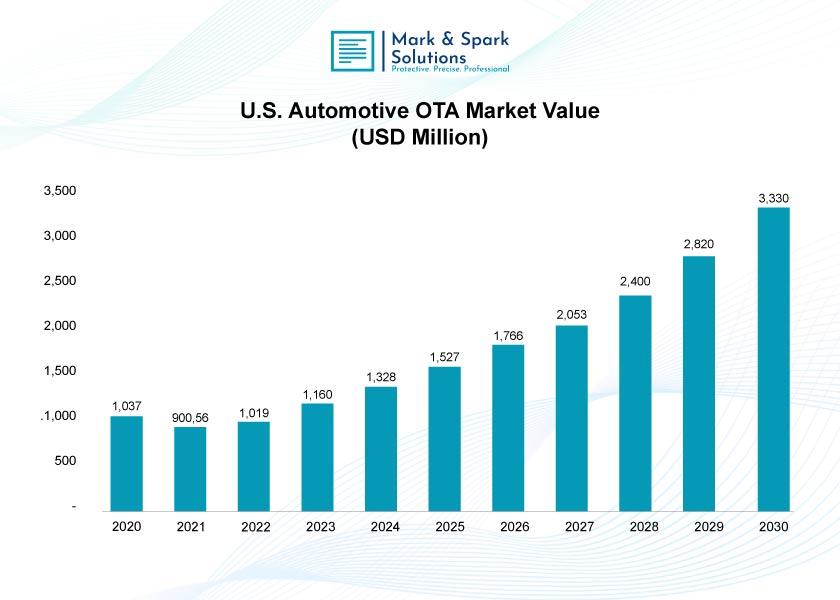
In 2026, the car in your driveway has evolved into a high-performance computer on wheels, with the Automotive OTA Market serving as the invisible tether keeping it modern. U.S. automotive OTA market was valued at USD 1,328 million in 2024 and is estimated to reach a value of USD 3,330 million by 2030 with a CAGR of 16.9%. This technology allows manufacturers to fix bugs, enhance performance, and even unlock new features like autonomous driving assistance without the owner ever setting foot in a dealership. As American drivers demand more from their tech-heavy cabins, the ability to refresh a vehicle’s soul through a wireless signal has become the most critical differentiator in the competitive landscape of 2026.
The rapid expansion of the U.S. Automotive OTA Market is fundamentally tied to the rise of electric vehicle (EV) architectures which are built from the ground up for connectivity. In 2026, the complexity of managing battery life, thermal regulation, and energy recovery systems necessitates a robust over-the-air pipeline that can handle massive data packets safely. Manufacturers are moving away from traditional hardware-fixed cycles, opting instead for a "Software-Defined Vehicle" (SDV) approach where the value of the car actually increases over time through consistent digital improvements. This shift is not just about convenience; it is a massive cost-saving measure that reduces expensive physical recalls for software glitches.
The integration of 5G connectivity across the United States has been a major catalyst for this industry surge in 2026. Higher bandwidth and ultra-low latency mean that critical firmware updates, which once took hours, can now be completed in a matter of minutes during a lunch break. Furthermore, the use of edge computing allows vehicles to process some of these updates locally, ensuring that safety-critical systems like braking or steering remain operational and secure during the transition. Cybersecurity has also taken center stage this year, with automakers deploying military-grade encryption to protect the OTA pipeline from potential external threats.
Looking toward 2030, the focus of the industry is shifting toward "Feature-on-Demand" (FoD) monetization models. In 2026, we are seeing the first widespread use of subscription-based heated seats, performance boosts, and advanced navigation packages that can be toggled on or off via the car's touchscreen. While this has sparked some debate among consumers, the flexibility it offers is undeniable. The era of the "static" car is over, replaced by a dynamic ecosystem that learns, adapts, and improves every time it connects to the cloud, ensuring that the American driving experience remains at the cutting edge of global innovation.

 English
 Arabic
 Français
 Español
 Português
 Deutsch
 Türkçe
 Dutch
Dutch
 Russian
 Romaian