


How Responsible AI Practices Can Drive Long-Term Business Value in Financial Services
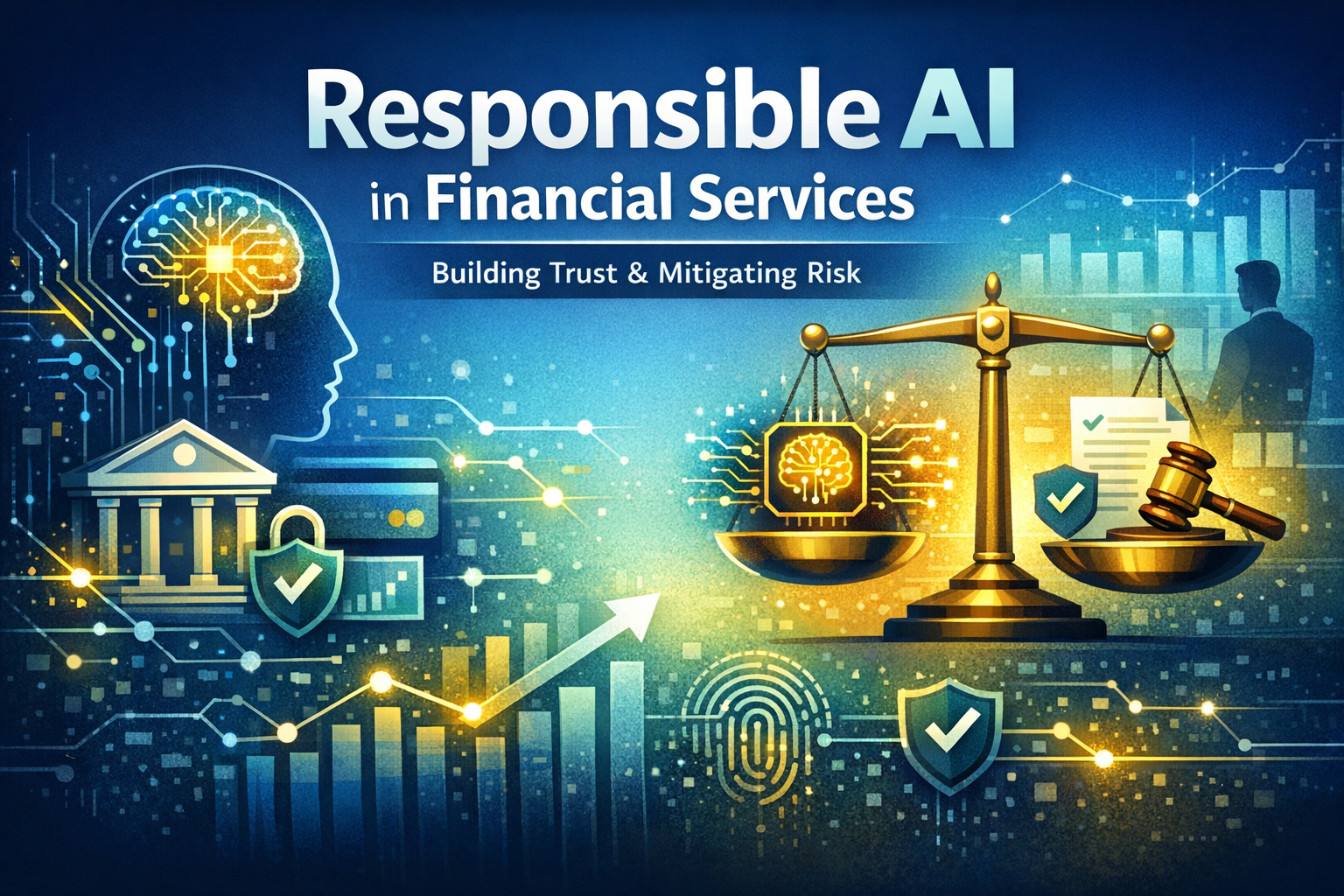
Artificial intelligence is now deeply embedded in financial services—from fraud detection and credit scoring to customer support and investment insights. But as AI becomes more powerful and more autonomous, financial institutions face a critical question: how do we scale AI without increasing risk?
The answer lies in responsible AI. Far from being a regulatory burden or compliance checkbox, responsible AI practices are increasingly a driver of long-term business value in financial services.
What Responsible AI Means in Financial Services
Responsible AI refers to the design, deployment, and governance of AI systems in a way that is transparent, fair, secure, explainable, and accountable. In financial services—where decisions directly affect individuals’ livelihoods and trust—these principles are especially important.
Responsible AI typically focuses on:
- Fairness and bias mitigation
- Explainability of model decisions
- Data privacy and security
- Human oversight and accountability
- Ongoing monitoring and governance
Rather than slowing innovation, these practices create a stable foundation for scaling AI safely.
Trust Is the Core Currency of Financial Services
Trust has always been central to banking, insurance, and capital markets. AI systems that are opaque or poorly governed can erode that trust quickly—both with customers and regulators.
Responsible AI builds trust by:
- Making decisions more explainable to customers and regulators
- Reducing the risk of discriminatory outcomes
- Demonstrating control over automated decision-making
When customers understand why decisions are made—and feel those decisions are fair—confidence in AI-driven services increases. That trust translates directly into higher adoption and longer customer relationships.
Reducing Regulatory and Compliance Risk
Financial services operate under some of the world’s most stringent regulatory frameworks. As AI regulations evolve globally, institutions without strong governance frameworks face growing exposure.
Responsible AI practices help organizations:
- Document model behavior and decision logic
- Maintain audit trails for regulatory review
- Align AI systems with data protection requirements
- Respond faster to regulatory inquiries or changes
By building compliance into AI systems from the start, institutions avoid costly retrofits, penalties, and deployment delays later.
Better Decision Quality Over Time
AI models are not “set and forget.” They drift, degrade, and reflect changes in data, markets, and behavior. Responsible AI emphasizes continuous monitoring and evaluation, which improves long-term performance.
Key benefits include:
- Early detection of bias or performance degradation
- Faster remediation of errors or anomalies
- More stable and reliable decision outcomes
Over time, this leads to higher-quality risk assessments, more accurate predictions, and better business decisions—especially in areas like credit risk, fraud prevention, and underwriting.
Enabling Scalable AI Adoption
Many financial institutions struggle to move AI beyond pilots. One reason is fear—fear of unintended consequences, regulatory backlash, or reputational damage.
Responsible AI reduces that fear by creating clear guardrails. When leaders know AI systems are governed, explainable, and monitored, they are more willing to:
- Expand AI use cases across departments
- Automate higher-impact decisions
- Integrate AI deeper into core operations
This enables AI to scale from isolated experiments into enterprise-wide capabilities that drive real ROI.
Stronger Customer Experience and Loyalty
Responsible AI doesn’t just protect institutions—it improves customer experience.
For example:
- Explainable AI helps customers understand credit decisions instead of feeling arbitrarily rejected
- Fairness controls reduce the likelihood of biased outcomes
- Secure AI systems protect sensitive financial data
These factors increase transparency and perceived fairness, which are critical for customer loyalty in an increasingly competitive market.
Talent, Culture, and Brand Advantage
Financial institutions are also competing for AI talent. Engineers, data scientists, and product leaders increasingly want to work for organizations that use AI ethically and responsibly.
Responsible AI practices:
- Attract and retain top technical talent
- Foster a culture of accountability and quality
- Strengthen brand reputation with partners and investors
Over time, this creates a virtuous cycle where responsible innovation becomes part of the organization’s identity.
Responsible AI as a Strategic Investment
A common misconception is that responsible AI slows innovation or increases cost. In reality, it reduces long-term risk, rework, and friction—all of which are expensive.
Institutions that invest early in responsible AI:
- Avoid costly compliance failures
- Reduce reputational damage
- Accelerate safe innovation
- Build durable competitive advantage
The cost of not adopting responsible AI is often far higher than the cost of doing it right.
Final Thoughts
In financial services, AI success isn’t measured only by speed or sophistication—it’s measured by trust, resilience, and sustainability. Responsible AI practices provide the foundation that allows institutions to innovate confidently, scale intelligently, and maintain the trust of customers, regulators, and markets.
Far from being a constraint, responsible AI is a long-term value driver—one that enables financial institutions to harness AI’s full potential while protecting what matters most.
About US:
AI Technology Insights (AITin) is the fastest-growing global community of thought leaders, influencers, and researchers specializing in AI, Big Data, Analytics, Robotics, Cloud Computing, and related technologies. Through its platform, AITin offers valuable insights from industry executives and pioneers who share their journeys, expertise, success stories, and strategies for building profitable, forward-thinking businesses.
Read More: https://technologyaiinsights.com/why-jpmorganchase-says-responsible-ai-is-key-to-long-term-value/

 Arabic
 Français
 Español
 Português
 Deutsch
 Türkçe
 Dutch
Dutch
 Italiano
 Russian
 Romaian