


Landscape Rendering vs. Traditional Landscape Illustration: What's the Difference
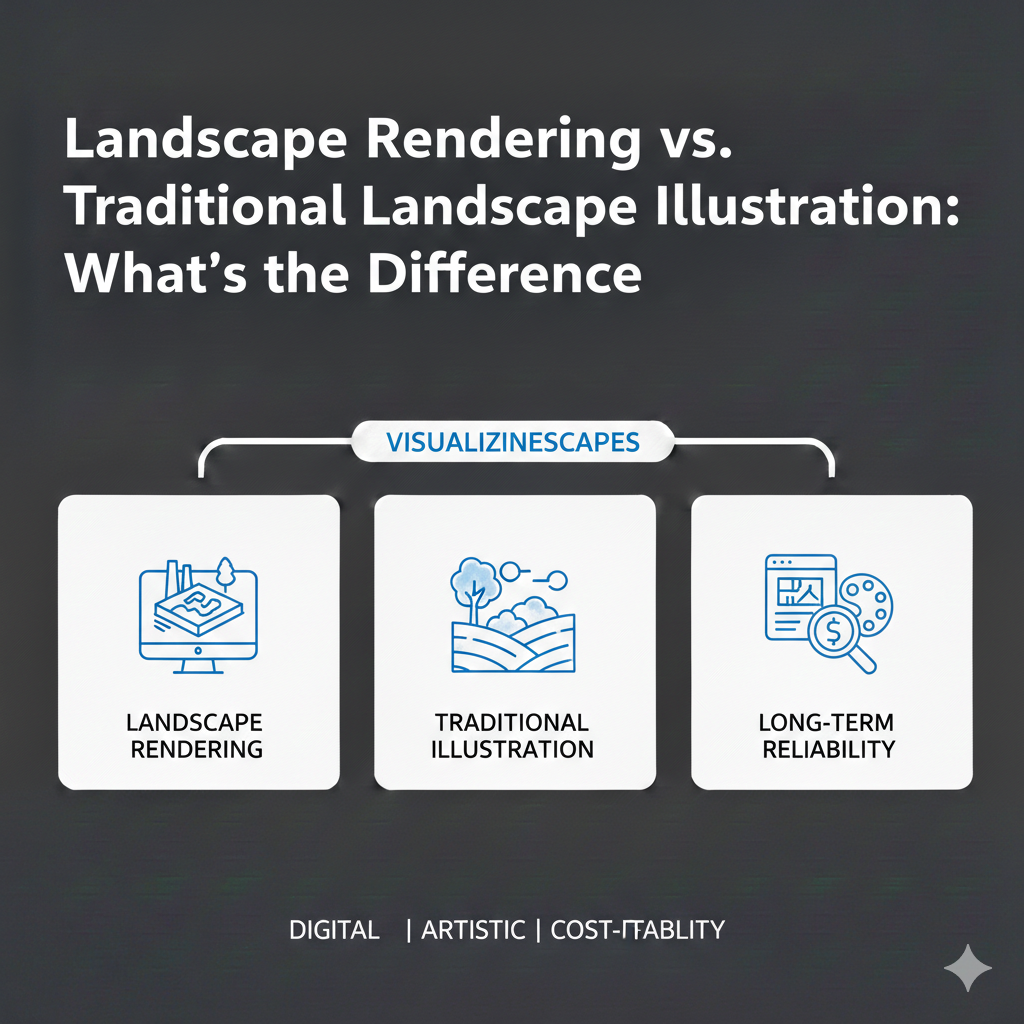
Have you ever wondered how to see your landscape project before it is built? Well, that is a possibility with something called Landscape Rendering. This innovative technology has made it possible to visualize a landscape in its entirety with all of its elements.
Presently, this technology is achieving wonders and has become an essential approach in any landscape project. That being said, there is also another method to view your landscape, and that is traditional landscape illustration.
In the current piece, we shall present a detailed discussion on both methods mentioned above and also the differences between them. This shall expand and enhance your knowledge. Thus, helping you in making the right and informed decision.
Landscape Rendering - A Digitized Innovative Technique
A digital approach that transforms landscape design drawings into photorealistic imagery. These images portray how an outdoor space will look and feel. Through this technique, a comprehensive landscape design rendering can be created. Thus, capturing all the details, whether minor or major. This rendering's digital aspect can realistically express real-time lighting, materials, textures, color, and more.
It can be said that in urban landscape development, whether for residential or commercial, this technique has proven itself worthy on all accounts.
Digital Rendering Engines
Continuing the above discussion, it is understood that this technique offers innovative solutions. But all of this is possible because of the modern digital rendering engines.
Because of these advanced digital engines, lifelike Landscape Rendering Services are being delivered to clients all over the world. The most promising rendering engines are:
-
Lumion
-
V-Ray
-
3Ds Max
-
Corona
-
Maya
-
Enscape
-
AutoCAD
-
Unreal Engine
-
SketchUp
A Look Into Traditional Landscape Illustration
The landscape illustrations are a captivating artistic design aspect that focuses on the outdoor environment. These illustrations are mostly hand-drawn, but have now been shifted to digital methods. Thus, it allows an artist to be more creative in developing a design.
On top of that, these illustrations depict and highlight the color hues, viewpoint, lighting, shadowing, and more. The media in which these illustrations can be rendered are:
-
Watercolor
-
Oil paint
-
Digital platforms
Development Process of Traditional Landscape Illustrations
A realistic traditional illustration of a landscape can be created through the following steps:
-
Perspective
The initial step in the above process is to create a point of view. This gives a kind of depth to the illustration in a landscape scene.
-
Layer Creation
In the second step, layers are created for adding design elements, which comprise foreground, middle ground, and background.
-
Color Combination
After design elements are added, colors are applied to give the illustration the desired mood.
-
Lighting & Shadowing
Once design elements and colors are implemented, the next step is applying a lighting effect along with shadowing. Note that the right lighting contributes greatly towards realism.
The Differences Explained
Below are some of the key differences between these two approaches that are explained in detail.
-
Intention
The intention of digital rendering for a landscape project is more practical. Professional architects and designers use rendering techniques to demonstrate how a finished project will look in reality. Residential Rendering Services provide detailed visuals about how outdoors will turn out in real time.
Whereas the intention of traditional landscape illustrations is more towards artistic aesthetics. These illustrations focus on the overall aesthetic appeal from an artist's point.
-
Technology Driven
Renderings completely depend on technology, as they ensure accurate dimensions and spatial arrangement. They ensure calculated landscape simulations for all the involved elements.
Unlike that, traditional art is more artistic. Thus, scale is emphasized for an artistic look. Therefore, the measurements can be enlarged for a sense of drama, for example, when adjusting the color for a special mood in a landscape.
-
Application
For a commercial level landscape project Commercial 3D Rendering Services are provided to communicate a client's vision in the form of photorealistic images. Any modification in design depicts the essence of a client's vision.
In contrast to that, traditional illustrations are not suited at all for commercial projects. An artist tends to exaggerate in terms of color and lighting to create a deeper impact. Thus, it would not be appropriate for comment buildings.
-
Targeted Audience
The target of the rendering approach is normally professional stakeholders. Designers and architects who desire precise landscape visuals. This means that the evaluation is based on accuracy, visual clarity, and how well the design intent is presented.
Contrarily, traditional illustrations captivate those viewers who are more oriented towards gaining an aesthetic experience.
-
Visual Effect
Renderings aim to provide a photorealistic effect that is hard to distinguish from reality. Every landscape element is depicted in an ultra-realistic manner. Thus, stimulating physical behavior that resonates with real-time scenarios.
On the other hand, traditional landscape illustrations are interpretations of an artist. Even the highly realistic illustrations lack reality and depict a human touch.
The Right Choice!
Both options rely solely on your project requirements. If you need aesthetically appealing or practical projects, then the decision is yours.
If you are looking for a practical result, this translation is the best option for you. It will provide you with accurate visuals, truly depicting the vision you have in mind.
And, by choosing SMA Archviz as your professional renderers, you can have the most realistic renderings within your budget.
End Note
This article provides you with extensive knowledge about the two techniques for a landscape project. Where one is focused on practicality with innovation. The other relies majorly on an artist's expertise. Both of these methods have their own unique characteristics, and what to choose solely depends on the purpose of your landscape project. So, go through this informative article, which extensively explains the difference between Landscape Rendering and traditional landscape illustration

 Arabic
 Français
 Español
 Português
 Deutsch
 Türkçe
 Dutch
Dutch
 Italiano
 Russian
 Romaian