


Why Businesses Are Moving from Reactive Chatbots to Proactive AI Agents
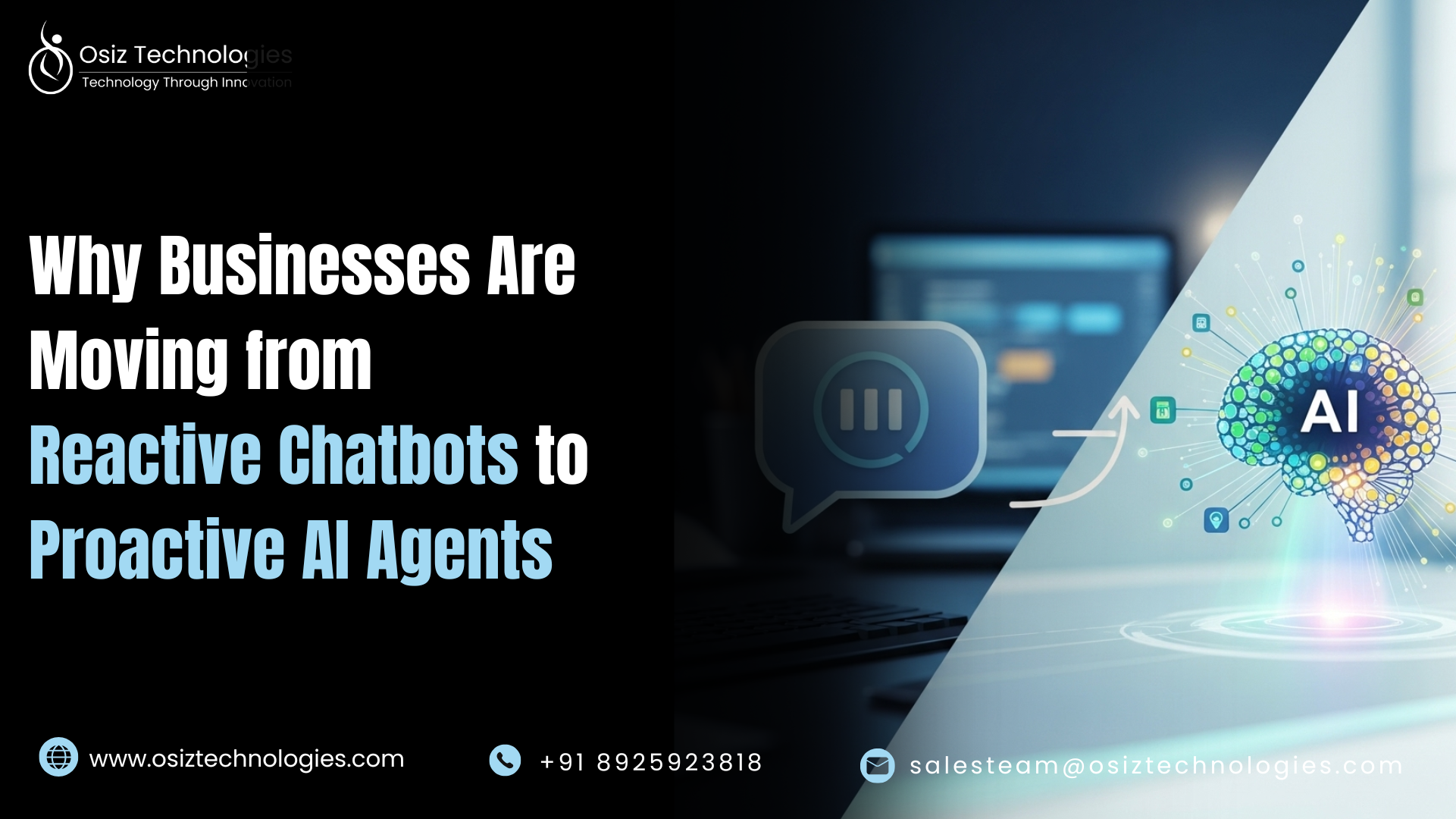
Businesses are no longer satisfied with systems that simply respond to queries. In today’s fast-moving digital environment, companies need intelligent solutions that can anticipate needs, execute tasks, and drive measurable outcomes. This shift marks the evolution from reactive chatbots to proactive AI agents.
Traditional chatbots were designed to answer predefined questions. They improved customer engagement, but their functionality often stopped at conversation. Proactive AI agents, however, go far beyond chat. They analyze context, set goals, coordinate workflows, and independently complete multi-step tasks. As enterprises aim for deeper automation and smarter decision-making, AI agents are becoming a strategic priority.
What Are Reactive Chatbots and Their Limitations
Reactive chatbots are rule-based or prompt-driven systems built to respond to user inputs. They follow predefined scripts or rely on basic natural language processing to generate answers. While useful for FAQs and simple customer service tasks, their capabilities are limited.
One major limitation is their dependency on user prompts. They cannot act unless a user initiates a request. They also lack persistent memory, meaning they struggle to maintain context across multiple interactions. Additionally, reactive chatbots are not designed for complex task execution. They provide information but rarely perform actions such as booking, coordinating, or decision-making independently.
As business processes become more dynamic, these limitations reduce efficiency and scalability.
What Are Proactive AI Agents? Key Capabilities Explained
Proactive AI agents represent the next stage of intelligent automation. Built through advanced AI Agent Development frameworks, these systems are designed to think, plan, and act autonomously toward specific goals.
Unlike traditional bots, AI agents possess context awareness and memory. They can recall previous interactions, analyze patterns, and adjust their responses accordingly. They are capable of multi-step task execution, meaning they can break down complex objectives into manageable actions and complete them without constant human input.
Another key capability is tool and API integration. AI agents can connect with enterprise systems, CRM platforms, databases, and third-party applications to execute tasks in real time. They are also goal-oriented, meaning they do not just respond — they proactively identify opportunities, trigger workflows, and optimize processes.
These capabilities allow businesses to move from simple conversational automation to intelligent operational systems.
Reactive Chatbots vs Proactive AI Agents: Key Differences
Response Style
Reactive chatbots respond only when prompted and typically follow predefined conversational paths. AI agents, on the other hand, can initiate actions, provide recommendations, and anticipate user needs.
Learning & Adaptation
Chatbots rely on static scripts or limited training data. AI agents continuously learn from interactions and adapt their decision-making based on context and feedback.
Workflow Handling
Chatbots handle isolated queries. AI agents manage end-to-end workflows, coordinating multiple systems and executing complex processes autonomously.
Business Impact
While chatbots enhance customer support efficiency, AI agents drive broader operational transformation by improving productivity, reducing costs, and enabling intelligent automation at scale.
Why Businesses Are Adopting Proactive AI Agents
Increased Operational Efficiency
AI agents automate repetitive and multi-step tasks, reducing manual effort across departments. By handling scheduling, reporting, coordination, and support activities, they streamline operations and free employees to focus on strategic initiatives.
Cost Reduction Through Automation
Automation minimizes dependency on large support teams and reduces operational overhead. AI agents can manage high volumes of tasks simultaneously, lowering costs while maintaining performance.
Enhanced Customer Experience
With contextual awareness and personalized responses, AI agents deliver faster and more accurate interactions. They can resolve issues proactively, recommend solutions, and provide seamless omnichannel experiences.
Scalable Business Operations
As businesses grow, AI agents scale effortlessly. They can manage increasing workloads without proportional increases in human resources, ensuring consistent performance during peak demand.
Data-Driven Decision Making
AI agents analyze large volumes of data in real time, generating insights that guide strategic decisions. This empowers organizations to respond quickly to market changes and optimize performance continuously.
Real-World Use Cases of Proactive AI Agents Across Industries
Healthcare
AI agents assist with patient scheduling, follow-ups, medical data analysis, and workflow coordination, improving care delivery and operational efficiency.
E-commerce
In online retail, AI agents manage product recommendations, inventory monitoring, personalized marketing, and automated order processing to enhance customer engagement.
Banking & Finance
Financial institutions use AI agents for fraud detection, risk analysis, customer onboarding, and real-time transaction monitoring.
Logistics & Supply Chain
AI agents optimize route planning, track shipments, predict disruptions, and coordinate warehouse operations to ensure timely deliveries.
SaaS & IT Operations
In technology environments, AI agents monitor system performance, automate ticket resolution, deploy updates, and support DevOps workflows.
How to Successfully Transition from Chatbots to AI Agents
Transitioning requires a structured AI agent development approach. Businesses should begin by assessing their current chatbot capabilities and identifying gaps in automation. Clear objectives must be defined, focusing on areas where proactive intelligence can deliver measurable impact.
Next, organizations must ensure data readiness and infrastructure compatibility. AI agents rely on integrated systems and accurate data to function effectively. Selecting scalable architectures and secure deployment models is critical.
Finally, continuous monitoring and optimization are essential. AI agents should be evaluated based on performance metrics, user satisfaction, and operational efficiency to ensure long-term success.
Why Choose Osiz for AI Agent Development
Osiz is a leading AI Agent Development Company delivering scalable, secure, and high-performance AI solutions tailored to modern business needs. With deep expertise in intelligent architecture, workflow automation, and seamless system integration, we build proactive AI agents that drive measurable efficiency and long-term growth. From strategy to deployment, Osiz ensures reliable, future-ready solutions aligned with your enterprise goals.

 English
 Arabic
 Français
 Español
 Deutsch
 Türkçe
 Dutch
Dutch
 Italiano
 Russian
 Romaian