


AI Development Explained: Model Training, Testing, and Optimization
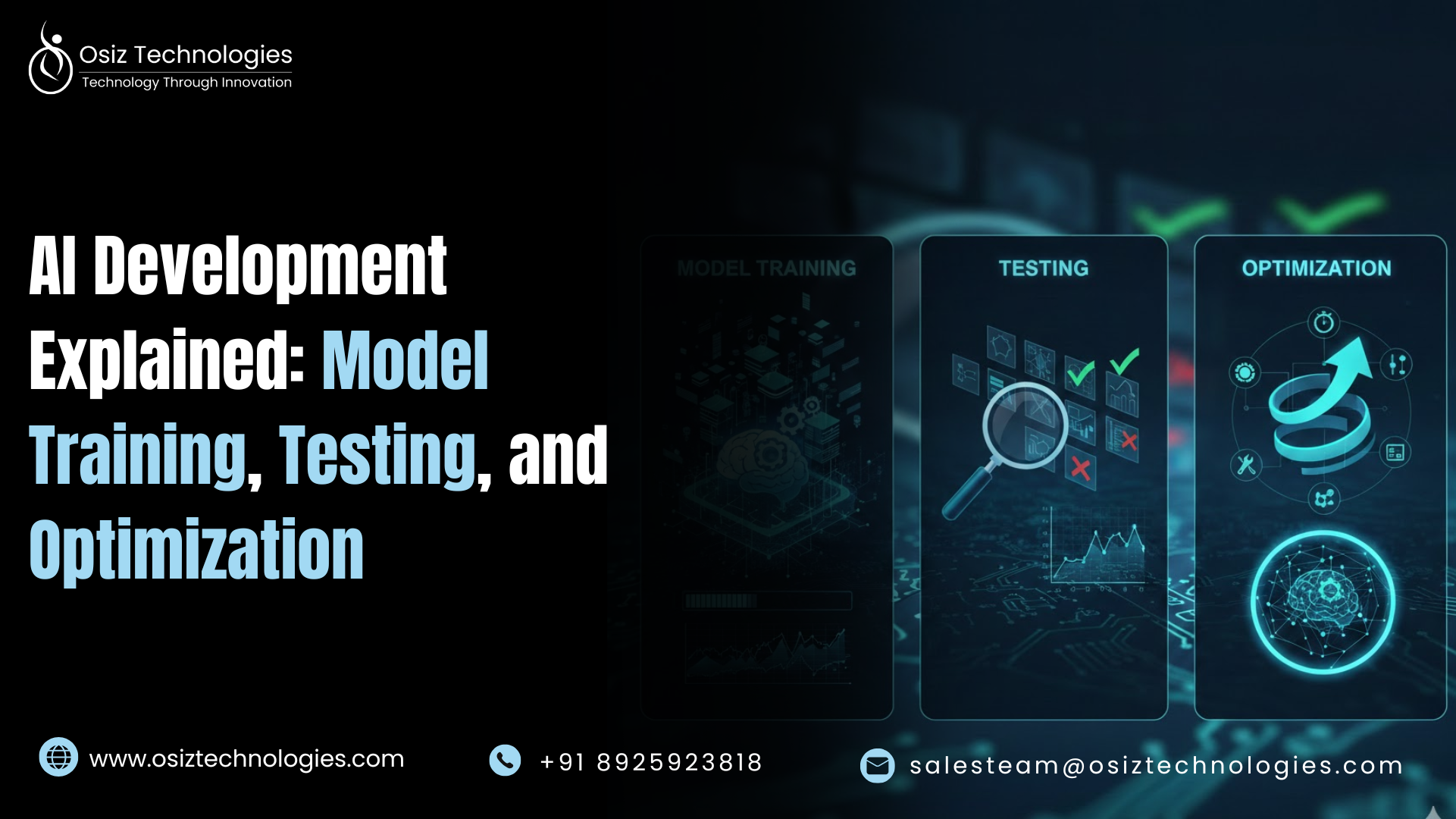
Artificial intelligence has moved from experimentation to real-world implementation across industries. At the core of every intelligent system lies a structured and disciplined process. AI development is not just about building models; it is about transforming raw data into actionable intelligence through training, testing, and continuous optimization.
A well-defined AI model development lifecycle ensures that business objectives align with technical execution. From understanding the problem statement to deploying a production-ready model, every stage plays a crucial role in determining the system’s accuracy, scalability, and reliability. Organizations that approach AI strategically are better positioned to build models that deliver measurable business value rather than isolated technical outputs.
Data Preparation for Effective Model Training
Data preparation is the foundation of any successful AI initiative. Even the most advanced algorithms cannot compensate for poor-quality data. This stage involves collecting relevant datasets, cleaning inconsistencies, handling missing values, and standardizing formats to ensure accuracy.
Feature engineering further enhances model performance by transforming raw data into meaningful input variables. Selecting the right features helps models learn patterns more efficiently. Additionally, handling imbalanced datasets is critical, especially in domains like fraud detection or healthcare diagnostics, where one class significantly outweighs another. Techniques such as resampling or class weighting help maintain fairness and prediction accuracy.
Strong data preparation directly influences the effectiveness of model training and long-term performance.
Model Training Techniques and Approaches
Model training is where data begins to generate intelligence. In modern AI Development, selecting the right training approach determines how well a system adapts to real-world scenarios. The training phase involves feeding prepared data into algorithms so they can learn patterns and relationships.
Algorithm Selection
Choosing the right algorithm depends on the problem type, dataset size, and desired output. Linear regression, decision trees, neural networks, and ensemble methods each serve different purposes. The key is balancing complexity with interpretability and performance.
Supervised vs Unsupervised Learning
Supervised learning uses labeled data to predict outcomes, making it suitable for classification and regression tasks. Unsupervised learning identifies hidden patterns within unlabeled data, such as clustering customer segments. The choice depends on business goals and data availability.
Training Pipelines
Training pipelines streamline the workflow from preprocessing to model fitting. Automated pipelines ensure consistency, reproducibility, and efficiency, especially when dealing with large datasets. Well-structured pipelines reduce errors and make scaling easier.
Hyperparameter Tuning and Model Configuration
After initial training, models require fine-tuning to improve performance. Hyperparameters control how a model learns and directly influence accuracy and generalization.
Grid Search and Random Search
Grid search systematically evaluates combinations of hyperparameters, while random search selects random combinations within defined ranges. Both methods aim to find the best-performing configuration, though random search is often more computationally efficient.
Cross-Validation Methods
Cross-validation improves reliability by dividing data into multiple subsets. Instead of relying on a single train-test split, it evaluates performance across different data segments, reducing the risk of biased results.
Performance Trade-offs
Optimizing hyperparameters often involves trade-offs between speed, complexity, and accuracy. A highly accurate model may require more computational power, while a simpler model might offer faster inference times. Balancing these trade-offs ensures practical deployment.
Model Testing and Evaluation Metrics
Testing validates whether a trained model performs well on unseen data. Without rigorous evaluation, deployment can introduce significant risks.
Train/Test Split Strategy
Separating training and testing data ensures the model does not memorize patterns. A proper split helps assess generalization capability and prevents overfitting.
Accuracy, Precision, Recall, F1-Score
Accuracy measures overall correctness, but it may not be sufficient for imbalanced datasets. Precision evaluates how many predicted positives are correct, while recall measures how many actual positives are identified. The F1-score balances precision and recall, offering a more comprehensive metric.
Confusion Matrix and ROC Curve
A confusion matrix provides a detailed breakdown of prediction outcomes. The ROC curve visualizes the trade-off between true positive and false positive rates, helping determine optimal decision thresholds.
Model Optimization Strategies
Optimization enhances model efficiency, scalability, and reliability before deployment.
Reducing Overfitting and Underfitting
Overfitting occurs when a model performs well on training data but poorly on new data. Underfitting happens when the model fails to capture patterns. Techniques such as validation monitoring and early stopping help maintain balance.
Regularization Techniques
Regularization methods like L1 and L2 penalize overly complex models, preventing them from memorizing noise in the data.
Model Compression and Pruning
For production environments, especially in edge computing, reducing model size is essential. Compression and pruning techniques remove redundant parameters while maintaining acceptable performance levels.
Monitoring, Maintenance, and Continuous Improvement
Deployment is not the end of the AI journey. Continuous monitoring ensures long-term reliability.
Model Drift Detection
Over time, real-world data changes. Model drift detection identifies when predictions start degrading due to shifting patterns.
Retraining Strategies
Periodic retraining with updated datasets helps maintain accuracy and relevance.
Performance Monitoring in Production
Tracking latency, prediction accuracy, and system load ensures smooth performance. Real-time dashboards and alerts enable proactive issue resolution.
Why Choose Osiz for AI Development
Osiz is a trusted AI Development Company with proven expertise in building scalable, high-performance AI solutions for businesses across industries. With a strong foundation in data engineering, advanced model training, and production-grade deployment, we ensure every AI system is built for accuracy, reliability, and long-term growth.
By combining technical excellence with a business-first mindset, we deliver AI solutions that create measurable operational and strategic impact. Our structured approach ensures security, compliance, and scalability, helping organizations confidently transform data into intelligent systems that drive sustainable competitive advantage.

 Arabic
 Français
 Español
 Português
 Deutsch
 Türkçe
 Dutch
Dutch
 Italiano
 Russian
 Romaian