


How Do Companies Ensure System Reliability?
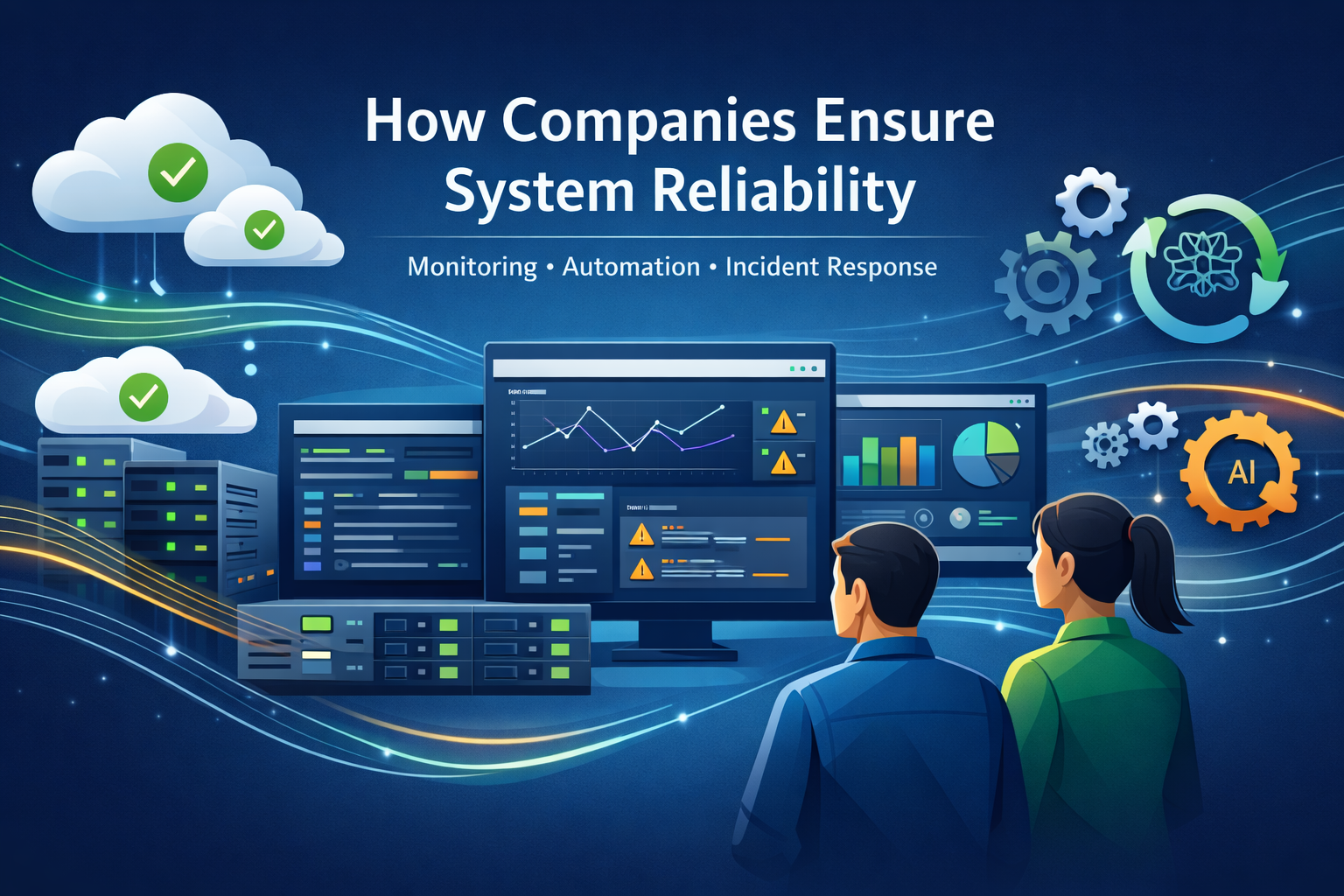
In today’s digital-first world, system reliability is no longer a “nice to have.” For modern companies, reliable systems are directly tied to customer trust, revenue, and brand reputation. A few minutes of downtime can lead to financial losses, frustrated users, and long-term damage. This is why organizations increasingly rely on site reliability engineering (SRE) practices to design, operate, and scale dependable systems.
System reliability is not achieved through a single tool or process. Instead, it is the result of disciplined engineering, continuous measurement, automation, and a strong operational culture. Let’s explore how companies ensure system reliability using proven SRE Training..
Designing Reliability from the Start
Reliable systems begin at the design stage. Companies that follow SRE principles treat reliability as a core feature, not an afterthought. This means building systems that can tolerate failure instead of assuming failures won’t happen.
Engineers design for redundancy, fault isolation, and graceful degradation. If one component fails, the rest of the system continues functioning with minimal impact. This approach reduces the blast radius of failures and ensures critical services remain available even during unexpected events.
By adopting reliability-focused architecture early, companies avoid costly redesigns and operational chaos later.
Defining Clear Reliability Targets
One of the most important ways companies ensure reliability is by setting measurable goals. Instead of vague promises like “high uptime,” SRE teams define clear performance targets using service-level indicators and objectives.
These targets help teams understand what level of reliability truly matters to users. Not every system needs 100% uptime, and chasing perfection often leads to burnout and poor decision-making. By defining acceptable reliability thresholds, teams balance innovation with stability.
This data-driven approach also creates accountability and aligns engineering efforts with real business impact.
Continuous Monitoring and Observability
You cannot improve what you cannot measure. Reliable companies invest heavily in monitoring and observability to gain deep visibility into system behavior.
Metrics, logs, and traces provide real-time insights into performance, errors, and resource usage. Instead of reacting to outages after users complain, teams detect anomalies early and address issues proactively.
Advanced observability helps engineers answer critical questions quickly:
What changed? Where is the failure happening? How severe is the impact?
This visibility dramatically reduces downtime and speeds up recovery during incidents.
Automation to Reduce Human Error
Manual operations are one of the biggest sources of system failure. To combat this, companies rely on automation as a core SRE practice.
Automation is used for deployments, scaling, incident response, backups, and recovery processes. When repetitive tasks are automated, systems become more consistent and less prone to mistakes.
Self-healing mechanisms allow systems to restart failed components or reroute traffic automatically, often resolving issues before users even notice. This not only improves reliability but also frees engineers to focus on higher-value work.
Proactive Incident Management
Even the most reliable systems fail occasionally. What sets successful companies apart is how they handle incidents.
SRE-driven organizations follow structured incident response processes with clear roles, communication channels, and escalation paths. When an incident occurs, the goal is rapid stabilization, not blame.
After recovery, teams conduct blameless post-incident reviews to identify root causes and prevent recurrence. These reviews focus on learning and system improvement rather than individual mistakes.
Over time, this culture of continuous learning significantly strengthens system reliability.
Managing Change with Care
Ironically, many outages are caused by changes meant to improve systems—new features, updates, or configuration changes. To reduce risk, companies apply SRE principles to change management.
Practices such as gradual rollouts, canary deployments, and automated testing allow teams to detect problems early. If something goes wrong, changes can be rolled back quickly with minimal impact.
By controlling how changes are introduced, companies innovate rapidly without sacrificing reliability.
Building a Reliability-First Culture
Tools and processes alone are not enough. Long-term reliability depends on organizational culture.
Successful companies treat reliability as a shared responsibility across development, operations, and leadership teams. Engineers are encouraged to prioritize stability, question risky decisions, and invest time in improving system resilience.
Leadership support is crucial here. When reliability work is valued and rewarded, teams are empowered to build systems that last.
Why SRE Certification Is Important
As SRE practices become more critical, SRE Foundation Certification plays an important role in developing skilled professionals and standardizing reliability knowledge.
An SRE certification validates a professional’s understanding of core concepts such as monitoring, incident management, automation, error budgets, and reliability metrics. For individuals, it builds credibility and confidence in managing complex systems. For organizations, certified professionals bring structured thinking, proven frameworks, and best practices that directly improve system stability.
In a competitive market, SRE certification helps companies ensure their teams are not relying on guesswork but are equipped with industry-recognized reliability expertise.
The Long-Term Impact of SRE on Reliability
Companies that adopt site reliability engineering do more than reduce downtime. They create systems that scale smoothly, recover quickly, and adapt to change without constant firefighting.
By combining thoughtful design, measurable goals, automation, proactive monitoring, and a strong reliability culture, organizations turn reliability into a competitive advantage rather than a constant struggle.
In a world where users expect services to be always available, SRE is no longer optional—it is the foundation of dependable, modern systems.

 English
 Arabic
 Français
 Español
 Português
 Deutsch
 Türkçe
 Dutch
Dutch
 Italiano
 Russian