


How Voice AI Is Transforming Healthcare Innovation
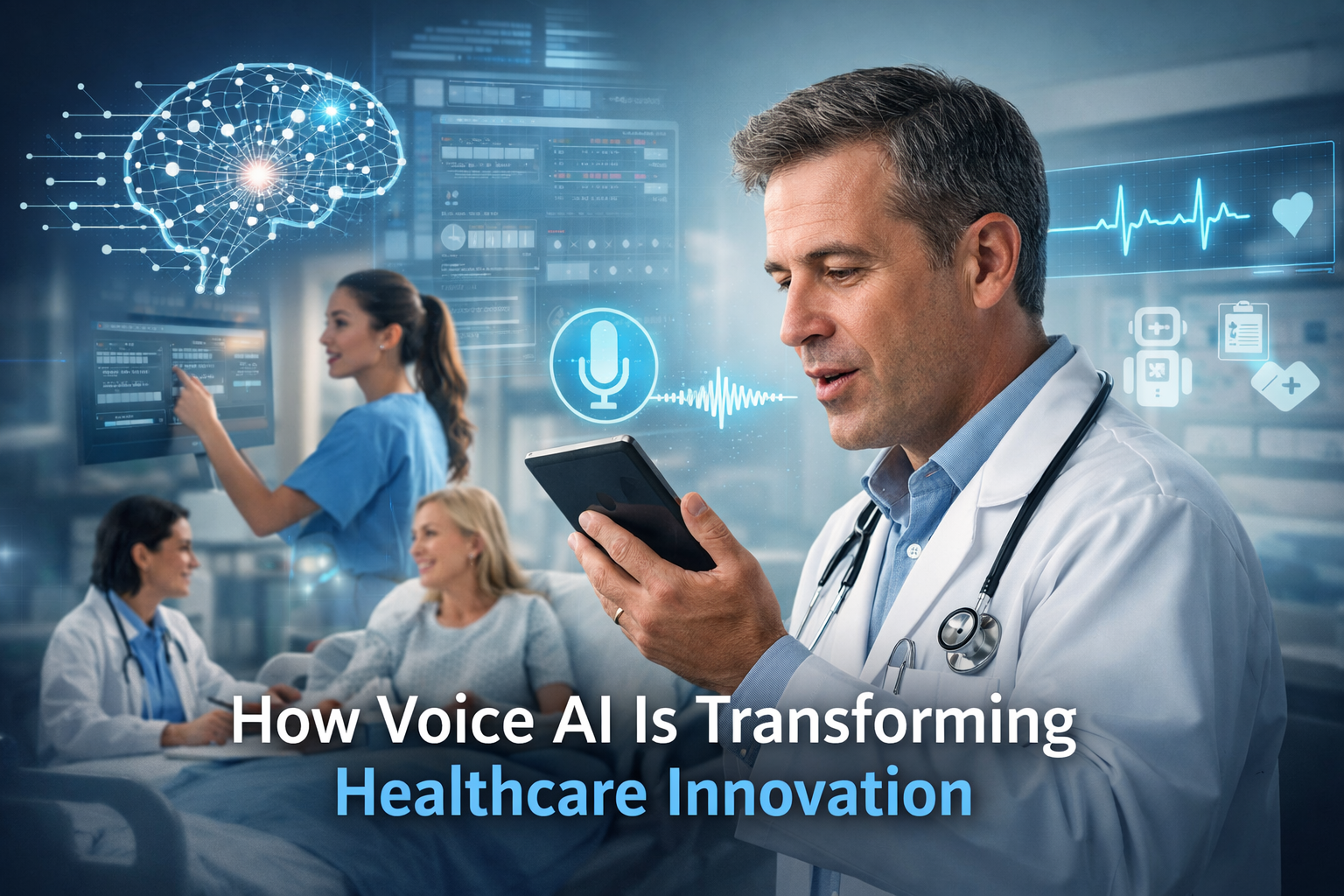
Healthcare systems worldwide face a shared challenge: rising demand, limited clinical staff, and growing administrative burden. Physicians and nurses often spend as much time documenting care as delivering it. In 2025, voice AI is emerging as one of the most practical and impactful technologies helping address this imbalance.
Voice AI in healthcare goes beyond simple speech recognition. It combines natural language understanding, medical context awareness, and workflow integration to support clinicians, improve patient experiences, and streamline operations.
Here’s how it’s reshaping healthcare innovation.
Reducing Clinical Documentation Burden
One of the most immediate benefits of voice AI is in medical documentation. Clinicians spend significant time entering notes into electronic health record (EHR) systems. Voice-enabled AI can:
- Transcribe patient encounters in real time
- Summarize clinical conversations into structured notes
- Extract relevant medical codes and terminology
- Populate EHR fields automatically
This reduces time spent typing and navigating systems, allowing providers to focus more on patient interaction and less on administrative tasks.
Enhancing Doctor-Patient Interaction
When clinicians are not tied to keyboards or screens, patient engagement improves. Voice AI supports more natural conversations during consultations by handling background documentation.
Benefits include:
- More eye contact and active listening
- Better patient trust and satisfaction
- Reduced cognitive load for providers
By minimizing digital distraction, voice AI helps restore human connection in clinical environments.
Improving Clinical Accuracy and Efficiency
Modern voice AI systems are trained to understand medical vocabulary, abbreviations, and contextual cues. This allows them to:
- Differentiate between similar-sounding medical terms
- Recognize medication names and dosages accurately
- Flag inconsistencies or missing documentation
In some implementations, voice AI can even prompt clinicians with relevant questions or reminders, supporting better decision-making without interrupting workflow.
Enabling Hands-Free Clinical Workflows
In hospital and surgical settings, hands-free interaction can be critical. Voice AI enables clinicians to access information without leaving sterile environments or interrupting procedures.
Applications include:
- Retrieving patient data verbally
- Requesting lab results or imaging summaries
- Navigating clinical systems through voice commands
This reduces friction in high-pressure environments and supports safer, more efficient care delivery.
Expanding Access Through Virtual Care
Voice AI also plays a growing role in telehealth and remote care. Intelligent voice systems can:
- Triage symptoms before appointments
- Guide patients through intake processes
- Conduct follow-up check-ins
- Monitor chronic conditions through conversational interfaces
These capabilities improve access to care, especially in underserved or remote regions, while reducing strain on frontline staff.
Supporting Multilingual and Inclusive Care
Healthcare systems serve diverse populations. Voice AI can help bridge language gaps by:
- Supporting multilingual transcription and translation
- Recognizing diverse accents and speech patterns
- Simplifying complex medical language for patients
Improved communication leads to better adherence, clearer understanding of treatment plans, and reduced risk of miscommunication.
Accelerating Data-Driven Insights
Voice AI doesn’t just capture conversations—it structures them. By transforming spoken interactions into analyzable data, healthcare organizations gain deeper insight into:
- Common patient concerns
- Treatment adherence trends
- Workflow inefficiencies
- Quality and compliance patterns
This supports broader healthcare innovation by enabling smarter operational and clinical decisions.
Addressing Privacy and Compliance Concerns
Healthcare is one of the most regulated industries, and voice AI adoption must prioritize security. Leading implementations focus on:
- Encrypted data processing
- Secure storage compliant with healthcare regulations
- Clear consent protocols
- On-device or secure cloud processing models
Trust is foundational. Voice AI systems that prioritize privacy and transparency are more likely to see sustained adoption.
Challenges and Considerations
While promising, voice AI is not without challenges. Accuracy must be high, especially in critical care settings. Integration with legacy systems can be complex. And clinicians must feel confident that AI supports—not overrides—their judgment.
Successful healthcare organizations treat voice AI as an assistive tool, not a replacement for clinical expertise.
Final Thoughts
Voice AI is transforming healthcare innovation by reducing administrative burden, enhancing patient engagement, and enabling more intelligent workflows. Rather than replacing human care, it amplifies it—freeing clinicians to focus on what matters most: patients.
As the technology matures and integration improves, voice AI will likely become a foundational layer of modern healthcare systems, helping organizations deliver more efficient, accessible, and human-centered care.
About US:
AI Technology Insights (AITin) is the fastest-growing global community of thought leaders, influencers, and researchers specializing in AI, Big Data, Analytics, Robotics, Cloud Computing, and related technologies. Through its platform, AITin offers valuable insights from industry executives and pioneers who share their journeys, expertise, success stories, and strategies for building profitable, forward-thinking businesses
Read More: https://technologyaiinsights.com/prosper-ai-raises-5m-healthcare-voice-ai-startup/

 English
 Arabic
 Français
 Español
 Português
 Deutsch
 Türkçe
 Dutch
Dutch
 Russian
 Romaian