


Improving Student Retention Rates with 3D Medical Anatomy and Real-Time Organ Visualization
Anatomy education often challenges even the most motivated students because complex systems demand spatial awareness, layered understanding, and long-term memory recall. When educators integrate 3D interactive anatomy into instruction, they unlock new opportunities to boost comprehension and dramatically improve retention rates. Classrooms that embrace immersive visualization consistently report higher engagement, stronger recall, and deeper conceptual understanding.
Traditional textbooks flatten the human body into static diagrams. However, students rarely build lasting memory connections from two-dimensional drawings alone. In contrast, 3D interactive anatomy tools allow learners to rotate organs, zoom into structures, and examine systems from multiple planes within seconds. That hands-on interaction strengthens neural connections and transforms passive observation into active exploration.
Within the first few minutes of exposure, students begin connecting structure to function. Instead of memorizing disconnected vocabulary terms, they explore relationships between tissues, vessels, and organs in motion. That immediate visual feedback accelerates comprehension and builds confidence.
The Visual Learning Advantage in STEM Classrooms
Visual learning drives retention because the brain processes images faster than text. When instructional designers integrate 3D interactive anatomy platforms into lessons, they create multi-sensory experiences that anchor information more effectively. Students do not just read about the circulatory system; they watch blood flow in real time. They do not merely label the heart; they examine chambers from multiple angles.
This dynamic approach increases cognitive engagement. As students manipulate anatomical structures, they ask more questions. They predict outcomes. They test understanding. Consequently, educators notice stronger participation and fewer disengaged learners.
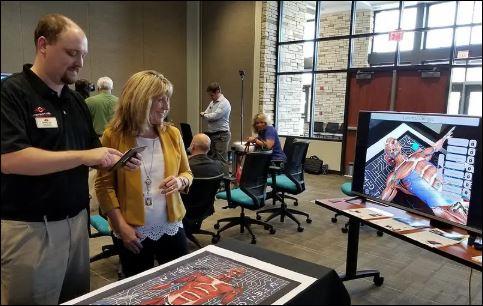
Augmented reality platforms further amplify this effect. Tablet-based AR combined with physical body-map mats enables learners to see life-sized anatomical overlays directly on a workspace. That physical interaction deepens spatial awareness, which proves critical for aspiring healthcare professionals.
Real-Time Organ Visualization Strengthens Memory Encoding
Memory retention improves when learners connect abstract information to movement and interaction. Real-time simulations show organ function in action — lungs expanding, blood circulating, digestive processes unfolding step by step. These animated sequences create narrative flow, and narrative strengthens recall.
Rather than memorizing isolated facts, students build mental stories around physiological processes. For example, dynamic visualizations of oxygen exchange help learners understand cause and effect instantly. They observe how structure supports function. They recognize patterns. That clarity reduces cognitive overload.
When educators embed built-in quizzes directly within the platform, they reinforce learning immediately. Students explore a model, then answer targeted questions. That instant reinforcement strengthens encoding and reduces forgetting curves. Instructional designers can strategically place checkpoints throughout lessons to sustain attention and reinforce mastery.
Collaboration Increases Engagement and Accountability
Retention rates improve when students collaborate. AR-based anatomy systems often include multiple tablets and screencasting capabilities, allowing small groups to work together. Two students might explore one tablet while discussing observations. Meanwhile, educators project the same model onto a smartboard for guided instruction.
This setup encourages peer teaching. Students explain structures to one another. They challenge misconceptions. They refine vocabulary naturally through discussion. That social reinforcement builds confidence and increases accountability.
Group-friendly design also allows STEM educators to rotate stations, differentiate instruction, and integrate inquiry-based learning. Instead of lecturing for forty minutes straight, instructors can facilitate exploration. They guide. They prompt. They challenge. The classroom energy shifts from passive listening to active discovery.
Cost-Effective Innovation That Supports Long-Term Programs
Many institutions hesitate to invest in fragile physical models or recurring online subscriptions. However, modern AR anatomy kits offer durable, portable solutions that reduce long-term costs. A complete package often includes tablets, a durable mat, screencasting tools, and a one-year license. Schools receive updates annually, ensuring alignment with evolving standards.
Platforms launched in recent years have refined their technology based on educator feedback, partnered with national health science organizations, and presented at HOSA conferences. These partnerships signal growing credibility within STEM education communities.
Instead of replacing educators, these tools empower them. Teachers maintain instructional control while leveraging technology to enhance visualization. Instructional designers can align AR modules with curriculum maps, pacing guides, and assessment strategies seamlessly.
Bridging the Gap Between Curiosity and Career Readiness
Health science programs aim to prepare students for real-world clinical environments. Static diagrams cannot fully simulate that complexity. However, immersive 3D interactive anatomy systems cultivate spatial reasoning skills that students later apply in labs, simulations, and healthcare training programs.
When learners manipulate organs in real time, they develop familiarity with anatomical orientation. They understand anterior versus posterior positioning. They visualize cross-sections. They internalize anatomical terminology through action rather than rote memorization.
As a result, students transition more confidently into advanced coursework. Retention improves not only within a single unit but across semesters. Engagement today fuels persistence tomorrow.
Creating a Future-Ready Anatomy Classroom
STEM educators and instructional designers constantly seek methods that elevate both engagement and outcomes. By integrating 3D interactive anatomy and real-time organ visualization into curriculum planning, schools create immersive learning ecosystems that support visual comprehension, collaborative inquiry, and durable memory formation.
Dynamic simulations, interactive exploration, and embedded assessments work together to reduce cognitive overload and increase mastery. When classrooms adopt 3D interactive anatomy, they move beyond memorization and toward meaningful understanding. Ultimately, 3D interactive anatomy empowers educators to improve student retention rates, strengthen conceptual clarity, and prepare the next generation of healthcare professionals with confidence and clarity.

 Arabic
 Français
 Español
 Português
 Deutsch
 Türkçe
 Dutch
Dutch
 Italiano
 Russian
 Romaian