


How Organizations Align Strategy with Execution
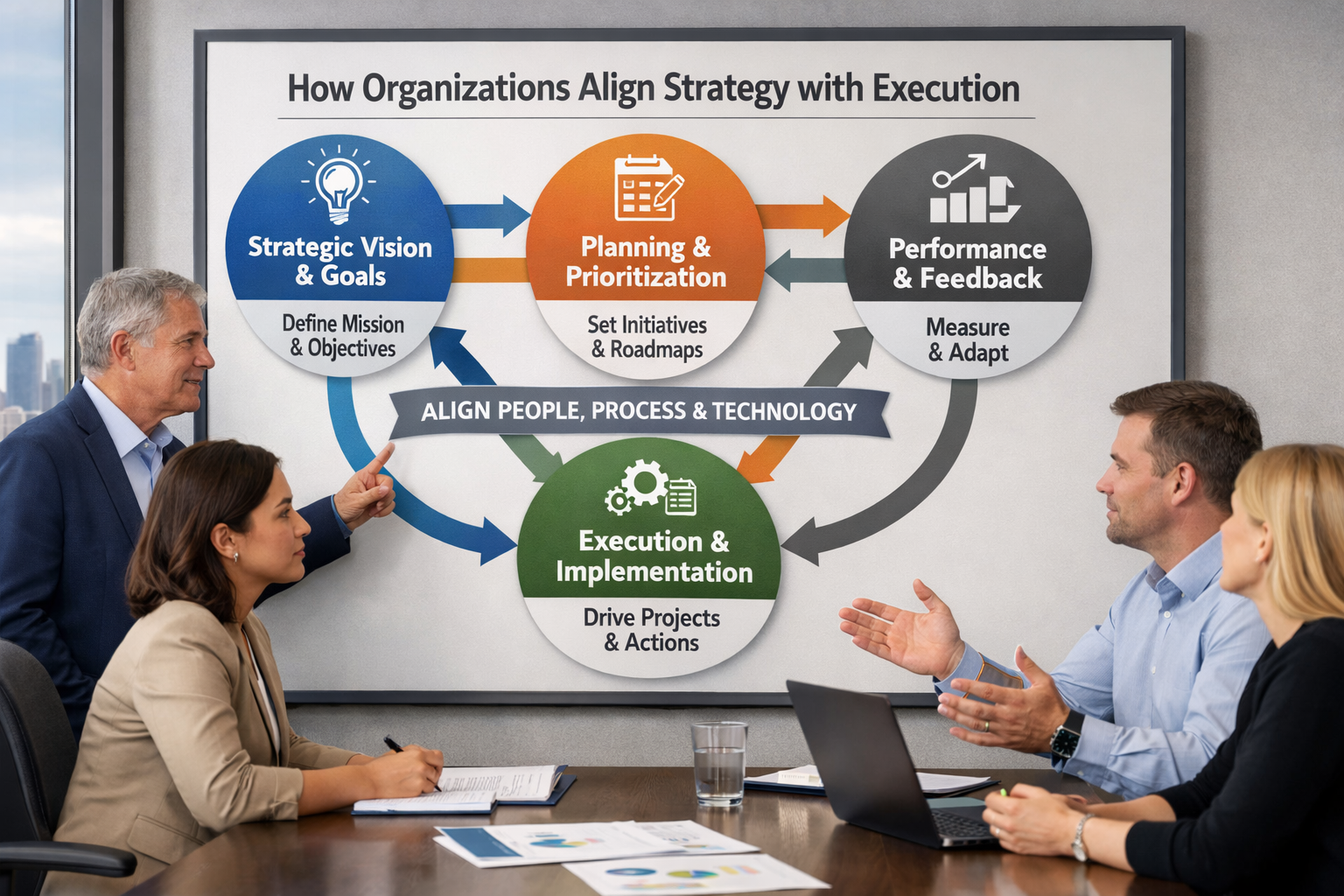
Every organization creates strategies to achieve long-term goals—whether it’s expanding market share, increasing revenue, or improving customer experience. However, many companies fail not because their strategy is wrong, but because they struggle to execute it effectively. Research by Harvard Business Review shows that around 60–70% of strategic plans fail due to poor execution rather than poor strategy.
Aligning strategy with execution ensures that a company’s vision turns into measurable results. When organizations connect high-level goals with daily operations, employees clearly understand how their work contributes to overall success.
Understanding Strategy vs. Execution
Before discussing alignment, it is important to understand the difference between strategy and execution.
Strategy refers to the long-term plan that defines where an organization wants to go.
Execution refers to the processes, actions, and behaviors that bring the strategy to life.
For example, if a company’s strategy is to become a market leader in digital services, execution might involve:
-
Launching new digital products
-
Hiring technology experts
-
Improving online customer experience
-
Investing in automation and cloud infrastructure
Without proper execution, even the best strategy remains only an idea.
Why Strategic Alignment Matters
Organizations that align strategy with execution typically perform better in the long run. According to a report by McKinsey & Company:
-
70% of transformation programs fail due to lack of alignment between strategy and execution.
-
Companies with strong alignment are 1.9 times more likely to achieve above-average profitability.
-
Organizations with clear execution frameworks see up to 30% improvement in operational efficiency.
These statistics highlight how critical alignment is for sustainable growth.
Key Ways Organizations Align Strategy with Execution
1. Clear Strategic Communication
One of the biggest barriers to execution is poor communication. Employees often do not understand how their roles support organizational goals.
Effective organizations:
-
Communicate strategy across all departments
-
Translate high-level goals into team objectives
-
Use town halls, dashboards, and leadership meetings
Companies like Microsoft emphasize transparency by regularly sharing strategic priorities with employees.
2. Breaking Strategy into Measurable Goals
Strategies become actionable when they are broken into specific and measurable objectives.
Organizations often use frameworks such as:
-
OKRs (Objectives and Key Results)
-
Balanced Scorecard
-
KPIs (Key Performance Indicators)
For example:
Strategic Goal: Increase market share
Execution Metrics:
-
15% increase in new customers
-
20% growth in digital sales
-
Launch of two new product lines
This approach ensures progress can be tracked and measured.
3. Aligning Leadership and Teams
Leadership alignment is essential for successful execution. If executives and managers interpret strategy differently, implementation becomes inconsistent.
Effective organizations ensure:
-
Leadership teams agree on priorities
-
Department goals align with company objectives
-
Managers regularly review performance
According to Gallup, organizations with aligned leadership teams are 2.5 times more likely to achieve strong performance outcomes.
Read More: Program Management vs Project Management vs Portfolio Management
4. Integrating Strategy with Daily Operations
Execution improves when strategy is embedded into everyday workflows.
This includes:
-
Linking strategy to project management
-
Aligning budgets with strategic initiatives
-
Integrating goals into performance reviews
For instance, companies like Amazon focus on operational discipline by connecting strategic objectives with daily decision-making processes.
5. Leveraging Technology and Data
Modern organizations increasingly rely on technology to monitor execution.
Popular tools include:
-
Strategy management software
-
Performance dashboards
-
Data analytics platforms
These tools help organizations:
-
Track real-time performance
-
Identify execution gaps
-
Make faster decisions
Data-driven organizations are 23 times more likely to acquire customers, according to research from McKinsey & Company.
6. Continuous Monitoring and Adaptation
Strategy alignment is not a one-time effort. Markets change rapidly, and organizations must continuously adjust.
Successful companies:
-
Conduct quarterly strategy reviews
-
Evaluate progress against KPIs
-
Adjust initiatives based on market conditions
For example, organizations that adopt agile strategy models can respond faster to market shifts and competitive threats.
Common Challenges in Strategy Execution
Even well-planned strategies face challenges. Some of the most common issues include:
-
Lack of clear ownership of strategic initiatives
-
Poor communication across departments
-
Misalignment between company goals and employee incentives
-
Resistance to change within the organization
Addressing these challenges requires strong leadership, effective communication, and a culture focused on accountability.
Conclusion
Aligning strategy with execution is essential for turning vision into results. Organizations that successfully connect strategic goals with daily operations gain a competitive advantage and improve long-term performance.
To achieve this alignment, organizations must:
-
Communicate strategy clearly
-
Set measurable goals
-
Align leadership and teams
-
Integrate strategy into operations
-
Use technology and data
-
Continuously monitor progress
When these elements work together, organizations can move beyond planning and ensure their strategies deliver meaningful and measurable outcomes.

 English
 Français
 Español
 Português
 Deutsch
 Türkçe
 Dutch
Dutch
 Italiano
 Russian
 Romaian