


How SLA-Based Tier 1 & 2 Services Improve First Call Resolution (FCR)
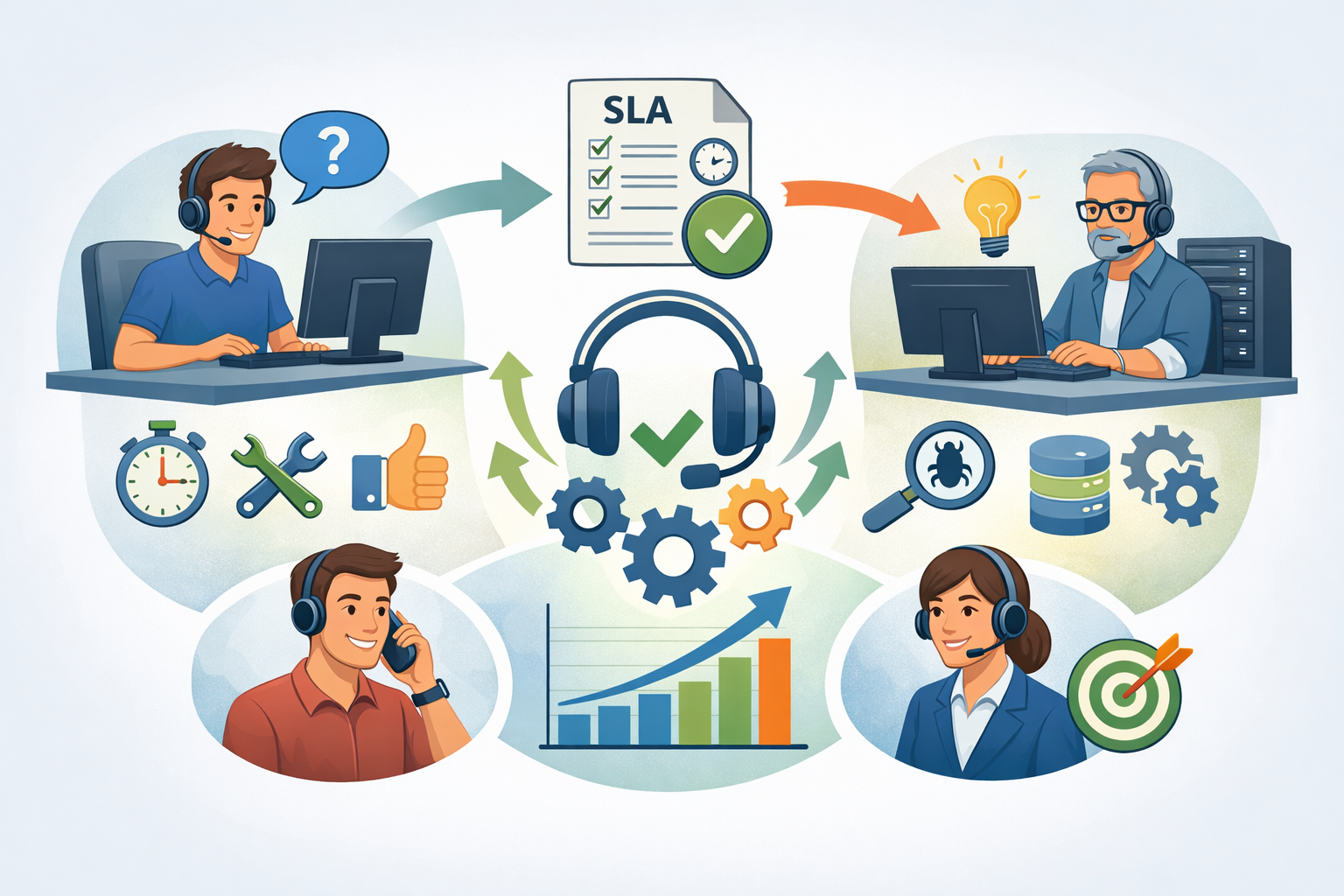
In today’s fast-paced digital environment, customers expect their technical issues to be resolved quickly — often on the very first interaction. Whether it’s a login error, connectivity issue, or software malfunction, long resolution times can negatively impact customer satisfaction and brand reputation. That’s why improving First Call Resolution (FCR) has become a top priority for IT support teams worldwide.
One of the most effective ways to increase FCR rates is by implementing SLA-based Tier 1 and Tier 2 support services. When structured correctly, this model creates accountability, streamlines escalation processes, and ensures that issues are resolved efficiently within defined performance benchmarks.
Understanding First Call Resolution (FCR)
First Call Resolution refers to the percentage of customer issues resolved during the first interaction, without the need for follow-up calls or escalations.
High FCR rates lead to:
-
Increased customer satisfaction (CSAT)
-
Lower operational costs
-
Reduced ticket backlog
-
Improved agent productivity
-
Stronger brand loyalty
However, achieving consistently high FCR requires more than just skilled agents — it demands a well-defined support structure backed by Service Level Agreements (SLAs).
Tier 1 vs Tier 2 IT Helpdesk Support
To understand how SLA-based services improve FCR, it’s important to clarify the difference between Tier 1 vs Tier 2 IT Helpdesk Support.
Tier 1 Support (Frontline Assistance)
Tier 1 agents are the first point of contact. They handle:
-
Password resets
-
Basic troubleshooting
-
Account configuration issues
-
Standard software guidance
-
Frequently asked questions
Their primary objective is to resolve common issues quickly using predefined scripts, workflows, and knowledge bases.
Tier 2 Support (Advanced Technical Resolution)
Tier 2 teams manage more complex technical challenges, including:
-
System-level diagnostics
-
Software bugs
-
Network and server issues
-
Escalated tickets requiring deeper technical expertise
-
Integration and infrastructure-related problems
A well-defined relationship between Tier 1 and Tier 2 ensures seamless transitions when escalation is necessary — without unnecessary delays.
The Role of SLA-Based Tier 1 & Tier 2 Support
An SLA (Service Level Agreement) sets clear expectations for response time, resolution time, escalation procedures, and service quality. When applied to Tier 1 and Tier 2 support, SLAs provide a performance-driven framework that enhances operational efficiency.
Instead of reacting to issues, teams operate within measurable performance boundaries that directly impact FCR.
How SLA-Based Structures Improve FCR
1. Faster Issue Diagnosis
SLAs require documented workflows and detailed knowledge management systems. This allows Tier 1 agents to quickly identify root causes and resolve common issues without escalation.
More structured troubleshooting leads to more first-call resolutions.
2. Clear Escalation Paths
Without defined escalation guidelines, tickets can bounce between teams. SLA-based systems establish:
-
Escalation triggers
-
Maximum response windows
-
Ownership accountability
-
Resolution checkpoints
This prevents unnecessary back-and-forth and ensures faster resolution.
3. Performance Accountability
SLAs introduce measurable KPIs such as:
-
Response Time
-
Resolution Time
-
Escalation Rate
-
FCR Percentage
-
SLA Compliance Rate
When support teams are evaluated against these metrics, it creates accountability and continuous improvement.
4. Knowledge Transfer from Tier 2 to Tier 1
A strong SLA-driven structure encourages collaboration between tiers. Over time, repeated Tier 2 solutions are documented and integrated into Tier 1 knowledge bases.
This enables frontline agents to handle increasingly complex issues independently — significantly improving FCR rates.
5. Reduced Ticket Reopen Rates
When issues are handled thoroughly within SLA frameworks, the chances of incomplete resolutions decrease. Customers are less likely to call back, improving overall service efficiency.
The Role of IT Help Desk Outsourcing in SLA Compliance
Many organizations rely on it help desk outsourcing partners to implement structured SLA-based Tier 1 and Tier 2 models effectively. Experienced providers bring:
-
Established SLA governance frameworks
-
24/7 support coverage
-
Skilled multi-tier technical teams
-
Real-time monitoring tools
-
Proven escalation management systems
This structured approach helps maintain consistent FCR performance while allowing internal teams to focus on strategic initiatives.
Business Impact of Improved FCR
Improving First Call Resolution isn’t just operationally beneficial — it drives tangible business outcomes:
-
Lower cost per ticket
-
Increased customer retention
-
Improved brand trust
-
Higher SLA compliance scores
-
Better overall service efficiency
When customers don’t have to call back multiple times for the same issue, their confidence in the organization grows.
Final Thoughts
SLA-based Tier 1 and Tier 2 support services provide the structure, clarity, and accountability required to improve First Call Resolution. By defining expectations, streamlining escalation processes, and continuously refining knowledge management systems, organizations can resolve more issues on the first interaction.
In a competitive environment where customer experience determines success, implementing a clearly defined SLA-driven support model is essential for delivering fast, reliable, and high-quality technical assistance.

 English
 Français
 Español
 Português
 Deutsch
 Türkçe
 Dutch
Dutch
 Italiano
 Russian
 Romaian