


The Difference Between AI, Machine Learning, and Deep Learning
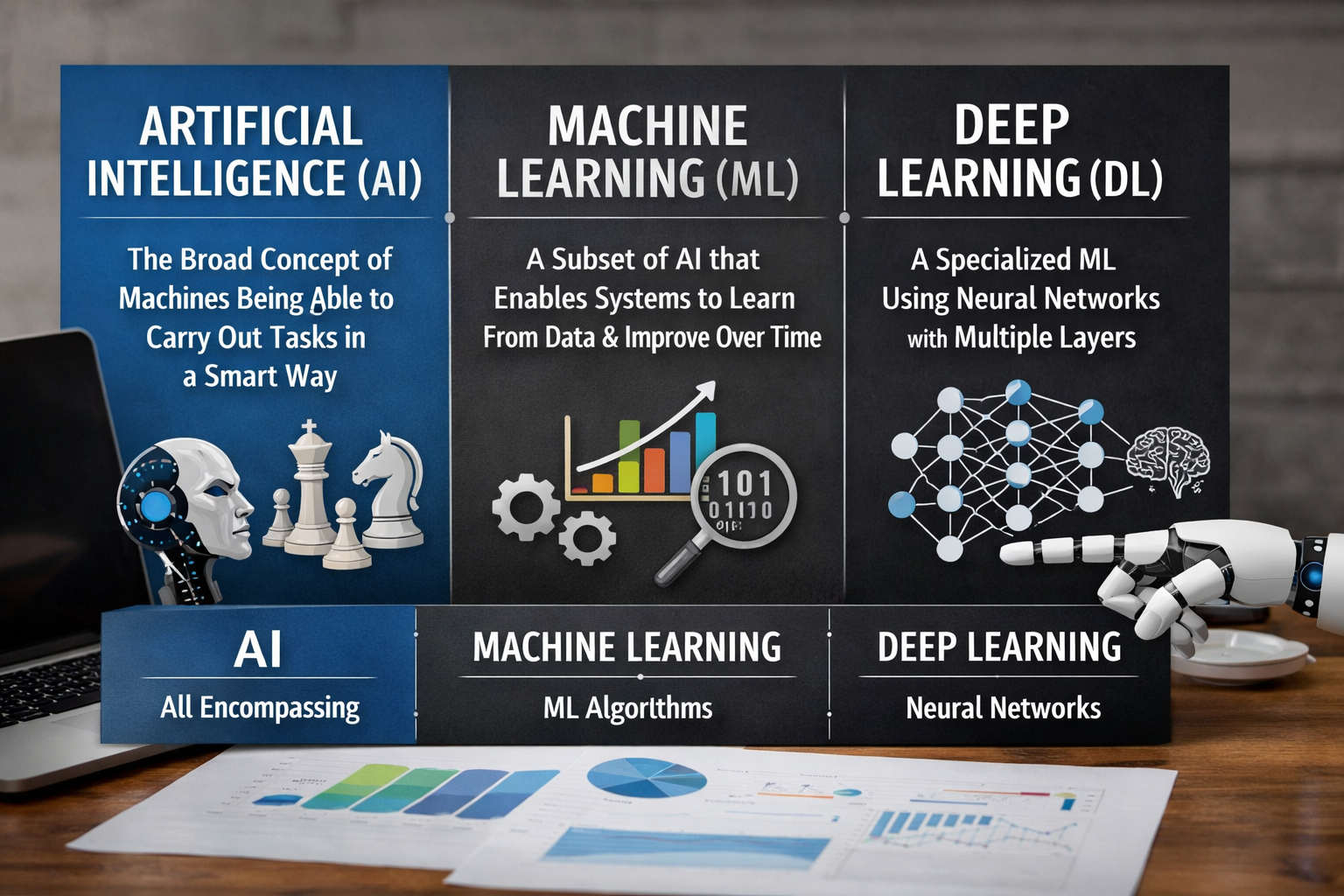
Artificial Intelligence (AI) has become one of the most talked-about technologies in recent years. From voice assistants to recommendation systems, AI is powering many tools we use daily. However, many people often use Artificial Intelligence (AI), Machine Learning (ML), and Deep Learning (DL) interchangeably. While they are related, they are not the same thing. In fact, they represent different levels within the same technological hierarchy.
Understanding the difference between these concepts helps businesses, developers, and learners better understand how modern intelligent systems actually work.
What is Artificial Intelligence (AI)?
Artificial Intelligence is the broadest concept among the three. It refers to machines or software that are designed to simulate human intelligence and perform tasks that normally require human thinking.
AI systems aim to perform functions such as reasoning, learning, problem-solving, decision-making, and language understanding.
Examples of AI in Real Life
-
Virtual assistants like Siri, Alexa, and Google Assistant
-
Self-driving cars
-
Chatbots for customer support
-
Fraud detection systems in banking
-
Smart home automation
Key Characteristics of AI
-
Mimics human decision-making
-
Uses logic, rules, and algorithms
-
Can work with or without learning models
-
Includes subfields like robotics, natural language processing, and computer vision
Market Growth
According to industry reports:
-
The global AI market was valued at around $196 billion in 2023.
-
It is expected to reach over $1.8 trillion by 2030, growing at a CAGR of nearly 37%.
This massive growth highlights how critical AI is becoming across industries.
What is Machine Learning (ML)?
Machine Learning is a subset of Artificial Intelligence. Instead of explicitly programming machines for every task, ML allows systems to learn patterns from data and improve performance over time.
In simple terms, ML enables computers to learn from experience without being manually programmed for every decision.
How Machine Learning Works
Machine Learning models learn by analyzing large datasets. The algorithm identifies patterns and uses them to make predictions or decisions.
Types of Machine Learning
-
Supervised Learning
-
Uses labeled data
-
Example: Spam email detection
-
-
Unsupervised Learning
-
Finds patterns in unlabeled data
-
Example: Customer segmentation
-
-
Reinforcement Learning
-
Learns through rewards and penalties
-
Example: Game-playing AI systems
-
Real-World Applications of Machine Learning
-
Netflix and Amazon recommendation systems
-
Credit scoring in banks
-
Predictive maintenance in manufacturing
-
Stock market analysis
-
Healthcare diagnosis support
Key Benefits of Machine Learning
-
Improves accuracy with more data
-
Automates complex decision-making
-
Reduces manual programming
-
Enables predictive analytics
Industry Adoption
Studies show that around 48% of organizations globally use Machine Learning in some capacity, especially in sectors like finance, healthcare, and e-commerce.
What is Deep Learning (DL)?
Deep Learning is a specialized subset of Machine Learning that uses artificial neural networks inspired by the human brain.
These neural networks contain multiple layers, allowing systems to analyze complex patterns in large datasets automatically.
Deep Learning is especially powerful for tasks involving images, speech, and natural language.
How Deep Learning Works
Deep learning models use multi-layer neural networks that process information in stages:
-
Input Layer – Receives raw data
-
Hidden Layers – Extract patterns and features
-
Output Layer – Produces predictions
Because of these layered structures, deep learning models can learn very complex representations of data.
Popular Deep Learning Applications
-
Facial recognition systems
-
Speech recognition
-
Language translation
-
Autonomous vehicles
-
Medical image analysis
Real-World Impact
For example:
-
Deep learning models can achieve over 95% accuracy in image recognition tasks.
-
Healthcare deep learning systems can detect diseases like cancer earlier than traditional diagnostic methods in some cases.
Read More: Beyond the Buzz: Generative AI Explained by Deciphering Model Mechanics
Key Differences Between AI, Machine Learning, and Deep Learning
Here is a simple comparison to understand how they differ: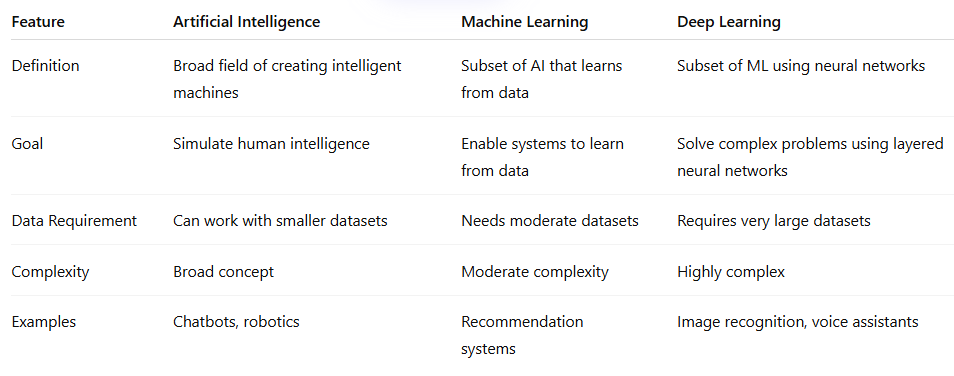
Simple Hierarchy
Think of it like this:
-
Artificial Intelligence (AI) → The big umbrella
-
Machine Learning (ML) → A subset of AI
-
Deep Learning (DL) → A subset of Machine Learning
Why Understanding the Difference Matters
Knowing the difference between AI, ML, and DL helps organizations choose the right technology for their needs.
Businesses can benefit by:
-
Selecting the right tools for automation
-
Improving data-driven decision making
-
Developing smarter products
-
Increasing operational efficiency
For example, a small company may only need Machine Learning for sales prediction, while a tech company building self-driving cars requires advanced Deep Learning models.
Conclusion
Artificial Intelligence, Machine Learning, and Deep Learning are closely connected but serve different roles in modern technology.
-
AI is the overarching concept of intelligent machines.
-
Machine Learning allows systems to learn from data.
-
Deep Learning takes it further by using complex neural networks to solve advanced problems.
As data continues to grow and computing power increases, these technologies will become even more powerful. Understanding their differences is the first step toward leveraging them effectively in the digital age. To take your AI skills to the next level, consider enrolling in a Generative AI Professional Certification Training and Course, designed to equip you with hands-on expertise in creating advanced AI models and applications.

 Arabic
 Français
 Español
 Português
 Deutsch
 Türkçe
 Dutch
Dutch
 Italiano
 Russian
 Romaian