


Key Components of Successful Test Automation Frameworks
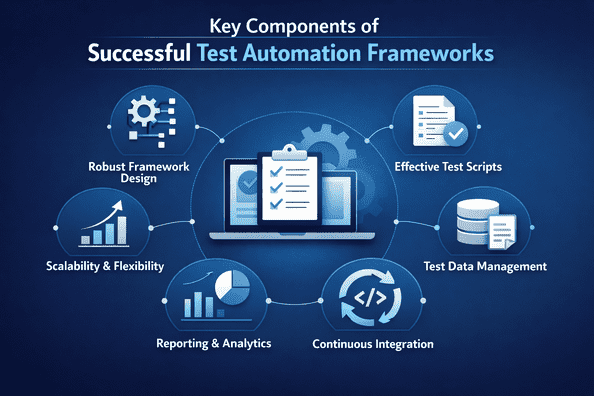
As software systems become more complex and release cycles become faster, organizations increasingly rely on automation to maintain product quality. A well-structured automation strategy depends heavily on strong test automation frameworks that provide consistency, maintainability, and scalability for automated testing efforts.
Test automation frameworks are more than just collections of automated scripts. They provide a structured environment that defines how tests are created, executed, and maintained. Understanding the key components that make these frameworks effective helps teams build reliable and efficient testing processes.
Test Script Structure
One of the most fundamental components of successful test automation frameworks is a well-organized test script structure. Clear and modular test scripts allow teams to manage large numbers of automated tests without creating confusion or duplication.
Organizing scripts by modules, features, or functionality makes it easier for testers and developers to locate, update, and reuse test cases. A consistent naming convention and logical directory structure improve readability and long-term maintainability.
Reusable Test Components
Reusable components are critical to maintaining efficient automation frameworks. Instead of writing repetitive scripts for similar actions, teams can create reusable functions or libraries that perform common tasks such as logging in, navigating pages, or validating outputs.
By incorporating reusable elements, test automation frameworks reduce redundancy and simplify updates. When a shared function needs modification, it can be updated in one place without affecting multiple test scripts.
Test Data Management
Effective handling of test data is another essential component of successful automation frameworks. Automated tests often require different input values to verify system behavior under various conditions.
Separating test data from test scripts allows teams to run the same tests with multiple datasets. This approach improves test coverage while keeping scripts clean and maintainable. Data-driven testing techniques are commonly used to manage this process efficiently.
Configuration and Environment Management
Applications typically run across multiple environments, such as development, staging, and production. Test automation frameworks must support environment configuration to ensure tests can run consistently across these different setups.
Configuration files or environment variables help manage parameters such as URLs, credentials, and system settings. This flexibility ensures that automated tests remain adaptable as the application evolves.
Reporting and Logging
Clear reporting is a vital component of any automation framework. When tests run automatically, teams need detailed information about which tests passed, which failed, and why failures occurred.
Comprehensive logs and reports help testers quickly diagnose issues and identify patterns in failures. Effective reporting also improves collaboration between developers and quality assurance teams by providing transparent insights into test results.
Integration with Development Pipelines
Modern development teams often integrate test automation frameworks into continuous integration and continuous delivery pipelines. This integration allows automated tests to run whenever new code changes are introduced.
Running tests automatically during builds ensures that issues are detected early in the development process. This practice reduces the risk of defects reaching production and supports faster development cycles.
Maintainability and Scalability
A successful automation framework must be designed with long-term maintainability in mind. As applications evolve, the test suite will grow, and poorly structured frameworks can quickly become difficult to manage.
Scalable test automation frameworks allow teams to add new tests without disrupting existing ones. Modular design, reusable components, and clear documentation all contribute to maintaining an efficient automation ecosystem.
Documentation and Guidelines
Proper documentation is often overlooked but remains a critical component of effective test automation. Documentation should explain how the framework is structured, how tests should be written, and how different components interact.
Clear guidelines ensure that team members follow consistent practices when adding new tests or modifying existing ones. This consistency improves collaboration and prevents framework complexity from increasing over time.
Conclusion
Successful test automation frameworks rely on a combination of well-structured scripts, reusable components, effective test data management, and strong reporting capabilities. These components create a stable environment for automated testing while supporting scalability and long-term maintainability.
When integrated with modern development workflows, well-designed test automation frameworks help teams detect issues early, improve software quality, and support faster release cycles. By focusing on these core components, organizations can build automation systems that remain efficient and adaptable as their applications continue to grow.

 Arabic
 Français
 Español
 Português
 Deutsch
 Türkçe
 Dutch
Dutch
 Italiano
 Russian
 Romaian