


Employee Attendance Management System: Smart Benefits
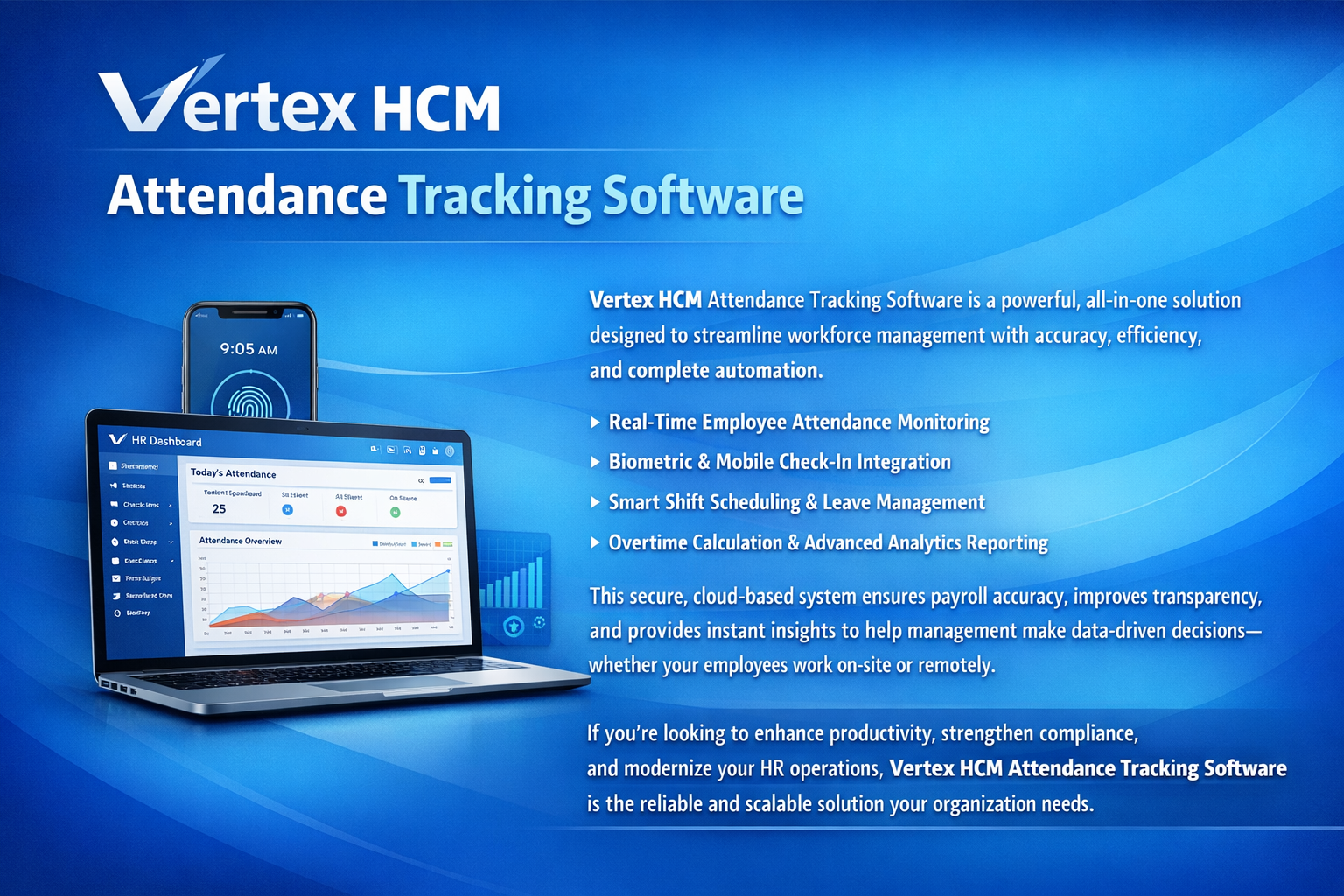
Employee Attendance Management System: A Smarter Way to Track Work Time
Managing employee attendance used to be simple when teams were small and work hours were fixed. A supervisor could glance at a register or spreadsheet and know who showed up and who didn’t. But workplaces have changed. Remote teams, flexible shifts, and hybrid work have made traditional tracking methods harder to maintain.
Many companies now find themselves dealing with scattered records, manual calculations, and frequent payroll corrections. These small issues add up over time and can create confusion for both managers and employees.
This is where an employee attendance management system begins to make sense. Instead of relying on paper logs or disconnected spreadsheets, businesses can track work hours, leaves, and attendance patterns in a structured digital environment.
Solutions such as Vertex HCM attempt to bring attendance data, leave management, and payroll calculations together so teams don’t have to maintain several systems at once. But before adopting any platform, it helps to understand how attendance systems actually work and what problems they solve.
What an Employee Attendance Management System Actually Does
At its core, an employee attendance management system records when employees start and end their workday. That sounds simple, but modern systems do much more than basic check-in and check-out tracking.
Most platforms store attendance records, calculate work hours automatically, and integrate that information with payroll processing. This reduces the need for manual adjustments that often happen when attendance data is collected through spreadsheets or paper logs.
A typical time attendance management system can track:
Employee login and logout times
Break durations
Leave requests and approvals
Overtime calculations
Shift schedules
Instead of manually compiling this data at the end of the month, managers can review attendance records in real time.
Why Businesses Are Moving Away from Manual Attendance Tracking
Manual attendance tracking still exists in many organizations, especially smaller ones. However, it often creates hidden problems.
One common issue is accuracy. Human error can easily occur when attendance is recorded by hand or updated in spreadsheets. Even a small mistake in time records may affect payroll calculations.
Another challenge is transparency. Employees sometimes question how their work hours were calculated, particularly when overtime or leave deductions are involved. With digital attendance tracking software, records are stored automatically and can be reviewed whenever needed.
There is also the time factor. HR teams often spend hours reconciling attendance sheets before payroll runs. Automated systems reduce that administrative burden.
How a Time Attendance Management System Works
Different systems operate in different ways, but most follow a similar process. Employees record their attendance through a digital method, which may include biometric devices, mobile applications, or web-based dashboards.
Recording Employee Attendance
Attendance data can be captured through several methods:
Biometric fingerprint scanners
Facial recognition devices
Mobile location-based check-ins
Desktop login tracking
Each method has advantages depending on the work environment. For example, mobile check-ins may suit field teams, while biometric devices are more common in office spaces.
Processing and Storing Data
Once attendance is recorded, the system automatically calculates working hours. It can also detect patterns such as late arrivals or frequent overtime.
This data is stored in the system and can later be used for payroll calculations, reporting, or compliance checks.
Platforms like Vertex HCM often combine attendance tracking with HR management tools so that employee data, leave records, and work hours remain connected.
Common Misconceptions About Attendance Tracking Software
Some businesses hesitate to adopt attendance software because they assume it will complicate their workflow. In reality, the opposite is often true.
Another misconception is that attendance systems are only useful for large corporations. Smaller organizations can benefit as well, especially if their HR team manages multiple administrative tasks.
There is also a belief that attendance software replaces managerial oversight. In practice, the system simply organizes data. Managers still make decisions regarding scheduling, leave approvals, and performance.
Who Benefits Most From Attendance Management Systems
Organizations with growing teams often see the biggest advantages from adopting digital attendance systems. As the number of employees increases, manual tracking becomes harder to maintain accurately.
Industries with shift-based work schedules also rely heavily on attendance systems. Retail businesses, healthcare organizations, and manufacturing companies frequently use time tracking tools to manage rotating shifts and overtime.
Remote and hybrid workplaces are another case where attendance systems become useful. When employees work from multiple locations, digital records help maintain accountability without constant supervision.
For HR departments, the main benefit is efficiency. Instead of spending time compiling attendance records, teams can focus on broader workforce planning and employee engagement.
The Changing Role of Attendance Systems in Modern Workplaces
Attendance tracking has evolved far beyond simple clock-in systems. Today’s platforms connect attendance data with scheduling, payroll, and workforce analytics.
This shift reflects a broader change in how organizations manage their workforce. Instead of treating attendance as an isolated HR function, businesses increasingly see it as part of a larger operational system.
The question is no longer just about tracking who arrived at work. It is about understanding patterns, supporting flexible schedules, and maintaining fairness in how work hours are recorded.
As workplaces continue to evolve, attendance management tools will likely keep adapting as well. The real challenge for businesses is deciding how much structure they need and what kind of system fits the way their teams actually work.

 English
 Arabic
 Français
 Español
 Português
 Deutsch
 Türkçe
 Dutch
Dutch
 Italiano
 Russian