


The Beginner's Guide to Understanding JCB Machine Parts and How They Work
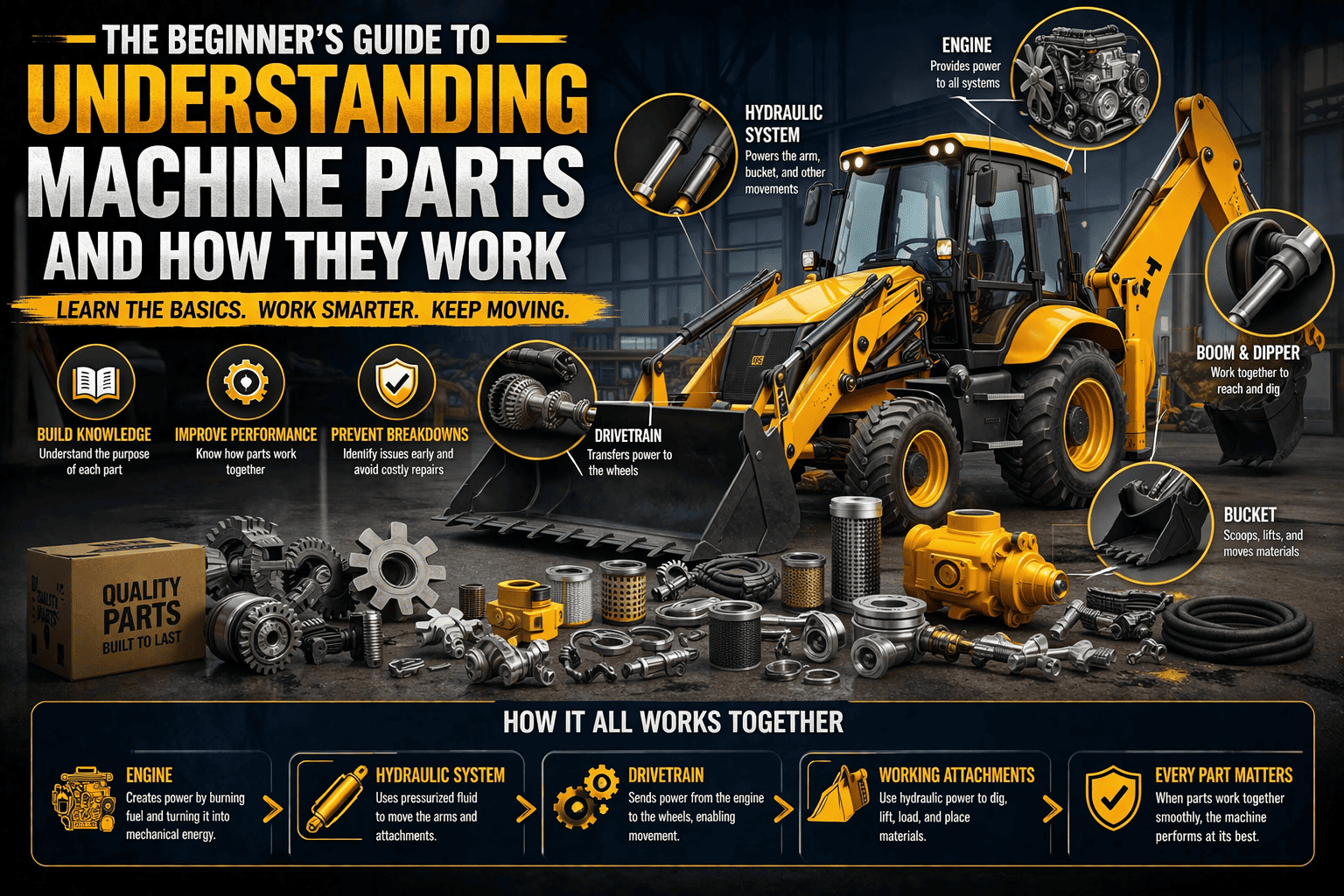
If you are new to the world of JCB machines, all the technical terms and part names can feel very confusing. Hydraulic rams, planetary hubs, axle parts, transmission — it sounds complicated. But once you understand what each part does and why it matters, taking care of your machine becomes much easier.
This guide is written for machine owners, new operators, and small contractors who want to understand their JCB machine better. No complicated technical language. No confusing jargon. Just simple, clear explanations of the most important parts on your machine and what they do every day.
Why Understanding Your Machine Parts Matters
You do not need to be a mechanic to own a JCB machine. But you do need to understand the basics. Here is why:
When you understand what each part does, you can spot problems early. You can talk to your mechanic confidently. You can make better decisions when buying spare parts. And you can avoid being overcharged or misled by sellers who assume you do not know anything.
Knowledge about your machine protects your investment. Let us start with the most important systems and parts.
Part 1 — The Engine
The engine is the heart of your JCB machine. It produces the power that makes everything else work. Most JCB backhoe loaders use a diesel engine because diesel gives more power and better fuel efficiency for heavy work.
The engine has many smaller parts inside it — pistons, valves, crankshaft, camshaft, and more. But from a maintenance point of view, the most important things to watch are:
- Engine oil — keeps all moving parts inside the engine lubricated and cool
- Engine oil filter — cleans the oil before it circulates through the engine
- Air filter — stops dust and dirt from entering the engine with the air it breathes
- Fuel filter — removes dirt and water from diesel before it enters the engine
- Coolant — keeps the engine from overheating
If you take care of these five things properly, your engine will run well for many years.
Part 2 — The Hydraulic System
The hydraulic system is what makes the JCB boom go up and down, the dipper extend and retract, the bucket curl and open, and the steering respond. It is the most powerful and most important system on the machine after the engine.
It works by pushing pressurised hydraulic oil through hoses and valves to hydraulic cylinders called rams. When oil is pushed into a ram, it extends. When oil is pulled back, it retracts. This simple principle moves everything on your machine.
Key parts of the hydraulic system:
- Hydraulic pump — creates the pressure that moves the oil
- Hydraulic rams — the cylinders that do the actual pushing and lifting
- Hydraulic hoses — carry the oil between pump, valves, and rams
- Hydraulic filter — keeps the hydraulic oil clean
- Control valves — direct the oil to the right place based on operator input
The hydraulic system needs clean oil and a good filter to work properly. Contaminated hydraulic oil is the number one cause of hydraulic system failure.
Part 3 — The Transmission
The transmission takes the power from the engine and sends it to the wheels so the machine can move forward and backward. On a JCB backhoe loader, the transmission also controls speed ranges — slow for digging and heavy work, faster for travelling on roads.
Signs of transmission problems include:
- Difficulty changing gears
- Machine moves slowly even at full throttle
- Unusual noise when the machine is moving
- Slipping feeling when driving on slopes
Transmission parts are expensive to replace when they fail completely. Catching problems early and using the right transmission fluid saves a lot of money.
Part 4 — The Axle
The axle connects the wheels to the machine and carries the full weight of the machine and its load. On a JCB backhoe loader there are two axles — front and rear. The front axle also handles steering.
Inside the axle you have gears, bearings, and seals. These need to be kept properly lubricated. A dry or damaged axle makes noise, causes vibration, and eventually fails completely — which means the machine cannot move at all.
Regular axle oil checks and timely seal replacements keep the axle healthy for years.
Part 5 — Pins and Bushes
Pins and bushes are small parts but they are absolutely critical. They are the joints that connect the boom, dipper, and bucket together. Every time the operator moves the boom or bucket, these pins and bushes take the full force of that movement.
Over time they wear down. When pins and bushes are worn, you will notice:
- Loose or sloppy feeling when moving the boom or bucket
- Rattling noise from the front attachment
- Poor digging control and reduced precision
Greasing pins and bushes every 50 hours prevents fast wear. Replacing them when worn keeps the whole front attachment working correctly and prevents damage to the boom structure itself.
Part 6 — Filters — The Most Important Small Parts
Filters are small. They are cheap compared to most other parts. But they do one of the most important jobs on the machine — they keep everything clean inside.
Think of filters as the guards of your machine. The engine oil filter guards the engine. The hydraulic filter guards the hydraulic system. The air filter guards the combustion chamber. The fuel filter guards the injectors.
When filters are clean and working properly, harmful particles never reach the expensive parts inside. When filters are blocked or low quality, contamination gets through and causes serious damage.
This is why buying jcb parts from a trusted supplier matters so much. A genuine part from a reliable source performs the job it was designed for. A cheap copy looks similar but fails to protect your machine the way a genuine part does.
Robot India supplies a full range of genuine JCB parts to machine owners and dealers across India and worldwide. With over 30 years in the business, they understand exactly what your machine needs and stock parts that meet full OEM specifications.
For filters specifically, getting the right jcb filters matched to your exact machine model ensures perfect fit and maximum protection for your engine and hydraulic system. The wrong size or wrong grade filter does not seal properly and lets contamination through — defeating the whole purpose of having a filter.
Part 7 — Body Parts and Electrical Parts
Beyond the mechanical systems, your JCB machine also has body parts — the cab, bonnet, panels, doors, and glass — and electrical parts — the battery, alternator, starter motor, lights, and wiring.
Body parts protect the operator and the internal systems from dust, rain, and impact. Damaged body panels should be repaired quickly because they expose the internal components to weather and dust which causes corrosion and electrical problems over time.
Electrical parts control starting, lighting, and many modern machine functions. Common electrical problems include:
- Machine not starting — usually battery or starter motor
- Lights not working — usually a fuse or wiring issue
- Warning lights staying on — usually a sensor or electrical connection problem
Always use correct replacement electrical parts for your machine model. Wrong electrical parts can cause short circuits and damage expensive control systems.
How All These Parts Work Together
Now that you understand each part separately, here is the big picture. When you start your JCB machine:
- The battery powers the starter motor which cranks the engine
- The engine burns diesel to produce power
- Power goes to the transmission which moves the machine
- Power also drives the hydraulic pump which pressurises hydraulic oil
- The operator controls valves that send pressurised oil to hydraulic rams
- The rams move the boom, dipper, and bucket through pins and bushes
- Filters throughout the system keep oil and air clean at every stage
- Seals and hoses keep all fluids contained where they should be
Every part depends on every other part. When one part fails, it puts stress on connected parts. This is why keeping every part in good condition is so important — the whole machine works as one connected system.
Final Thoughts
Understanding your JCB machine does not require years of mechanical training. Learning the basics of what each part does and why it matters gives you the knowledge to make better decisions every day — from maintenance to buying spare parts to spotting problems early.
A machine owner who understands their machine is a machine owner who saves money, avoids breakdowns, and gets more productive years from their investment.
Start with the basics in this guide. Ask your mechanic questions. And always make sure the parts going into your machine are genuine, quality parts from a supplier you trust.

 English
 Arabic
 Français
 Español
 Português
 Deutsch
 Türkçe
 Dutch
Dutch
 Italiano
 Russian