


Experience Letter Format: A Clear and Practical Guide for Employees and Employers
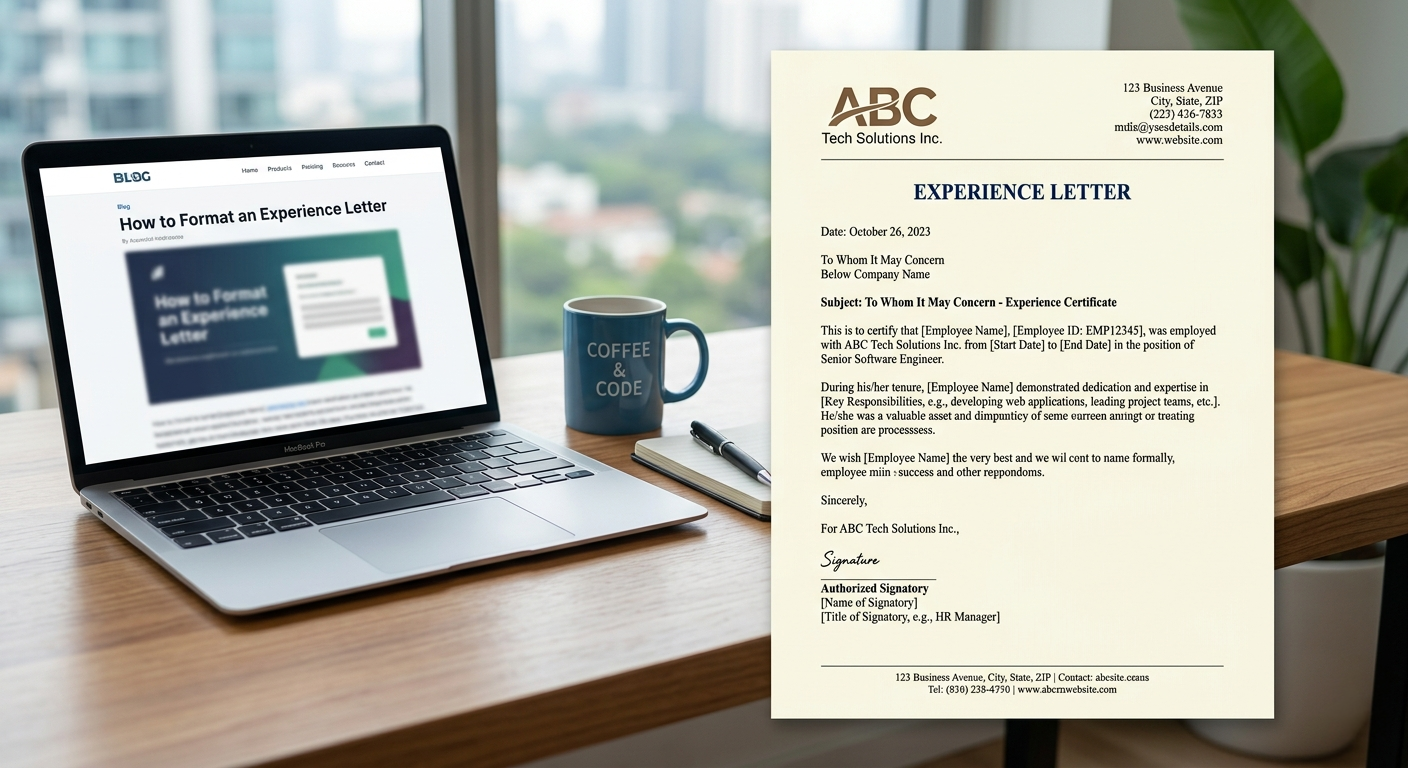
Picture this: an employee's last day at your company. The handover is done, the farewell cake has been cut, and now they walk up to HR with one final request: their experience letter. This moment happens in every organisation, every single day. Yet so many companies fumble it, with late letters, wrong designations, and missing signatures. The result? A frustrated ex-employee and a dented employer reputation.
This guide is here to fix that. Whether you are the HR professional writing the letter or the employee waiting to receive one, you will find everything you need right here.
So, What Exactly Is an Experience Letter?
An experience letter is a formal document that a company gives to an employee when they move on. It officially confirms that the person was part of your organisation, held a particular position, and worked for a specific length of time.
It is not the same as a relieving letter, which simply marks the last working day. Nor is it an offer letter, which marks the beginning. The experience letter is the final chapter, a written record of the employee's professional journey with your company.
In simple terms, it is your company saying, "This person worked here. Here is the proof."
Why Should You Take It Seriously?
A lot of people treat the experience letter as just another HR formality. It is not.
For the employee stepping into a new role, this letter is one of the most critical documents in their career file. Recruiters use it to verify employment history. Universities ask for it during admission processes. Immigration authorities require it for visa applications. Background verification agencies treat it as a primary reference. If the letter is missing, vague, or poorly written, real consequences follow: job offers get withdrawn, applications get delayed, and professional reputations take a hit.
For the HR team issuing the letter, it reflects the quality and maturity of your people processes. A clean, well-structured experience letter tells the world that your organisation values its employees, even after they leave. A sloppy one does the opposite.
And from a documentation standpoint, keeping a consistent format across all letters makes your HR records organised, uniform, and easy to audit.
What Goes Inside an Experience Letter?
You do not need a ten-page document. What you need is clarity and accuracy. Here is every element a proper experience letter must contain:
1. Official Company Letterhead
Start with your company's letterhead. This includes the logo, registered company name, address, and contact details. It is the first signal of authenticity.
2. Date of Issue
Mention the exact date the letter is being generated. This matters for record-keeping and future verification.
3. Employee's Full Name
Use the name exactly as it appears in your HR records. Even a minor spelling difference can create headaches during background verification.
4. Designation and Department
Clearly state the role the employee held. If there were promotions during the tenure, you may mention the most recent title or list both positions.
5. Employment Dates
The start and end dates are often the most carefully scrutinised details. Make sure they are accurate and match what is in your HRIS or payroll records.
6. Key Responsibilities
A short paragraph or a few lines summarising what the employee did in their role. This gives context and makes the letter far more useful than a bare-bones certificate.
7. Performance Remark
Include a professional, positive comment about the employee's work ethic and conduct. Keep it honest, specific, and concise.
8. Reason for Leaving (Optional)
This is not always required, but can be included when the separation is amicable and the context adds value.
9. Authorised Signature
The letter must be signed by someone with authority, an HR head, a reporting manager, or a designated company representative. A letter without a signature is not worth much.
10. Company Seal
Where applicable, stamp the letter with the official company seal to further validate its authenticity.
A Ready-to-Use Experience Letter Template
Here is a simple, professional format you can start using right away:
[Company Letterhead]
Date: [DD/MM/YYYY]
To Whom It May Concern,
This is to certify that [Employee Full Name], bearing Employee ID [Employee ID], served as [Job Designation] in the [Department Name] at [Company Name] from [Joining Date] to [Last Working Date].
Throughout the period of employment, [Employee Name] was entrusted with [brief outline of key duties and responsibilities]. [He/She/They] carried out all assigned tasks with sincerity, professionalism, and a consistent commitment to quality.
[Employee Name] was a valued member of our team, and we sincerely wish [him/her/them] continued success in all future professional pursuits.
Yours sincerely,
[Name of Authorised Signatory] [Designation] [Company Name] [Email Address / Phone Number]
Feel free to adapt the tone, add role-specific details, or include additional information based on your company's documentation guidelines.
Mistakes That HR Teams Commonly Make
Even seasoned HR professionals sometimes let small errors slip through. Being aware of them is the first step to avoiding them.
1. Inaccurate employment dates are one of the most frequent issues. A wrong joining date or the last working day can create serious problems during background checks. Always cross-verify with system records before the letter goes out.
2. Letters without proper authorisation lose their value instantly. Make sure every single letter carries both a signature and, where required, a company stamp.
3. Overly generic wording is another common trap. Phrases like "the employee performed well" add little substance. Be precise about what the person actually did and how they contributed.
4. Delayed issuance is perhaps the most damaging mistake. An employee should ideally receive their experience letter on their last working day, or within a reasonable window of 30 to 45 days at most. Unnecessary delays leave a lasting negative impression.
5. Outdated templates are also a concern, especially if your company has recently rebranded or relocated. Always make sure your templates reflect the current company identity.
How Technology Simplifies the Process
When you are managing a growing team with regular attrition, drafting each experience letter manually becomes a real burden. The chances of inconsistencies and errors increase, and the time spent on what should be a straightforward task starts to add up.
This is where a modern HRMS platform like SavvyHRMS changes the game. With a centralized HR system, you can maintain pre-approved experience letter templates that automatically pull in accurate employee data, name, designation, department, and dates of employment, without any manual input. Every letter that goes out looks polished, follows the same format, and can be generated in a matter of minutes.
Beyond saving time, it also means your HR records are always clean and consistent, which makes audits, legal reviews, and reference requests far easier to handle.
Can an Employee Request an Experience Letter?
Absolutely. Employees are well within their rights to request an experience letter, even if they have already left the organisation. The standard approach is to reach out to the HR department via email or through the company's official HR portal, providing their name, employee ID, designation, and employment dates to help speed up the process.
One important note for HR teams: you are generally obligated to issue an experience letter regardless of how or why the employee left. Withholding it, even in cases of difficult exits, can have legal implications. It is always the safer and more professional choice to provide it.
Wrapping Up
An experience letter is a small document that carries significant weight. For employees, it is proof of their professional story. For HR teams, it is an opportunity to leave a lasting positive impression, even after the goodbye.
The key is to get the format right, the details accurate, and the process timely. Whether you are handling this manually or through an automated HRMS solution like SavvyHRMS, treating it with the attention it deserves goes a long way in building a reputation as an employer that truly cares about its people, from day one to the very last day.

 English
 Arabic
 Français
 Español
 Português
 Deutsch
 Türkçe
 Dutch
Dutch
 Italiano
 Romaian