


Delta Testing in CI/CD: How to Run Smarter, Faster Test Pipelines
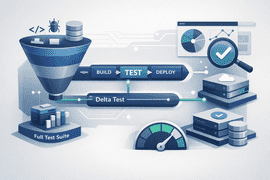
Every engineering team eventually hits the same wall. The test suite that once ran in five minutes now takes forty-five. Developers stop running tests locally because feedback takes too long. Pull request pipelines become bottlenecks. The CI/CD promise of fast, continuous feedback quietly breaks down, not because teams stopped caring about quality, but because the test suite grew faster than the infrastructure supporting it.
The answer most teams reach for is more parallelization, more compute, or faster test runners. These help at the margins. But the more fundamental fix is running fewer tests more intelligently. That is exactly what delta testing addresses.
What Is Delta Testing?
Delta testing is a test execution strategy that focuses validation on the parts of a system that have actually changed, rather than running the entire test suite on every code push. The word "delta" refers to the difference between two states of a codebase, and delta testing uses that difference to scope which tests are relevant for a given change.
In a traditional CI/CD pipeline, every commit triggers a full test run regardless of what changed. A one-line fix to a utility function kicks off the same thousand-test suite as a major architectural refactor. Delta testing challenges this assumption. If a change only touches the payment module, why run tests for the notification service, the authentication layer, and the reporting dashboard?
The answer, of course, is that teams run everything because they are not confident about the blast radius of any given change. Delta testing provides that confidence through precise change impact analysis.
How Delta Testing Works in a CI/CD Pipeline
Implementing delta testing in a CI/CD context involves three core steps: change detection, impact mapping, and scoped test execution.
Change Detection
The pipeline begins by identifying exactly what changed between the current commit and the previous stable state. This goes beyond a simple file diff. A robust delta testing implementation understands the difference between a change to a shared utility used by twenty services and a change to a leaf-node function with one caller. Tools use a combination of version control diffs, dependency graphs, and call graph analysis to build a precise picture of what changed and where.
Impact Mapping
Once the changed components are identified, the pipeline maps those changes to the tests that cover them. This requires a test-to-code coverage map, essentially an index that records which tests exercise which parts of the codebase. When a function changes, the system looks up which tests have historically executed that function and marks them as relevant for the current run.
This coverage map is built incrementally over time. Each full test run contributes data to the map, making impact mapping progressively more accurate as the system learns the relationship between code and tests.
Scoped Test Execution
With the relevant test set identified, the pipeline runs only those tests. The scope might be ten tests on a small isolated change or eight hundred tests on a change that touches a core shared library. Either way, the executed set is grounded in actual impact rather than a blanket policy of running everything.
The key design requirement is that delta testing must fail safe. If impact mapping is uncertain, if a change touches infrastructure or configuration rather than application code, or if the coverage map is stale, the pipeline falls back to a full test run. Precision is valuable; false confidence is dangerous.
Why Delta Testing Matters More as Systems Scale
The value of delta testing scales with codebase size and team velocity. In a small application with a hundred tests, running everything on every commit is perfectly reasonable. But as codebases grow into millions of lines across dozens of services, full test runs become increasingly impractical as a default strategy.
Consider a monorepo serving fifteen microservices. A team making ten commits per day per engineer generates hundreds of pipeline runs weekly. If each run executes ten thousand tests over thirty minutes, the cumulative compute cost and developer wait time become significant engineering problems in their own right. Delta testing can compress that thirty-minute run to under five minutes for isolated changes, restoring the fast feedback loop that makes CI/CD valuable.
This is also where delta testing intersects directly with the broader goal of automated regression testing. Rather than replacing comprehensive regression validation, delta testing makes it sustainable. Full regression suites still run on a schedule, on merge to main, or before production deployments. Delta testing handles the high-frequency, per-commit validation layer where speed is critical and scope can be safely narrowed.
Delta Testing for API and Microservice Pipelines
Delta testing is particularly well suited to API-driven architectures, where service boundaries create natural blast radius containment. A change to Service A's internal logic that does not alter its API contract is unlikely to affect Service B, and delta testing can reflect that in what it chooses to run.
This is where tools like Keploy fit naturally into a delta testing strategy. Keploy captures real API traffic and generates test cases and mocks from observed interactions. In a CI/CD pipeline, those captured tests form a living regression suite tied directly to the API surface of each service. When a service changes, the pipeline can run only the Keploy-generated tests covering that service's API behavior, providing fast, targeted validation that the contract has not broken.
The combination of traffic-captured tests and delta execution gives teams a regression layer that is both precise and grounded in real usage patterns, without requiring engineers to manually maintain a test matrix for every inter-service dependency.
Common Pitfalls to Avoid
Delta testing is powerful but requires disciplined implementation. Three pitfalls are worth flagging for teams adopting it for the first time.
Incomplete coverage maps lead to false confidence. If the mapping between tests and code is built only from unit test coverage and ignores integration tests, the delta scoping will miss failures that only surface at the integration layer. Coverage maps need to be built from the full test suite to be reliable.
Infrastructure and configuration changes are often invisible to code-level impact analysis. A change to a database schema, an environment variable, or a deployment configuration can affect large parts of the system without modifying application code. Delta testing implementations must account for these non-code changes and trigger broader test runs when they are detected.
Stale dependency graphs are a subtle but serious problem. As codebases evolve, the relationship between modules changes. If the dependency graph powering impact mapping is not kept current, the system will make incorrect scoping decisions. Rebuilding the graph as part of regular full test runs keeps it accurate.
Building a Delta Testing Strategy That Lasts
The most durable delta testing strategies treat it as a layer within a broader testing architecture rather than a wholesale replacement for comprehensive coverage. A practical structure looks like this.
Per-commit pipelines use delta testing to run only the tests relevant to the change. These pipelines complete in minutes and give developers immediate feedback without waiting for a full suite run.
Nightly or scheduled pipelines run the complete test suite to validate the system as a whole, refresh the coverage map, and catch any gaps that delta scoping may have missed during the day.
Pre-production pipelines run the full suite again before any deployment to a staging or production environment, providing a final safety net regardless of what delta testing approved earlier in the day.
This layered approach preserves the speed benefits of delta testing for the high-frequency commit layer while maintaining the thoroughness that production software demands at deployment time.
Final Thoughts
Delta testing does not make CI/CD pipelines faster by cutting corners. It makes them faster by being precise. Running every test on every change is not thoroughness; in large systems it is noise, and noise slows teams down.
When implemented correctly, delta testing restores the core value proposition of CI/CD: fast, reliable feedback tied directly to what changed. Combined with a strong test generation layer and a disciplined pipeline architecture, it gives engineering teams the confidence to ship frequently without the overhead of treating every commit as a full system regression event.

 Arabic
 Français
 Español
 Português
 Deutsch
 Türkçe
 Dutch
Dutch
 Italiano
 Russian
 Romaian