


B.Tech. Mechanical Engineering - Build the Machines That Run the World
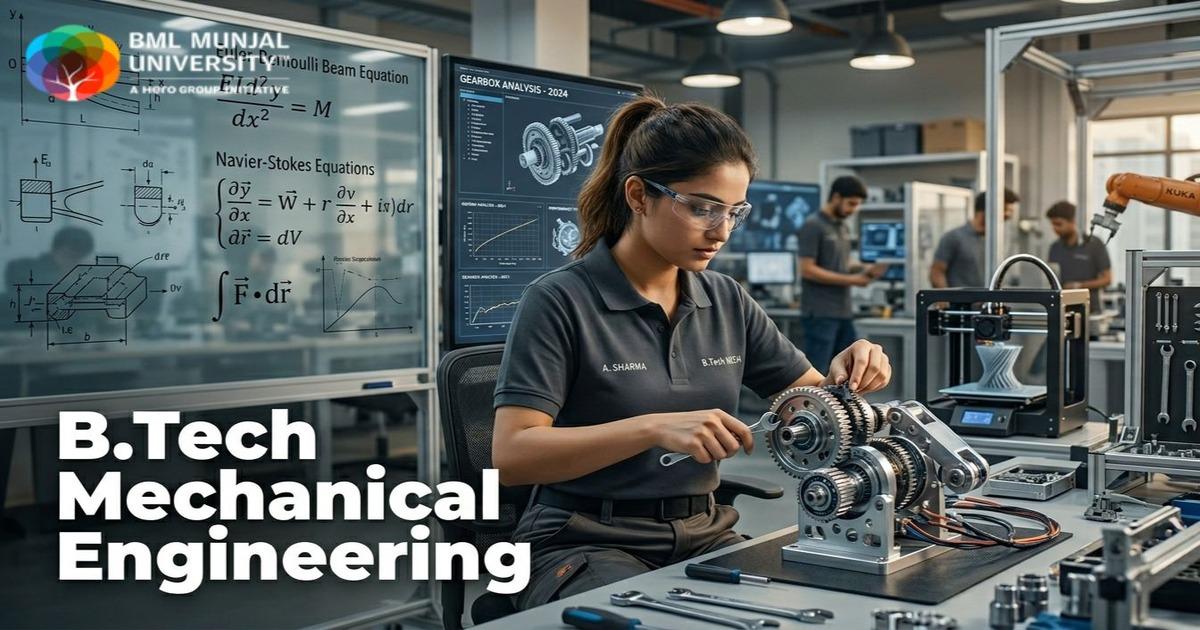
Mechanical Engineering is often seen as the “safe” option, something that’s been around for years, reliable and flexible enough to keep multiple career options open. And yes, that image isn’t completely wrong.
However, the problem is, many students end up choosing it without really understanding the course structure. So before you make the final decision, it’s worth taking a closer look at what four years of B.Tech. Mechanical Engineering actually involves.
The Subjects You'll Actually Study
The first year won't feel like Mechanical Engineering at all. Engineering maths, physics and basic drawing are shared with most other branches and give you very little taste of what's coming. That changes from the second year onwards, when the actual mechanical engineering courses start and the workload jumps with them.
People often think students spend all their time building and fixing machines. In reality, most of your time goes into understanding how those machines work, which means a lot of theory and equations before you get hands-on.
Here are the core mechanical engineering courses that make up the bulk of the degree:
Thermodynamics
Heat, energy and how engines convert one into the other. Tougher than it sounds and it sounds tough.
Fluid Mechanics
How liquids and gases behave under pressure. Shows up in everything from pipe design to aircraft wings.
Strength of Materials
How materials handle being pulled, pushed, twisted. You need this before designing any real component.
Machine Design
Where theory meets actual design, gears, shafts, bearings. This one is more satisfying than most.
Manufacturing Processes
Casting, welding, machining, how things are actually made in a factory, not just designed on paper.
Theory of Machines
Kinematics and dynamics of moving parts. How motion travels through linkages and mechanisms.
Heat Transfer
Conduction, convection, radiation. Connects directly to engine cooling, power plants and HVAC systems.
CAD / CAM
SolidWorks, AutoCAD, you'll spend real hours here. Design on screen before anything gets built.
Where Do Mechanical Engineering Graduates Go?
The job market after B.Tech. Mechanical Engineering is genuinely wide. Automobile companies, aerospace firms, oil and gas, defence manufacturing, industrial equipment, these are the obvious ones. But graduates also land in supply chain roles, production management and increasingly in robotics and automation as those industries grow.
A decent chunk go for M.Tech in specialisations like Thermal, Production or CAD/CAM if they want to go deeper into a specific area. Others do an MBA and shift toward operations or project management. The degree doesn't box you into one path, which is one thing it genuinely has going for it.
Is Mechanical Engineering the Right Fit for You?
Not everyone who picks mechanical engineering courses ends up enjoying it. The students who do tend to share a few things- they're curious about physical systems, they don't mind lab work alongside classroom theory and they're patient with subjects that take time to click. Thermodynamics and Strength of Materials are both subjects where you can work hard and still find the exam difficult. That's just the nature of them.
If you're the kind of person who looks at a running engine and wonders how it works or who gets interested in why a bridge is designed the way it is, Mechanical will hold your attention. If you chose it because the placements looked good and you didn't know what else to pick, the first two years are going to feel long. Not impossible, but long. Better to know that going in than to figure it out in semester three.

 Arabic
 Français
 Español
 Português
 Deutsch
 Türkçe
 Dutch
Dutch
 Italiano
 Russian
 Romaian