


The Mobile App Development Process: A Complete Stage-by-Stage Guide for Business Leaders
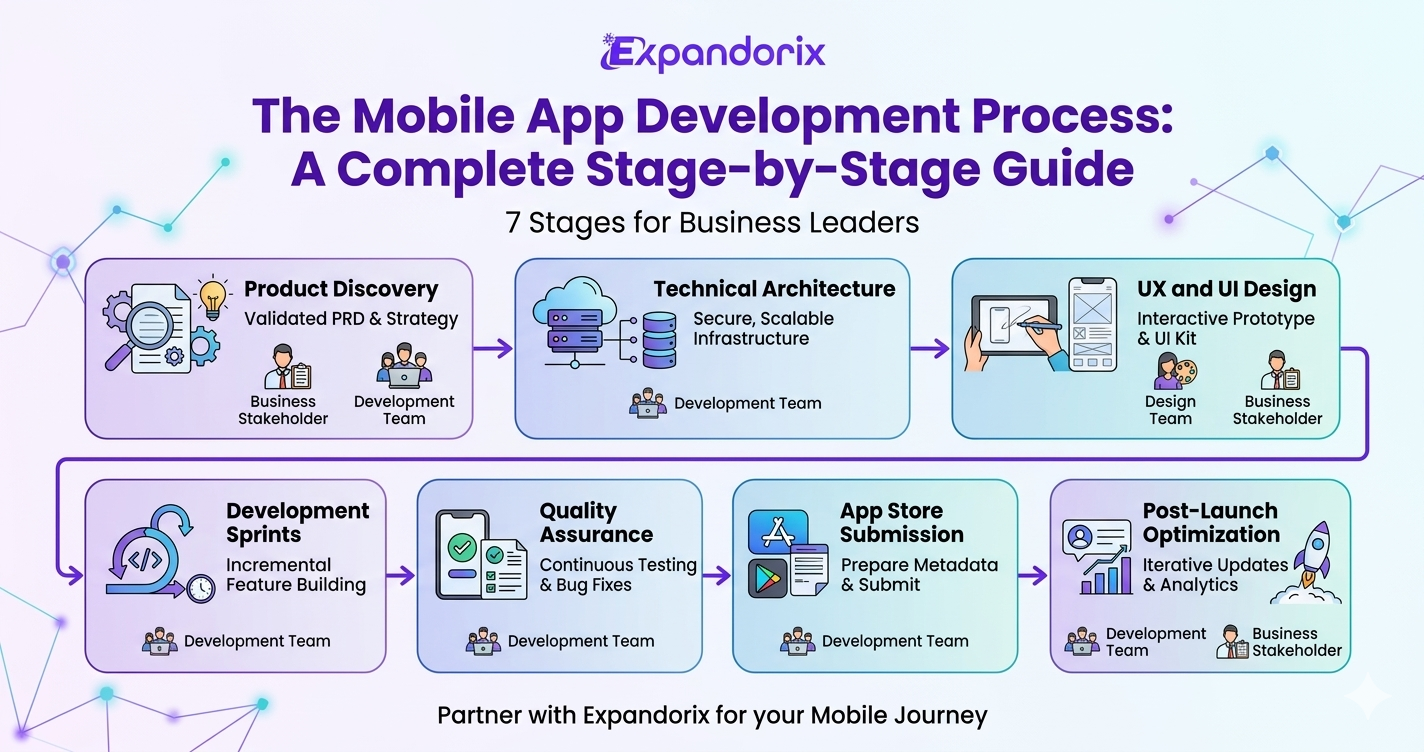
Mobile app development is frequently misunderstood by business leaders who are not themselves technologists. It is perceived either as a black box — a mysterious process that developers vanish into for several months before emerging with a finished product — or as a relatively straightforward exercise in translating a feature list into working software. Neither mental model is accurate, and both lead to the same outcome: misaligned expectations, budget overruns, missed deadlines, and products that do not achieve their intended business objectives.
The reality of professional mobile app development is that it is a complex, multi-disciplinary process involving strategic thinking, user research, design craft, engineering, quality assurance, and ongoing operational management. Understanding this process at a structural level — what happens in each stage, why it matters, and what your role as a business stakeholder should be — is one of the most valuable things you can do to improve the likelihood of your project's success. This guide provides that understanding in practical, accessible terms.
Stage One: Product Discovery and Requirements Definition
Every successful mobile app begins not with code but with clarity. The discovery stage is the process of establishing that clarity — translating a business vision into a detailed, validated, actionable product specification that the development team can build from with confidence. In a well-run project, discovery is treated as a genuine investment, not a box-checking exercise, because the decisions made in this stage determine the architecture of everything that follows.
Discovery begins with stakeholder alignment workshops. These structured sessions bring together every person whose requirements the app must satisfy — business owners, department heads, operations staff who will use the system daily, customer service teams who understand user pain points, and technical teams responsible for integrating the app with existing systems. The goal is to surface all requirements, identify conflicts between them, establish priorities, and build shared understanding of what the app must achieve.
User research runs in parallel with stakeholder workshops. If the app serves external users — customers, partners, members of the public — understanding those users is non-negotiable. User interviews, survey research, contextual observation sessions (watching people attempt to accomplish the tasks the app will support using current tools), and analysis of existing usage data all contribute to the development of validated user personas and journey maps. These artefacts are not academic exercises — they are the foundation on which every subsequent design and engineering decision is made.
Technical due diligence is also conducted during discovery. This involves assessing existing systems that the app must integrate with, identifying technical constraints (API documentation quality, authentication protocols, data schemas), evaluating security requirements, and making initial recommendations about technology stack and architecture. The output of technical due diligence is a technical specification that gives the development team sufficient context to estimate accurately and architect confidently.
The discovery stage concludes with the delivery of a Product Requirements Document (PRD) — a comprehensive specification covering user personas, user stories mapped to features, functional requirements, non-functional requirements (performance, security, accessibility), technical architecture overview, and success metrics. This document becomes the single source of truth for the entire project, reducing ambiguity and providing a clear basis for scope change discussions when requirements evolve.
Stage Two: Technical Architecture and System Design
Once the requirements are documented and validated, the development team designs the technical architecture that will support them. This stage happens largely behind the scenes — business stakeholders are not typically involved in the detailed decisions — but its quality has a profound impact on the long-term health of the product.
Technical architecture design covers several interconnected domains. Database architecture involves selecting the right data storage technologies (relational databases like PostgreSQL for structured, transactional data; NoSQL databases like MongoDB or Firebase for flexible, unstructured data; caching layers like Redis for high-speed read operations) and designing the schema — the structure of the data — to support the app's query patterns efficiently. Poor database design is one of the most common causes of performance problems that emerge at scale.
API design covers the contracts between the mobile app and the backend services — the specific requests the app can make, the data structures it receives in response, and the authentication mechanisms that protect these interactions. Well-designed APIs are modular, versioned, and documented, making it easier to evolve the backend independently of the mobile client and to integrate third-party services without coupling them tightly to the core application logic.
Infrastructure design involves selecting the cloud platform (AWS, Google Cloud, Azure), designing the deployment architecture (containerised microservices, serverless functions, or traditional server infrastructure), configuring auto-scaling policies, setting up content delivery networks for global performance, and establishing monitoring, alerting, and logging systems. These decisions have direct implications for the app's performance, reliability, and operational cost at scale.
Stage Three: UX and UI Design
Design and development ideally proceed in parallel, with design always slightly ahead — providing a rolling horizon of validated, approved designs for the development team to implement. The design process itself has a clear internal sequence that should not be compressed or skipped.
Information architecture is the first design activity: mapping all the screens in the application, the navigation flows between them, and the hierarchy of information within each screen. This work is done in simple, un-styled form — often as a site map diagram or a flow chart — because the goal is to validate the structure and completeness of the navigation system without being distracted by visual details. Mistakes in information architecture are cheap to fix at this stage and extremely expensive to fix after the interface has been designed and built.
Wireframing translates the information architecture into low-fidelity screen representations that show the layout, content hierarchy, and interactive elements of each screen without specifying visual design. Wireframes are reviewed with stakeholders and — for consumer-facing apps — tested with representative users to validate that the proposed interaction patterns match users' mental models and task expectations. Multiple rounds of wireframe iteration are normal and healthy; each iteration improves the fundamental usability of the product.
High-fidelity design transforms wireframes into fully specified visual mockups: typography (typeface, size, weight, colour, line height), colour palette (primary, secondary, accent, neutral, semantic colours for success, warning, and error states), spacing and grid system, iconography, illustration style, photography treatment, motion design language (how elements animate and transition), and component specifications for every UI element in the app. This visual layer is not just aesthetic — it encodes brand personality, communicates hierarchy and affordance, and shapes the emotional register of the user experience.
The design process culminates in the creation of an interactive prototype — a clickable simulation of the final app built in a design tool like Figma. This prototype is used for usability testing (placing it in front of real users and observing them attempting to complete key tasks), stakeholder alignment (allowing decision-makers to experience the product before it is built), and developer handoff (providing engineers with a living specification they can reference throughout development).
Stage Four: Development Sprints
With architecture designed and initial screens ready for implementation, development begins in earnest. Modern development teams use Agile methodology, organising work into sprints — time-boxed iterations of typically two weeks in which the team commits to delivering a specific set of features in working, tested form.
Each sprint begins with a planning session in which the team selects stories from the product backlog (the prioritised list of all features to be built), estimates the effort required, and commits to a sprint goal. During the sprint, developers build, unit test, and integrate features, with daily standup meetings providing a brief daily synchronisation on progress, blockers, and coordination needs. At the end of the sprint, the team conducts a sprint review — a demonstration of the working software completed during the sprint — and a retrospective to identify process improvements for the next sprint.
For business stakeholders, sprint reviews are the primary mechanism for maintaining visibility into project progress and providing feedback. A working demonstration of real software every two weeks is far more informative than a progress report, because it reveals not just what has been built but how it actually works — and sometimes surfaces misunderstandings about requirements that are much cheaper to correct at this stage than after several more sprints of development.
Backend and frontend development typically proceed in parallel, coordinated through the agreed API contracts. Frontend developers build screens against a mock API that returns realistic test data, while backend developers implement the actual business logic and data persistence. This parallel approach maximises development velocity by preventing the frontend team from being blocked on backend readiness. API integration — replacing mock responses with real backend calls — happens progressively as backend features become ready.
Stage Five: Quality Assurance
Quality assurance is a continuous practice, not a final gate. From the first sprint, automated unit tests are written alongside application code, providing a safety net that catches regressions as the codebase grows. Integration tests validate that components work correctly together. Automated end-to-end tests simulate complete user flows through the application, catching issues that unit tests miss because they test the system as a whole rather than its parts in isolation.
In the final weeks before launch, a dedicated QA phase runs a comprehensive suite of manual and automated tests designed to validate the app's readiness for production. This includes functional testing of every feature against the requirements in the PRD; regression testing to ensure that recent changes have not broken existing functionality; performance testing under realistic load conditions to verify that the app performs acceptably with the number of concurrent users expected at launch and at projected scale; security testing, including penetration testing by specialist security professionals; accessibility testing against WCAG 2.1 guidelines; and cross-device compatibility testing across a representative matrix of devices, screen sizes, and operating system versions.
Stage Six: App Store Submission and Launch
Preparing an app for app store submission involves more work than most business stakeholders expect. Both Apple's App Store and Google's Play Store require extensive metadata: the app's name, subtitle, and description (carefully optimised for discoverability); screenshots and preview videos for each supported device size; a privacy policy URL; an age rating questionnaire; content advisory information; and, for apps with in-app purchases or subscriptions, detailed product descriptions and pricing configurations.
Apple's review process is more stringent than Google's and can take one to seven business days. Common rejection reasons include crashes and bugs discovered during Apple's testing, insufficient description of features that require privacy permissions, inaccurate or misleading metadata, and violations of App Store guidelines around in-app purchase implementation. An experienced development team anticipates these issues and addresses them before submission, minimising rejection cycles.
Launch strategy matters as much as submission mechanics. A staged rollout — releasing to a small percentage of users first and monitoring crash rates and engagement metrics before expanding to the full user base — is strongly advisable for complex apps. It limits the blast radius of any issues that escaped QA testing under real-world usage conditions.
Stage Seven: Post-Launch Optimisation and Ongoing Development
The work of building a great mobile app does not end at launch — it intensifies. The first weeks and months after launch are the most data-rich period in the product's life, as real user behaviour generates insights that no amount of pre-launch testing could have produced. Crash reporting tools (Firebase Crashlytics, Sentry) surface technical issues that need immediate attention. Analytics platforms (Firebase Analytics, Amplitude, Mixpanel) reveal which features are being used, which are being ignored, and where users are dropping off in key flows. User reviews in the app stores provide qualitative feedback that complements the quantitative signal from analytics.
Iterating on this data — prioritising the most impactful improvements, designing solutions, building and testing them, and releasing updates on a regular cadence — is what transforms a good launch into a great product. The best mobile app development company offer structured post-launch support retainers that ensure continuity of the development team's context and provide the capacity for rapid iteration in the critical post-launch period.
Conclusion
The mobile app development process is a complex, multi-stage discipline that rewards thoroughness at every step. Business leaders who understand this process are better positioned to set realistic expectations, make informed decisions when trade-offs arise, maintain productive relationships with their development partners, and ultimately build products that achieve their intended objectives. The investment in process understanding pays dividends throughout the project — and in the quality of the product that emerges from it.

 English
 Arabic
 Français
 Português
 Deutsch
 Türkçe
 Dutch
Dutch
 Italiano
 Russian
 Romaian