


Emergency Orthopedics: How Seasons, Weather, and Trends Drive Injury Patterns
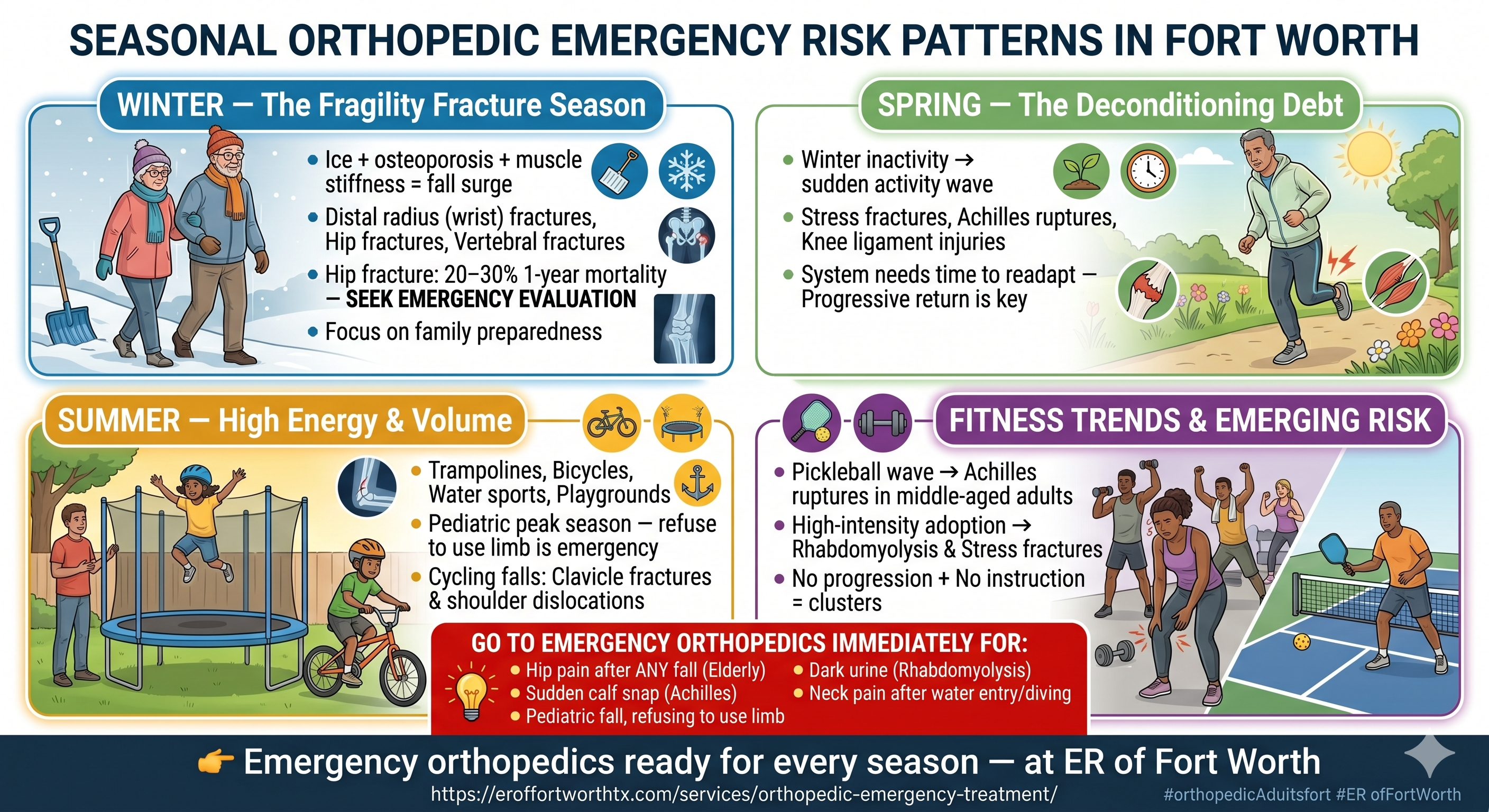
Emergency Orthopedics: How Seasons, Weather, and Trends Drive Injury Patterns
There is a predictable rhythm to emergency orthopedics that most patients never notice — but that experienced emergency physicians observe clearly across every year of their clinical practice. Certain injuries surge in specific months. Certain weather patterns produce specific fracture types. Certain fitness trends generate characteristic injury presentations that appear in emergency rooms in waves — following the adoption curve of each new training modality, recreational activity, or sporting season that captures the public's attention and draws people into physical activities their musculoskeletal systems are not prepared for.
Understanding this rhythm — the seasonal, meteorological, and cultural forces that drive orthopedic emergency presentations — is not simply an interesting epidemiological observation. It is practically valuable knowledge that helps individuals anticipate their elevated risk periods, prepare their musculoskeletal systems appropriately, and recognize the injury warning signs most relevant to their specific activities at the specific times of year when those activities produce the highest emergency burden.
The Seasonal Architecture of Orthopedic Emergency Presentations
Emergency orthopedic physicians experience the year not as a uniform clinical landscape but as a sequence of distinct injury seasons — each characterized by a specific constellation of presenting conditions, specific patient demographics, and specific clinical challenges that reflect the outdoor activities, sporting seasons, and environmental conditions that define each period of the calendar year.
This seasonal architecture is not random. It is the direct clinical expression of the activities people engage in, the environments they navigate, and the physiological demands they place on their musculoskeletal systems at different times of year. Understanding it allows both clinicians and patients to anticipate the orthopedic emergency presentations most likely to be encountered in each season — and to prepare for them with the specific clinical knowledge and individual preventive awareness that each season demands.
4 Seasonal and Trend-Driven Forces Shaping Emergency Orthopedic Presentations
1. Winter — Ice, Snow, and the Fragility Fracture Season
Winter represents the peak season for a specific and clinically significant category of orthopedic emergency — the fragility fracture sustained by elderly adults on icy or snow-covered surfaces. The combination of reduced environmental traction, reduced daylight limiting visibility of hazardous surface conditions, cold-induced muscle stiffness that reduces protective neuromuscular response speed, and the structural bone vulnerability that accompanies aging and osteoporosis creates a perfect physiological and environmental storm for fall-related fractures that peaks in the winter months across every climate that experiences ice and snow.
Distal radius fractures — the classic Colles fracture resulting from a fall on an outstretched hand — surge dramatically in winter months as people instinctively extend their arms to break a fall on icy surfaces. Hip fractures — the most clinically serious fragility fracture category, carrying a one-year mortality of 20 to 30% in elderly patients — follow a similar winter seasonal pattern, driven by the same environmental hazards and the same age-related structural vulnerability. Vertebral compression fractures — often occurring without a discrete fall event, simply from the compressive loading of daily activities on severely osteoporotic bone — are encountered year-round but cluster in winter when cold-induced muscle splinting increases axial spinal loading.
For families with elderly members, winter represents the highest-risk period for emergency orthopedics presentations — and the season during which the identification of the right emergency orthopedic facility, the preparation of a medical information summary, and the establishment of a clear emergency response plan are most urgently needed. The environmental hazards of winter are largely uncontrollable. The preparedness of the family response is entirely within your control.
2. Spring — The Deconditioning Debt Comes Due
Spring represents a different but equally predictable surge in emergency orthopedics presentations — one driven not by environmental hazard but by the physiological consequence of winter deconditioning meeting the sudden resumption of high-demand physical activity. The pattern is consistent and clinically familiar to every emergency orthopedic physician who has practiced through multiple annual cycles.
Winter reduces outdoor activity for a significant proportion of the population — people walk less, run less, cycle less, and engage in less recreational sport. The musculoskeletal system responds to this reduced demand by downregulating the adaptive processes that maintain bone density, tendon stiffness, muscular strength, and neuromuscular coordination at activity-appropriate levels. Bone mineral density decreases modestly. Tendon mechanical properties change in response to reduced loading. Muscular strength and endurance decline. Proprioceptive acuity — the joint position sense that enables dynamic stability during athletic movement — diminishes.
Spring then arrives, and with it the motivation to return to outdoor running, recreational sports, gardening, and the full range of physically demanding activities that winter had curtailed. This return to activity is frequently abrupt — not a gradual, progressive reintroduction of physical demand that gives the deconditioned musculoskeletal system time to readapt, but a sudden resumption of pre-winter activity levels that places loading demands on a system whose adaptive capacity has been reduced by months of relative inactivity.
The clinical consequences present in emergency orthopedics facilities throughout spring — acute stress fractures in runners who returned to full mileage without a rebuilding phase, Achilles tendon injuries in recreational athletes whose tendons lost stiffness during winter deconditioning, acute muscle tears in middle-aged adults resuming garden work with physical demands their deconditioned muscles cannot safely meet, and knee ligament injuries in recreational athletes whose proprioceptive deficits from winter inactivity compromised the dynamic joint stability that protects against acute ligamentous injury.
3. Summer — High Energy, High Impact, and the Pediatric Orthopedic Surge
Summer brings the highest overall volume of emergency orthopedics presentations across virtually every demographic — driven by the combination of increased outdoor activity, recreational sports participation, travel to unfamiliar physical environments, and the dramatic surge in pediatric orthopedic injuries that accompanies the school vacation period when children spend extended periods in physically demanding, minimally supervised recreational environments.
Pediatric orthopedic injuries surge dramatically in summer — and their character reflects the specific activities of summer recreation. Trampoline injuries — responsible for a disproportionate number of pediatric fractures and growth plate injuries relative to the time spent on the activity — peak in summer when trampolines are in constant outdoor use. Playground injuries, bicycle accidents, skateboard falls, swimming pool injuries, and the full range of childhood recreational trauma all reach their annual peak during the summer months.
For adult recreational athletes, summer represents the peak season for cycling injuries — including clavicle fractures, humeral fractures, and road rash with underlying soft tissue injuries from falls — and for water sports injuries including cervical spine injuries from shallow water diving, shoulder dislocations from water skiing falls, and ankle fractures from paddleboarding and surfing. Each of these injury categories has specific emergency management requirements that a quality emergency orthopedics facility is equipped to address — and that a general urgent care center or unprepared emergency facility may not be.
Summer travel introduces an additional orthopedic emergency risk factor that is frequently overlooked — the unfamiliar physical environment. Hiking trails with uneven terrain, beach environments with unstable sandy surfaces, water parks with running-prohibited surfaces that people run on anyway, and the general physical adventurousness that vacation settings encourage all create orthopedic injury opportunities that people encounter without the environmental familiarity that normally moderates their risk. For patients who want to understand what the emergency evaluation process looks like for the orthopedic injuries most common in summer recreational settings — including the imaging studies that are central to accurate diagnosis — this resource from ER of Fort Worth on emergency orthopedics and seasonal injury patterns is an excellent preparation guide.
4. Fitness Trends — How Cultural Adoption of New Activities Creates Emergency Orthopedic Waves
Beyond seasonal patterns, emergency orthopedics physicians observe a distinct phenomenon driven not by weather or calendar but by cultural trends in fitness and recreation — the wave of characteristic injury presentations that follows the mass adoption of each new exercise modality, sporting activity, or recreational trend that captures the public's enthusiasm.
The pattern is remarkably consistent across different trends and different time periods. A new exercise modality gains cultural momentum — driven by social media, celebrity endorsement, or mainstream media coverage. A large number of people adopt the activity simultaneously — often without appropriate progression, without qualified instruction, and without understanding the specific injury risks associated with the activity. A wave of characteristic injuries begins appearing in emergency orthopedic facilities — injuries that reflect the specific biomechanical demands and failure modes of the new activity — peaking several months after the adoption surge as the cumulative training load and technique errors of new participants generate their inevitable clinical consequences.
Pickleball — one of the fastest-growing recreational sports in the United States — has generated a characteristic wave of orthopedic emergency presentations dominated by Achilles tendon ruptures in middle-aged and older adults whose tendons are unprepared for the explosive lateral movement demands of the sport, ankle fractures from the rapid directional changes on hard court surfaces, and shoulder injuries from the overhead and sidearm striking mechanics that the sport demands. High-intensity interval training and functional fitness modalities have generated characteristic waves of rhabdomyolysis — the breakdown of muscle tissue from extreme loading — along with acute tendon injuries and stress fractures in participants who progress too aggressively without adequate recovery.
Understanding the specific orthopedic emergency risks associated with your current fitness activities — and the warning signs that indicate those specific risks are materializing — is the most practically valuable application of this trend-driven injury pattern awareness.
Seasonal and Trend-Specific Warning Signs That Demand Emergency Orthopedic Care
Winter — fragility fracture warning signs:
- Hip pain and inability to bear weight following any fall — regardless of perceived fall severity
- Wrist pain and deformity following a fall on an outstretched hand
- Back pain following any minor trauma in a patient with known or suspected osteoporosis
- Any fall in an elderly patient where loss of consciousness preceded the fall — cardiac cause must be excluded
Spring — deconditioning injury warning signs:
- Localized bone pain that worsens with continued activity and improves with rest — stress fracture pattern
- Sudden severe calf pain during running with inability to push off — possible Achilles rupture
- Acute muscle pain following first significant exertion of the season with dark urine — possible rhabdomyolysis
- Knee swelling developing within hours of recreational sport return — intra-articular injury
Summer — recreational and pediatric injury warning signs:
- Any pediatric fall from playground equipment with refusal to use the affected limb
- Cyclist fall with shoulder pain and visible deformity — clavicle fracture or shoulder dislocation
- Any neck pain or neurological symptom following a water entry or diving injury
- Ankle pain following a water sports fall with inability to bear weight
Fitness trend — new activity warning signs:
- Calf tightness progressing to sudden snap during court sport — Achilles tendon rupture
- Muscle soreness disproportionate to exercise performed with dark or tea-colored urine — rhabdomyolysis
- Localized pain over a specific bone during or after training that worsens progressively — stress fracture
- Shoulder pain during overhead movement that is progressively worsening across consecutive training sessions
ER of Fort Worth — Emergency Orthopedics Ready for Every Season and Every Trend
At ER of Fort Worth, emergency orthopedics care is delivered by a team that understands the seasonal, meteorological, and trend-driven forces that shape orthopedic injury patterns across the Fort Worth community. From the winter fragility fracture surge to the spring deconditioning injury wave, from the summer pediatric orthopedic peak to the fitness trend-driven injury presentations that appear in characteristic clusters — the emergency physicians at ER of Fort Worth are equipped with the clinical knowledge, diagnostic infrastructure, and specialist access to manage every orthopedic emergency presentation with the expertise it demands.
Explore the full range of emergency services available at ER of Fort Worth — and discover why Fort Worth families trust this team for orthopedic emergency care that is always ready for whatever the season brings.
Because orthopedic emergencies follow patterns. The best emergency orthopedic teams follow them too — and stay one step ahead.
Orthopedic injury this season? Don't wait. Visit ER of Fort Worth — emergency orthopedics ready for every season, every trend, every patient, 24 hours a day.

 English
 Arabic
 Français
 Español
 Português
 Deutsch
 Türkçe
 Dutch
Dutch
 Italiano
 Romaian