


When Routine Injuries Become Emergencies: The Systemic Health Conditions That Change Everything
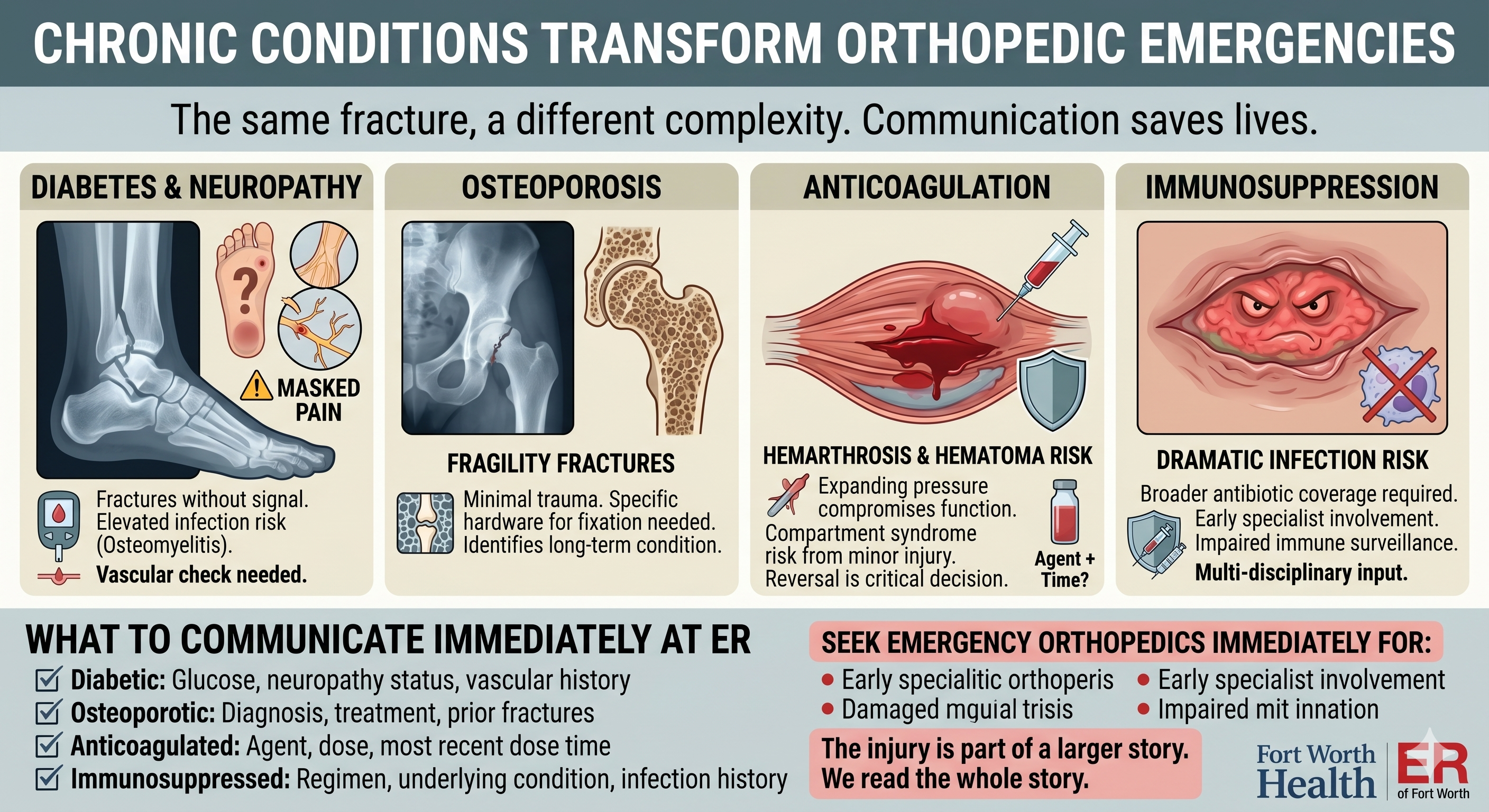
There is a clinical reality in emergency orthopedics that experienced emergency physicians understand clearly but that patients and families rarely appreciate until it affects them directly — the reality that the severity of an orthopedic injury is not determined solely by the mechanism of trauma or the structural damage to the bone, joint, or soft tissue involved. It is determined by the interaction between the injury and the systemic health conditions of the person who sustained it — conditions that can transform what would be a straightforward, conservatively managed orthopedic injury in a healthy adult into a complex, potentially life-threatening orthopedic emergency that demands immediate, sophisticated clinical management.
Understanding which systemic health conditions most significantly modify orthopedic emergency presentations — and how they change the clinical assessment, treatment decisions, and outcome expectations for affected patients — is knowledge that every person managing a chronic health condition, and every family member or caregiver who supports them, deserves to have.
The Systemic-Orthopedic Intersection — Why the Whole Patient Changes the Injury
The traditional model of orthopedic injury assessment — evaluate the mechanism, examine the injured structure, obtain imaging, determine the extent of structural damage, initiate appropriate management — works reasonably well for healthy adults without significant comorbidities. But this model becomes inadequate when the patient has systemic health conditions that alter bone quality, impair wound healing, compromise immune defense, affect coagulation, modify pain perception, or reduce the physiological reserve available to respond to the stress of significant injury and its treatment.
In each of these circumstances, the structural injury that presents in the emergency room is the visible, acute component of a clinical picture whose complexity is determined as much by the systemic conditions operating in the background as by the acute injury in the foreground. Quality emergency orthopedics recognizes this complexity from the first clinical interaction — incorporating the systemic health assessment into the orthopedic injury evaluation in ways that produce more accurate risk stratification, more appropriate treatment selection, and more realistic outcome expectations for every patient whose systemic health conditions modify their orthopedic emergency.
4 Systemic Health Conditions That Transform Orthopedic Injuries Into Complex Emergencies
1. Diabetes — When Impaired Healing Turns Every Orthopedic Injury Into a High-Stakes Event
Diabetes mellitus — affecting more than 37 million Americans and representing one of the most common chronic conditions in the Fort Worth population that emergency orthopedics facilities serve — modifies orthopedic injury management in ways that elevate the clinical complexity and the potential consequences of injuries that would be routine in non-diabetic patients.
The mechanisms through which diabetes complicates orthopedic emergency care are multiple and intersecting. Diabetic peripheral neuropathy — the progressive loss of sensory function in the distal extremities that accompanies poorly controlled diabetes — impairs the pain perception that normally serves as the earliest warning signal of orthopedic injury. Diabetic patients with significant peripheral neuropathy may sustain serious foot and ankle injuries — including fractures and dislocations — without the pain response that would prompt immediate emergency evaluation in a patient with intact sensation, presenting instead when the injury has progressed to the point where structural consequences and skin breakdown are visible.
Diabetic peripheral vascular disease — the accelerated atherosclerosis that affects the small and medium vessels supplying the distal extremities — significantly impairs the tissue perfusion that wound healing, fracture repair, and the resolution of soft tissue swelling around orthopedic injuries requires. A diabetic patient with significant peripheral vascular disease who sustains a foot fracture has a wound healing environment that is functionally impoverished — with inadequate oxygen delivery and immune cell trafficking to the injured tissue that dramatically increases the risk of wound complications, deep tissue infection, and the osteomyelitis that represents the most serious infectious complication of orthopedic injury in diabetic patients.
The specific emergency orthopedics assessment modifications required for diabetic patients include comprehensive neurovascular evaluation that explicitly assesses sensory deficits and peripheral pulses — because the clinical signs of serious injury may be attenuated by neuropathy and the vascular reserve available for healing may be compromised by peripheral arterial disease. Wound care for open injuries requires more aggressive initial management in diabetic patients — because the infection risk that would be modest in a non-diabetic patient is substantially elevated in the context of impaired immune function and reduced tissue perfusion.
2. Osteoporosis — When the Bone Fails Before the Trauma Justifies It
Osteoporosis — the progressive reduction in bone mineral density that accompanies aging, hormonal changes, certain medications, and specific chronic disease states — is responsible for one of the most clinically challenging categories of orthopedic emergency presentations: the fragility fracture that occurs at loading levels that would not injure normal bone and that produces a clinical picture whose severity seems disproportionate to the mechanism of injury until the underlying bone quality deficit is considered.
The fragility fractures that osteoporosis produces — hip fractures from standing-height falls, vertebral compression fractures from minimal trauma, distal radius fractures from low-energy falls on outstretched hands — represent emergency presentations where the structural failure visible on imaging reflects the accumulated deficit of years of bone loss rather than the acute trauma that provided the final increment of loading that exceeded the bone's reduced structural capacity.
For emergency orthopedics teams managing fragility fractures, the osteoporosis diagnosis transforms several specific clinical decisions. Surgical fixation of osteoporotic fractures requires different implant selection and surgical technique than fixation of the same fractures in normal bone — because the reduced mechanical strength of osteoporotic bone cannot provide the same implant purchase that standard fixation hardware requires, and surgical planning must account for this reduced bone quality from the outset. The anesthetic and perioperative medical management of elderly patients with fragility fractures — who frequently have the cardiac, pulmonary, and renal comorbidities that accompany the age-related conditions producing their bone loss — requires medical optimization that significantly influences both operative timing and anesthetic technique.
Beyond the acute fracture management, the osteoporosis diagnosis that a fragility fracture reveals — if it was not previously known — represents a major clinical finding that changes the patient's long-term health management in ways that the emergency orthopedics team is positioned to initiate by ensuring that the diagnosis is communicated clearly in the discharge documentation and that the specialist referral for osteoporosis management is confirmed as part of the discharge plan.
3. Anticoagulation Therapy — When Blood-Thinning Creates Orthopedic Emergencies
The millions of patients taking anticoagulant medications — warfarin, direct oral anticoagulants, and antiplatelet agents — for cardiovascular indications including atrial fibrillation, deep vein thrombosis, pulmonary embolism, and mechanical heart valves represent a patient population whose orthopedic emergency presentations carry specific clinical risks that are directly related to their pharmacologically impaired coagulation system.
The most immediately serious clinical consequence of anticoagulation in the orthopedic emergency context is the potential for hemorrhagic complications that are significantly more severe than the same injuries would produce in patients with normal coagulation. A joint dislocation or periarticular fracture that would produce a self-limiting hemarthrosis in a normally coagulating patient can produce a rapidly expanding joint hematoma of sufficient pressure to compromise neurovascular function in an anticoagulated patient. A muscular injury that would produce localized bruising in a normal patient can produce an expanding intramuscular hematoma of sufficient volume to cause compartment syndrome in an anticoagulated patient.
The specific emergency orthopedics assessment and management modifications required for anticoagulated patients begin with the immediate documentation of the specific anticoagulant agent, the current dose, the most recent dose time, and the most recent coagulation monitoring result — information that directly determines the urgency of reversal decisions and the feasibility of surgical intervention if it is indicated. For anticoagulated patients with injuries that carry significant hemorrhagic risk — particularly head injuries where intracranial bleeding is a concern and hemarthroses where joint pressure is compromising neurovascular function — the reversal decision must be made rapidly and in the context of the specific clinical risk-benefit calculation that weighs the thrombotic risk of reversal against the hemorrhagic risk of continued anticoagulation.
4. Immunosuppression — When Infection Risk Changes the Entire Management Algorithm
Patients on immunosuppressive medications — organ transplant recipients, patients with autoimmune conditions treated with biological agents or corticosteroids, patients receiving chemotherapy, and patients with conditions including HIV and hematological malignancy that produce immune compromise through disease mechanisms — present to emergency orthopedics with a clinical risk profile that is fundamentally modified by the impairment of the immune surveillance that normally protects against the infectious complications of orthopedic injury.
The most clinically significant consequence of immunosuppression in the orthopedic emergency context is the dramatically elevated risk of septic arthritis — bacterial infection inside a joint — and osteomyelitis — bacterial infection of bone — from mechanisms that would not produce infection in immunocompetent patients. An open fracture that would be managed with standard irrigation, debridement, and antibiotic prophylaxis in a healthy patient requires more aggressive infectious management in an immunosuppressed patient — with broader-spectrum antibiotic coverage, lower threshold for repeat debridement, and earlier specialist involvement for assessment of antibiotic adequacy.
The timing and specific regimen of antibiotic prophylaxis for orthopedic procedures in immunosuppressed patients requires careful consideration of the specific immunosuppressive regimen, the organisms most likely to cause infection in the specific immune deficit present, and the interaction between the proposed antibiotics and the patient's existing medication regimen — a clinical calculation that requires the kind of multidisciplinary input that quality emergency orthopedics facilities are equipped to provide through specialist consultation pathways that activate from the earliest stages of the evaluation. For patients who want to understand how systemic health conditions are incorporated into the emergency orthopedic evaluation — including the imaging and diagnostic processes that characterize the full clinical picture — this resource from ER of Fort Worth on emergency orthopedics and the systemic health factors that shape orthopedic emergency management provides an excellent and genuinely informative patient-centered guide.
How to Communicate Your Systemic Health History in an Orthopedic Emergency
When presenting to emergency orthopedics with any significant injury, the following systemic health information directly shapes your care and should be communicated to the clinical team immediately:
For diabetic patients:
- Current glucose control — HbA1c if known, recent blood glucose readings
- Presence and severity of peripheral neuropathy — any areas of reduced sensation
- Peripheral vascular disease — any previous bypass surgery, claudication, or non-healing wounds
- Insulin and medication regimen — particularly relevant for perioperative management
For patients with osteoporosis:
- Confirmed diagnosis and current treatment — bisphosphonates, denosumab, or other bone-modifying agents
- History of previous fragility fractures — location and management
- Vitamin D and calcium supplementation status
- Steroid use history — systemic corticosteroids are a major secondary osteoporosis cause
For anticoagulated patients:
- Specific anticoagulant agent and dose
- Most recent dose time
- Indication for anticoagulation — determines reversal risk-benefit calculation
- Most recent INR if on warfarin
For immunosuppressed patients:
- Specific immunosuppressive regimen and doses
- Underlying condition producing immune compromise
- History of previous opportunistic infections
- Current white blood cell count if recently measured
Orthopedic Emergency Warning Signs That Require Immediate Care — Especially With Systemic Conditions
Seek emergency orthopedics care immediately for:
- Any fracture in a patient with diabetes — particularly foot and ankle injuries where neuropathy may have masked the severity
- Any fall with hip pain and inability to bear weight in a patient with osteoporosis
- Rapidly expanding hematoma or joint swelling in an anticoagulated patient following any injury
- Open wound near a bone or joint in an immunosuppressed patient — infection risk is dramatically elevated
- Disproportionate pain following any injury in a patient on corticosteroids — pain may be attenuated by steroid anti-inflammatory effects
ER of Fort Worth — Emergency Orthopedics That Sees the Whole Patient
At ER of Fort Worth, emergency orthopedics care is delivered with the systemic health awareness that transforms adequate orthopedic emergency management into genuinely excellent orthopedic emergency management. From the diabetic patient whose neuropathy requires explicit sensory assessment to the anticoagulated patient whose hemorrhagic risk requires immediate coagulation management — and from the osteoporotic patient whose fragility fracture requires implant planning that accounts for reduced bone quality to the immunosuppressed patient whose infection risk demands aggressive prophylaxis — the team at ER of Fort Worth delivers orthopedic emergency care that sees the whole patient behind every injury.
Explore the full range of emergency services available at ER of Fort Worth — and discover why Fort Worth families with every combination of systemic health conditions and orthopedic emergencies trust this team to deliver care that is always calibrated to the complete clinical picture.
Because the injury is always part of a larger story. The best emergency orthopedics teams read the whole story.
Orthopedic injury with a complex health history? Visit ER of Fort Worth — emergency orthopedics that sees the whole patient, available 24 hours a day.

 English
 Arabic
 Français
 Español
 Português
 Deutsch
 Türkçe
 Dutch
Dutch
 Russian
 Romaian