


High-Performance Simulink System Modeling
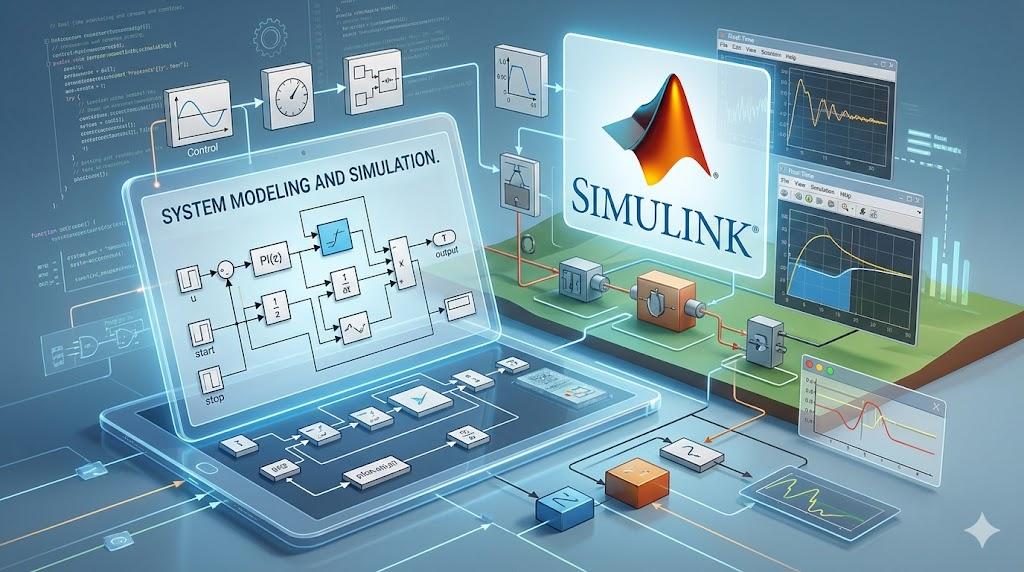
Simulink System Modeling
Simulink system modeling is a powerful approach used for designing, simulating, analyzing, and testing dynamic systems through a graphical environment. It enables engineers and developers to represent complex systems using interconnected blocks instead of traditional text-based programming. Widely adopted across industries such as automotive, aerospace, robotics, telecommunications, industrial automation, and energy systems, Simulink helps organizations accelerate development while improving system accuracy and reliability.
Simulink operates as an extension of MATLAB and provides an interactive platform where mathematical models, control logic, signal processing algorithms, and physical system behaviors can be created visually. Engineers can drag and drop predefined functional blocks, connect them with signal lines, and simulate real-world system behavior under varying operating conditions. This graphical modeling approach simplifies the development process, especially for multidisciplinary engineering teams.
One of the major advantages of Simulink system modeling is its ability to support Model-Based Design (MBD). In traditional development methods, design, coding, and testing are performed separately, which can increase development time and introduce integration issues. Simulink enables a unified workflow where system models serve as the central source throughout development. Engineers can simulate system behavior early in the design phase, validate requirements, detect errors sooner, and reduce costly redesigns later in the project lifecycle.
Simulink system modeling is extensively used for control system development. Engineers can model controllers such as PID controllers, state-space systems, adaptive control systems, and advanced algorithms for real-time applications. These models can be tested against virtual plant models to evaluate system response, stability, and performance before hardware implementation. This capability significantly reduces risks associated with physical prototyping and testing.
Another important feature of Simulink is multi-domain system modeling. Modern engineering systems often combine mechanical, electrical, hydraulic, thermal, and software components. Simulink integrates with specialized toolboxes and libraries that allow users to model these diverse domains within a single simulation environment. This integrated modeling capability is particularly valuable in industries developing electric vehicles, autonomous systems, renewable energy systems, and smart manufacturing solutions.
Simulation plays a central role in Simulink system modeling. Users can run simulations under different operating scenarios to analyze system behavior, identify bottlenecks, and optimize performance. Simulation results are displayed through scopes, dashboards, plots, and data visualization tools, helping engineers understand dynamic responses in real time. Engineers can also perform parameter tuning, sensitivity analysis, and fault condition testing to improve system robustness.
One of the key strengths of Simulink is automatic code generation. Using tools such as Simulink Coder and Embedded Coder, developers can automatically generate optimized C, C++, or HDL code directly from validated models. This reduces manual coding effort, minimizes human errors, and ensures consistency between design and implementation. Automatically generated code can be deployed to embedded processors, microcontrollers, FPGAs, and real-time systems, enabling faster deployment of production-ready applications.
Simulink also supports Hardware-in-the-Loop (HIL) and Software-in-the-Loop (SIL) testing methodologies. These testing approaches allow engineers to validate software and control algorithms within simulated environments before integrating with physical hardware. HIL testing is especially important for safety-critical industries such as automotive and aerospace, where system reliability and compliance are essential. By simulating real-world operating conditions, organizations can improve product quality while reducing testing costs and development risks.
Collaboration is another major benefit of Simulink system modeling. Large engineering projects often involve teams working across multiple disciplines and locations. Simulink models provide a common visual language that improves communication between software developers, control engineers, system architects, and project managers. Version control, model comparison, requirement traceability, and documentation features further support efficient collaboration and project management.
In the automotive industry, Simulink system modeling is widely used for developing advanced driver assistance systems (ADAS), electric powertrain systems, battery management systems, engine control units, and autonomous driving technologies. Aerospace companies use Simulink for flight control systems, navigation systems, and mission-critical simulations. Industrial automation organizations use it for robotics, process control, predictive maintenance, and digital twin applications.
Educational institutions also use Simulink extensively for teaching engineering concepts. Students can visualize mathematical models, simulate physical systems, and experiment with control strategies interactively. This hands-on learning approach improves understanding of complex engineering principles and prepares students for industry practices.
Despite its advantages, successful Simulink system modeling requires proper model architecture, validation strategies, and simulation management. Engineers must ensure that models remain scalable, modular, and maintainable as system complexity increases. Adopting industry standards, reusable libraries, and structured development practices helps organizations maximize the benefits of model-based workflows.
As industries continue moving toward automation, intelligent systems, and connected technologies, Simulink system modeling remains a critical tool for innovation. Its ability to combine modeling, simulation, testing, and code generation within a unified platform enables organizations to develop high-quality systems faster and more efficiently. By reducing development cycles, improving accuracy, and supporting advanced engineering workflows, Simulink continues to play a vital role in modern system engineering and embedded software development.

 Arabic
 Français
 Español
 Português
 Deutsch
 Türkçe
 Dutch
Dutch
 Italiano
 Russian
 Romaian