


How Falling Weight Deflectometer Enhances Structural Analysis of Flexible Pavements
Flexible pavements form the foundation of modern transportation systems, supporting everything from urban traffic corridors to high-capacity expressways. As traffic intensity continues to rise, maintaining the structural integrity of these pavements has become a critical challenge for engineers and infrastructure authorities. Accurate pavement evaluation is no longer optional—it is essential for ensuring long-term performance, safety, and cost efficiency.
One of the most effective technologies used for this purpose is the Falling Weight Deflectometer. Known for its precision and non-destructive testing capability, the Falling Weight Deflectometer has transformed the way engineers analyze flexible pavement structures. With advanced solutions offered by Intellitest, this technology is helping infrastructure professionals improve pavement performance analysis and optimize maintenance planning.
Understanding Flexible Pavements
Flexible pavements are multilayered road structures designed to distribute traffic loads gradually to the underlying soil. These pavements are commonly used in highways, urban roads, airport taxiways, and industrial transportation routes.
Unlike rigid pavements, flexible pavements are more susceptible to:
- Fatigue cracking
- Rutting under heavy loads
- Moisture-related damage
- Layer weakening over time
Because many of these issues begin below the surface, visual inspections alone cannot accurately determine pavement health. This is where the Falling Weight Deflectometer becomes highly valuable.
What Is a Falling Weight Deflectometer?
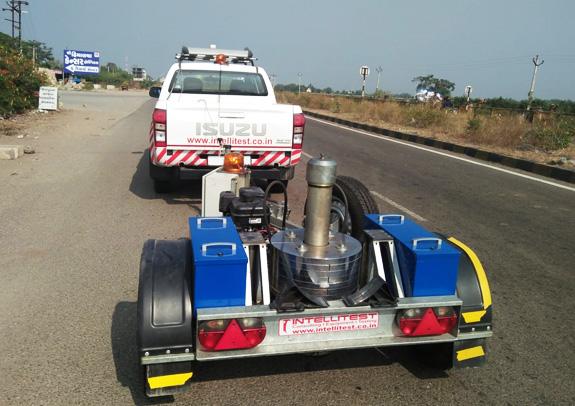
A Falling Weight Deflectometer is a specialized pavement testing device used to evaluate the structural behavior of road surfaces under simulated traffic loading conditions.
The system works by:
- Dropping a controlled weight onto a circular loading plate
- Creating a force similar to the load produced by moving vehicles
- Measuring pavement deflection using highly sensitive sensors
- Generating deflection data for structural analysis
The collected information helps engineers understand how different pavement layers respond to stress and identify weaknesses that may affect long-term performance.
Importance of Structural Analysis in Flexible Pavements
Structural analysis is essential for understanding whether a pavement can safely withstand current and future traffic loads. Without proper analysis, hidden weaknesses may lead to premature failures, increased maintenance costs, and reduced road lifespan.
The Falling Weight Deflectometer plays a critical role in improving this analysis by providing accurate, measurable structural data rather than relying on assumptions or surface observations.
This enables engineers to make smarter infrastructure decisions backed by real-time field information.
How Falling Weight Deflectometer Improves Pavement Analysis
Accurate Load Simulation
One of the key strengths of the Falling Weight Deflectometer is its ability to simulate real traffic loading conditions. This allows engineers to study how flexible pavements behave under actual operational stress.
The data generated provides a more realistic understanding of pavement performance than traditional testing methods.
Layer-Wise Structural Evaluation
Flexible pavements consist of multiple layers, including asphalt, base, sub-base, and subgrade. Weakness in any one of these layers can impact the entire pavement structure.
The Falling Weight Deflectometer helps engineers analyze how each layer contributes to load distribution, making it easier to identify problem areas.
Detection of Hidden Structural Failures
Surface cracks are often only symptoms of deeper structural issues. The Falling Weight Deflectometer can detect weaknesses before visible damage appears, allowing early corrective action.
This proactive approach helps reduce future major rehabilitation costs.
Support for Pavement Rehabilitation Design
When roads begin to deteriorate, engineers must determine the most effective rehabilitation strategy. Falling Weight Deflectometer data helps identify the root cause of pavement distress and supports the design of appropriate strengthening measures.
This ensures that rehabilitation efforts are efficient and technically accurate.
Advantages of Using the Falling Weight Deflectometer in Flexible Pavements
Non-Destructive Testing
The Falling Weight Deflectometer performs structural evaluation without damaging the pavement surface. This allows repeated testing and long-term monitoring without affecting road usability.
High Precision Data Collection
Modern systems use advanced sensors that capture highly accurate pavement deflection measurements. This improves confidence in analysis and engineering decisions.
Faster Survey Operations
The system enables rapid testing across long road stretches, reducing project delays and improving operational efficiency.
Better Maintenance Planning
Reliable structural data helps infrastructure authorities prioritize maintenance activities based on pavement condition rather than assumptions.
Improved Pavement Lifespan
By identifying issues early and enabling targeted repairs, Falling Weight Deflectometer testing helps extend pavement service life.
Applications Across Infrastructure Projects
The Falling Weight Deflectometer is widely used across different infrastructure sectors where flexible pavements are common.
National Highways
High-volume traffic corridors require regular structural analysis to maintain safety and durability.
Smart City Roads
Urban transportation systems benefit from accurate pavement condition monitoring to support smooth traffic movement.
Industrial Logistics Networks
Heavy freight movement places extreme stress on pavements, making structural analysis essential.
Airport Pavements
Airport taxiways and runways require precise evaluation to withstand aircraft loading conditions.
Integration with Modern Engineering Technologies
The effectiveness of the Falling Weight Deflectometer is further enhanced through integration with digital engineering systems.
Automated Data Recording
Modern equipment minimizes manual intervention and improves consistency during testing.
Real-Time Analysis Tools
Engineers can evaluate structural responses in real time and make immediate decisions.
Cloud-Based Data Management
Stored pavement data can be analyzed over time to monitor performance trends and support predictive maintenance.
Advanced Reporting Systems
Modern software generates detailed reports that simplify interpretation and project planning.
Intellitest’s Role in Advanced Pavement Evaluation
Since 2011, Intellitest has been delivering innovative civil engineering testing solutions for sectors including highways, railways, construction, infrastructure, and mining.
The company offers advanced pavement testing equipment, geotechnical solutions, structural testing systems, and consultancy services to improve infrastructure quality and efficiency.
Through advanced Falling Weight Deflectometer solutions, Intellitest supports infrastructure professionals in conducting accurate structural analysis of flexible pavements. Their expertise helps organizations improve road performance, optimize maintenance planning, and ensure long-term pavement durability.
For more details, visit here: https://www.intellitest.co.in/falling-weight-deflectometer-in-india.html.
Future of Flexible Pavement Analysis
As infrastructure systems become smarter and more data-driven, the role of the Falling Weight Deflectometer will continue to expand.
Future developments may include:
- Artificial intelligence-based pavement performance prediction
- Smart sensor integration
- Automated condition monitoring systems
- Enhanced visualization tools for pavement modeling
- Faster mobile testing platforms
These innovations will make structural analysis even more accurate and efficient.
Conclusion
The Falling Weight Deflectometer has become one of the most valuable technologies for analyzing the structural behavior of flexible pavements. Its ability to simulate real traffic loads, accurately measure pavement response, and identify hidden weaknesses makes it essential for modern infrastructure engineering.
From improving rehabilitation planning to supporting preventive maintenance and enhancing pavement lifespan, the benefits of Falling Weight Deflectometer testing are extensive.
With advanced solutions and technical expertise, Intellitest continues to contribute to smarter pavement evaluation and more sustainable infrastructure development.
As road networks continue to evolve, the importance of accurate structural analysis through Falling Weight Deflectometer technology will only increase, helping engineers build stronger, safer, and longer-lasting flexible pavements for the future.

 English
 Arabic
 Français
 Español
 Português
 Deutsch
 Dutch
Dutch
 Italiano
 Russian
 Romaian