


Tired of Alert Fatigue? Why SOC Risk-Based Security Monitoring Is the Answer
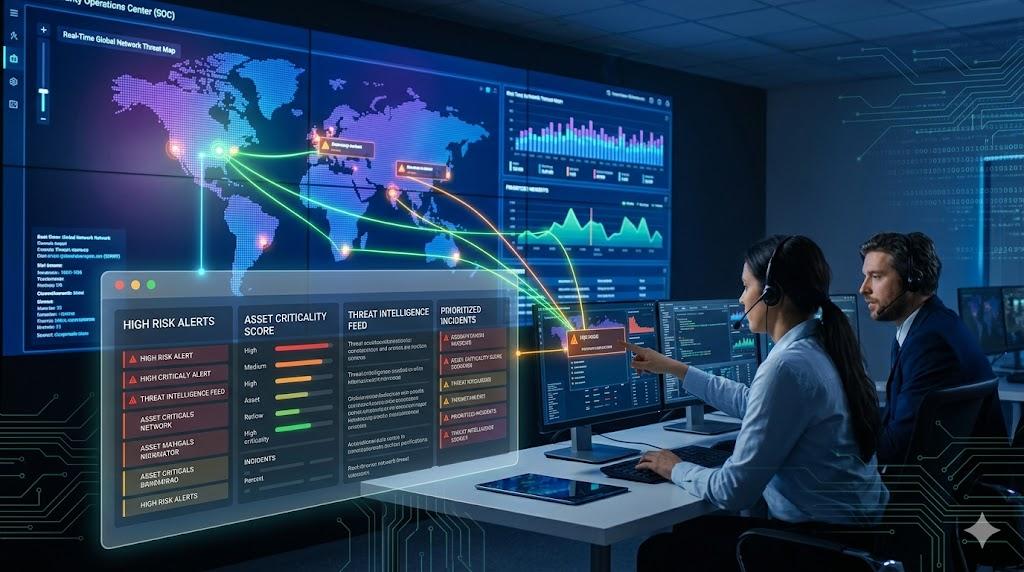
Imagine this: It is 3 AM. Your Security Operations Center (SOC) analysts are drowning in a sea of red alerts flashing across their screens. Every device, every application, and every user action is generating a notification.
Amidst this relentless noise, a low-level alert triggers on a critical database containing sensitive customer data. Because it isn’t labeled "Critical" by a generic legacy tool, it gets buried in the queue. By morning, the damage is done. Ransomware has exfiltrated the data, and your organization is facing a financial and reputational nightmare.
This isn’t a hypothetical scenario; it is the daily reality for organizations relying on outdated, high-volume security monitoring. In an age of sophisticated cyber threats, trying to boil the ocean by monitoring everything with equal intensity means you effectively monitor nothing.
The solution to this crushing alert fatigue and increased window of exposure is a strategic shift to SOC risk-based security monitoring.
Traditional SOC monitoring operates on a linear, rules-based methodology. If event 'X' happens, trigger alert 'Y.'. While this worked in less complex environments, today’s hybrid clouds, remote workforces, and IoT landscapes generate too much telemetry for this model to sustain.
Request a Quote @ https://ess.net.in/soc-risk-based-security-monitoring-and-remediation
The result is alert fatigue. Studies suggest that SOC analysts miss nearly 50% of legitimate alerts simply because they are overwhelmed by false positives.
SOC Risk-Based Security Monitoring changes the game by introducing context. It is not merely about identifying technical anomalies; it is about aligning security monitoring with business risk.
Instead of treating an alert on a guest Wi-Fi connection with the same urgency as an alert on your financial controller's laptop, a risk-based approach uses data ingestion and behavioral analytics to answer critical questions:
-
How critical is the asset? (Is this the CEO’s device or a testing server?)
-
How severe is the vulnerability?
-
What is the current threat intelligence? (Is this specific exploit being used actively in the wild?)
By combining these factors into a single risk score, your SOC stops firefighting and starts prioritizing.
When you transition to SOC risk-based security monitoring, you aren't just buying another security tool; you are transforming your organization’s defensive posture.
Imagine a SOC where your analysts are energetic and focused, working only on high-fidelity alerts that pose real danger. This is the desire that risk-based monitoring fulfills.
Here is what this transformation looks like for your business:
-
Drastic Reduction in False Positives: By focusing on context and behavior rather than generic signatures, you can reduce alert volume by up to 90%, allowing analysts to focus on true threats.
-
Improved Mean Time to Respond (MTTR): When priority is automatically assigned based on risk, your team knows exactly where to focus first, neutralizing threats before they can laterally move or exfiltrate data.
-
Optimized Resource Allocation: Stop wasting expensive tier-3 analyst time on tier-1 noise. A risk-based approach automates the triaging process.
-
Demonstrable ROI: Move beyond vanity metrics like "number of alerts processed" and start reporting on business-centric metrics, such as "reduction in critical risk exposure."
By aligning your security operations with your business priorities, you transform the SOC from a cost center into a strategic enabler of business resilience.
Contact us at https://ess.net.in/contact.
The cyber threat landscape is not slowing down. Every hour your SOC spends wading through false positives is an hour you are vulnerable to a catastrophic breach. Standing still with legacy monitoring is no longer an option.
It is time to evolve.
Embracing SOC risk-based security monitoring is a journey, but it begins with a single step. Start by assessing your current asset criticality and integrating threat intelligence into your existing SIEM or XDR platforms.
Don't wait for a breach to prove that your current monitoring isn't working. Take dynamic action to secure your enterprise’s future. If you are ready to eliminate alert fatigue and implement a smarter, more resilient defense, contact our expert security consultants today for a comprehensive SOC maturity assessment.
About us
At ESS, we understand the intricate demands of the modern business landscape. As a premier enterprise IT solutions company, we are committed to empowering organizations with cutting-edge technology and innovative solutions. Our mission is to seamlessly integrate technology into your business processes, ensuring efficiency, scalability, and long-term success.
OUR CONTACT

 Arabic
 Français
 Español
 Português
 Deutsch
 Türkçe
 Dutch
Dutch
 Italiano
 Russian
 Romaian