


What Are AOC-4 and MGT-7 in ROC Filing?
Introduction
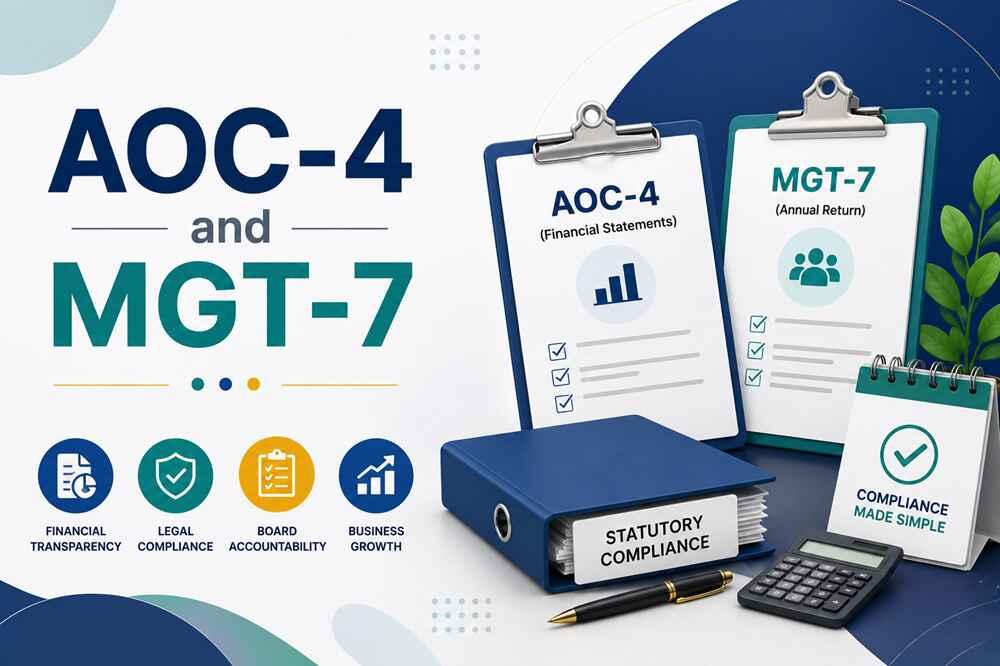
When it comes to company compliance in India, AOC-4 and MGT-7 in ROC filing are two forms that every private limited company cannot ignore. Under the Companies Act, 2013 and the updated compliance framework as applicable in 2025, these filings form the backbone of annual reporting to the Registrar of Companies (ROC).
Here’s the thing. Many business owners treat ROC filing as a routine task, but AOC-4 and MGT-7 actually carry deep financial and legal significance. One deals with financial statements, while the other focuses on annual returns. If either is missed or filed incorrectly, it can lead to penalties and compliance issues.
So let’s break it down in a simple, practical way and understand what these forms really mean.
Meaning of AOC-4 Filing
AOC-4 filing starts with understanding AOC-4 itself. AOC-4 is the form used to file financial statements of a company with ROC every year.
In simple terms, it is the financial snapshot of the company submitted officially.
1. AOC-4 reports balance sheet and profit & loss account
2. It includes auditor’s report and board report
3. It must be filed after AGM
4. It applies to all companies registered in India
5. It ensures transparency in financial reporting
6. Late filing leads to heavy penalties
Meaning of MGT-7 Filing
Now let’s talk about the second part of ROC, which is MGT-7.
MGT-7 is the annual return of a company filed with ROC. It focuses on company structure and shareholder details rather than financials.
1. MGT-7 contains details of shareholders and directors
2. It shows shareholding pattern of the company
3. It reflects changes during the year
4. It is mandatory under Companies Act compliance
5. It confirms company’s legal existence and structure
6. It must be certified by a professional in many cases
Applicability of AOC-4 and MGT-7
Understanding who needs to file AOC-4 and MGT-7 is very important because almost every registered company falls under this requirement.
Let’s break it down simply:
1. All private limited companies must file both forms
2. Public companies are also covered
3. One person companies file MGT-7A instead of MGT-7
4. Dormant companies also fall under compliance rules
5. Foreign companies with Indian presence may have obligations
6. LLPs are excluded from AOC-4 and MGT-7
7. Even zero-activity companies must comply
Due Dates for Filing
Timelines are critical in AOC-4 and MGT-7 because delay leads to penalties.
Generally, due dates are linked to the Annual General Meeting.
1. AOC-4 must be filed within 30 days of AGM
2. MGT-7 is filed within 60 days of AGM
3. AGM is usually held by 30th September
4. Timelines are strictly monitored under Companies Act
5. Late filing impacts compliance rating of company
6. Extensions are rarely granted in normal cases
Documents Required for Filing
To complete AOC-4 and MGT-7, proper documentation is essential. Without it, filing cannot be done correctly.
Here are the key requirements:
1. Audited financial statements for AOC-4
2. Board report and auditor report
3. Details of shareholders for MGT-7
4. List of directors and changes during year
5. Digital signatures of authorized persons
6. AGM details and resolutions
7. Supporting annexures under AOC-4 and MGT-7
Step-by-Step Filing Process
Filing AOC-4 and MGT-7 follows a structured online process on MCA portal.
Let’s break it into simple flow:
1. Login to MCA portal using credentials
2. Download latest forms for AOC-4 and MGT-7
3. Fill company master data carefully
4. Attach financial statements for AOC-4
5. Enter shareholder details in MGT-7
6. Validate forms using pre-scrutiny tool
7. Upload and submit with DSC
Penalties for Non-Compliance
Ignoring AOC-4 and MGT-7 can cost heavily.
The penalty structure is strict under Companies Act.
1. Late fees increase per day of delay
2. Additional penalties for prolonged non-filing
3. Company status may become non-compliant
4. Directors may face disqualification risk
5. ROC may issue notices or strikes
6. Compliance rating gets negatively impacted
7. Penalty applies separately for AOC-4 and MGT-7
Conclusion
Understanding AOC-4 and MGT-7 in ROC filing is essential for every company operating under the Companies Act in India. These filings are not optional tasks. They are mandatory disclosures that define how transparent and compliant your business is in the eyes of the law. AOC-4 captures your financial reality, while MGT-7 captures your ownership and structural details. Together, they create a complete compliance picture.

 Arabic
 Français
 Español
 Português
 Deutsch
 Türkçe
 Dutch
Dutch
 Italiano
 Russian
 Romaian