


Overcoming Climate Uncertainties with Precision Farming
Climate change presents the most significant challenge to modern food security, causing highly volatile weather patterns worldwide. Leveraging Smart Agriculture infrastructure provides farmers with the tools required to adapt dynamically to these rapidly shifting environmental conditions. Unexpected droughts, unseasonal frosts, and sudden torrential downpours can instantly devastate traditional farming operations. However, by utilizing predictive weather modeling and real-time sensor data, growers can implement defensive strategies hours before extreme weather events impact their land, protecting vulnerable crops.
Smart irrigation networks prove vital during extended periods of drought, ensuring that limited water resources are utilized efficiently. These systems automatically cross-reference localized soil moisture data with regional meteorological forecasts to calculate the exact amount of hydration needed. If rain is predicted within twelve hours, the system delays watering to prevent resource waste and over-saturation. This level of intelligent conservation keeps crops healthy during heatwaves while respecting strict regional water restrictions implemented by environmental protection agencies.
Similarly, advanced frost warning systems utilize temperature sensors scattered across varied micro-climates on a single property. When temperatures drop to critical thresholds, automated wind machines or misting systems activate instantly to protect delicate blossoms or early-stage crops. This automated responsiveness eliminates the need for constant overnight monitoring by farm operators during dangerous seasonal transitions. By mitigating these immediate environmental threats, precision technology stabilizes annual food production volumes and protects financial investments from sudden weather disasters.
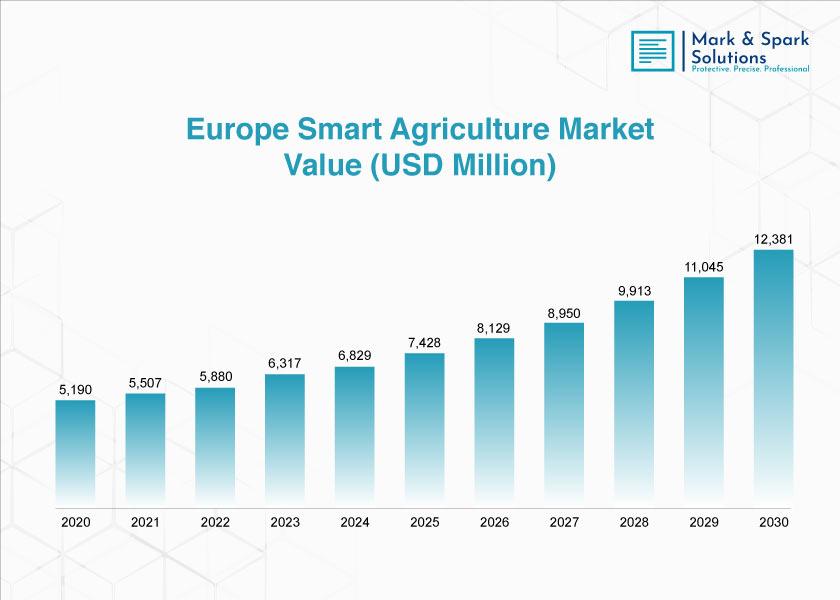
The strong financial growth within the sector underscores the urgency with which producers are adopting these climate-resilient solutions. The Europe Smart Agriculture Market Growth was valued at USD 6,829 Million in 2024 and is projected to grow to USD 12,381 Million by 2030, with a compound annual growth rate (CAGR) of 10.8% from 2025 to 2030. This steady expansion highlights how crucial technology has become in neutralizing climate risks for agricultural enterprises. Financial institutions are increasingly requiring the adoption of precision tools as a prerequisite for securing agricultural loans and crop insurance.
As predictive AI algorithms continue to mature, their ability to forecast long-term climate trends will improve exponentially. Farmers will receive highly customized recommendations regarding the best planting windows and crop varieties for upcoming seasons based on global climate shifts. This proactive adaptation strategy ensures that the agricultural industry remains incredibly robust, profitable, and capable of delivering consistent food supplies. Embracing these advanced systems is no longer merely an operational upgrade; it is a fundamental survival strategy for global food production networks.

 Arabic
 Français
 Español
 Português
 Deutsch
 Türkçe
 Dutch
Dutch
 Italiano
 Russian
 Romaian