


Ecommerce Content Automation: Simplifying Ecommerce Content Workflows
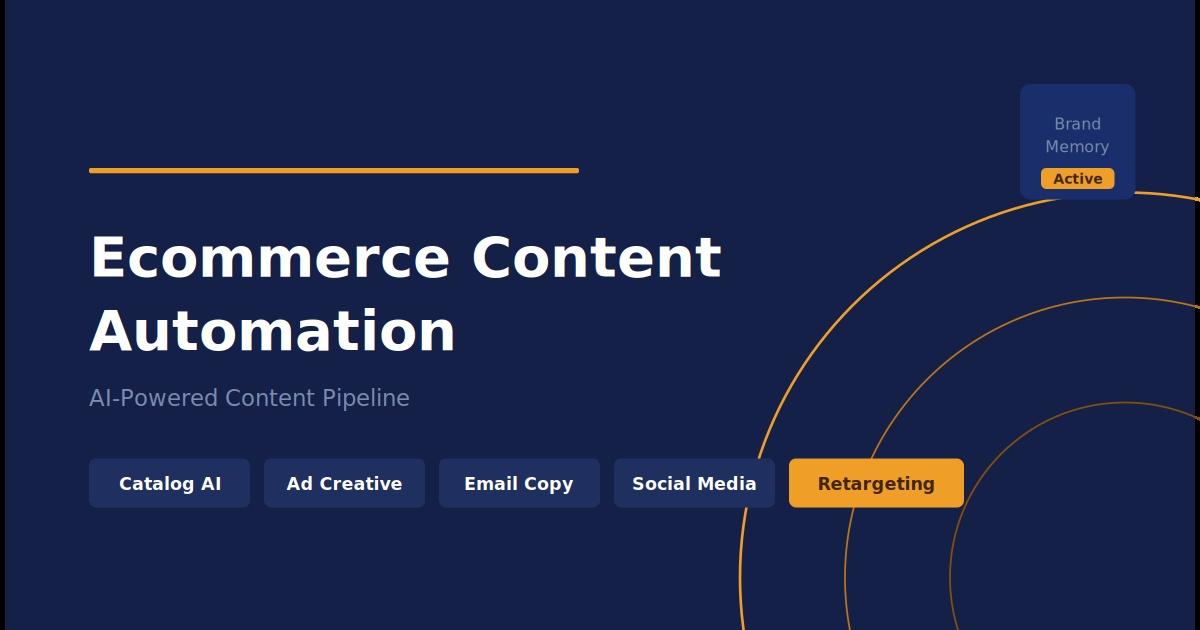
Managing Content Faster
Most ecommerce brands do not notice content becoming a problem until growth starts accelerating.
At first, creating product descriptions, ad creatives, social posts, banners, and email campaigns feels manageable. But as catalogs grow and campaigns become more frequent, content production starts expanding faster than internal teams can handle.
That is where ecommerce content automation becomes important.
The challenge is not a lack of creativity. Ecommerce teams usually know their products, customers, and messaging very well. The real issue is operational. Every launch creates repetitive production tasks across websites, marketplaces, paid ads, email marketing, and social media channels.
Writers spend hours rewriting similar copy. Designers repeatedly resize assets. Marketing teams rebuild workflows across multiple platforms. Over time, content production becomes slower, more expensive, and increasingly difficult to manage.
Artificial intelligence helps reduce that operational pressure by automating repetitive work while allowing teams to stay focused on strategy, customer experience, and campaign performance.
In this article, we will explore why ecommerce content workflows become difficult to scale, how AI-powered systems improve operational efficiency, and why automation is becoming essential for modern ecommerce growth.
Why Content Operations Become Overwhelming
Ecommerce content automation becomes critical when content demand starts slowing execution across teams.
As ecommerce businesses expand, every channel creates additional production requirements.
Every Product Requires Multiple Content Assets
One product launch can require SEO descriptions, marketplace listings, social captions, promotional banners, ad creatives, and email campaigns simultaneously.
For brands managing large catalogs, this quickly becomes difficult to coordinate manually.
Repetitive Work Slows Production
Most ecommerce teams spend more time adapting content than creating new campaigns.
Writers rewrite descriptions for multiple platforms. Designers repeatedly resize creatives for different placements. Marketing teams duplicate workflows across channels.
Over time, repetitive tasks reduce efficiency significantly.
Delays Impact Business Performance
In ecommerce, speed matters.
If product pages or campaign assets are delayed, launches lose momentum and promotional opportunities become smaller.
Eventually, slow content production begins affecting revenue growth directly.
Why Manual Scaling Creates Friction
Ecommerce content automation helps businesses avoid the inefficiencies caused by manual scaling.
Adding more people may temporarily improve output, but it also introduces more operational complexity.
Larger Teams Create More Bottlenecks
As more agencies, freelancers, designers, and stakeholders become involved, workflows become harder to manage.
Approvals take longer. Communication becomes fragmented. Revision cycles increase.
Instead of improving efficiency, larger teams often slow production down.
Content Costs Increase Rapidly
Manual production becomes expensive as ecommerce businesses grow.
Brands often rely heavily on agencies and external creative support to keep up with growing content demands. Over time, operational costs rise significantly.
Brand Messaging Becomes Inconsistent
Different teams naturally create content differently.
Descriptions may vary across marketplaces. Ads may use different messaging styles. Social content may no longer feel connected to the overall brand identity.
That inconsistency becomes more visible as operations scale.
Ecommerce Content Automation Simplifies Production
Ecommerce content automation uses AI to automate repetitive production tasks while allowing teams to maintain creative oversight.
Teams upload product titles, specifications, features, images, and brand guidelines. The platform then generates descriptions, social captions, ad creatives, and promotional messaging automatically.
Instead of building every asset manually, teams start with structured, production-ready content.
That dramatically improves execution speed.
What a Content Pipeline Actually Solves
A strong ecommerce content pipeline creates one connected workflow across every customer-facing channel.
The same product information can support ecommerce websites, marketplaces, paid advertising, social media campaigns, and email marketing simultaneously.
Instead of managing disconnected systems, teams work from one centralized process.
That structure becomes increasingly valuable as businesses grow.
How AI Improves Workflow Efficiency
An AI-powered content pipeline combines workflow automation, publishing systems, and generative AI into one streamlined operation.
The platform understands product features, customer intent, and keyword opportunities before generating tailored content for different channels.
For example, one product upload can instantly create SEO descriptions, ad variations, social captions, and email messaging simultaneously.
This allows ecommerce businesses to scale content production without constantly increasing operational complexity.
AI Content Feels More Natural
One of the biggest concerns around AI-generated content used to be quality.
Earlier systems often produced generic or repetitive messaging. Modern generative AI content creation systems are significantly more advanced.
AI can now adapt tone, structure, and messaging based on campaign goals, audience segments, and brand voice.
A premium beauty brand can sound polished and editorial, while a sportswear company can sound energetic and performance-driven.
That flexibility makes AI much more practical for ecommerce marketing.
Better Product Descriptions at Scale
Product descriptions remain one of the most repetitive tasks in ecommerce operations.
That is why many brands now use AI generated product descriptions to improve production speed while maintaining SEO consistency.
AI can transform technical specifications into customer-focused messaging that highlights benefits and improves discoverability.
For businesses managing large catalogs, this removes a major operational burden.
Faster Advertising Production
Performance marketing depends heavily on testing and iteration.
With automated ad creative generation, AI can quickly create multiple headlines, promotional angles, and campaign variations for different audience segments.
Instead of spending days creating ad copy manually, teams can move directly into campaign optimization and testing.
That speed creates a major competitive advantage.
Scaling Visual Content
Visual production often becomes one of the biggest bottlenecks during seasonal campaigns and product launches.
AI generated ecommerce creatives help brands transform product imagery into banners, marketplace graphics, and promotional visuals automatically.
Assets can be resized and adapted across channels with minimal manual effort.
This allows design teams to focus more on creative direction instead of repetitive formatting work.
Social Media Gets Easier to Manage
Social media requires constant publishing to remain competitive.
Most ecommerce teams struggle to maintain posting schedules while also managing launches and promotional campaigns.
That is why AI social media content creation is becoming increasingly valuable. AI can generate captions, hashtags, post ideas, and campaign messaging directly from product information.
One campaign can create weeks of social-ready content within minutes.
The Bigger Operational Advantage
The biggest benefit of automation is not simply producing more content faster.
It is reducing operational pressure.
Campaigns become easier to launch. Workflows become easier to manage. Teams spend less time repeating tasks and more time focusing on storytelling, customer experience, and strategic growth.
That operational clarity becomes a major advantage for growing ecommerce businesses.
A Real Ecommerce Example
Imagine a fashion retailer preparing for a major seasonal launch involving 2,500 products.
Without automation, descriptions, banners, ad creatives, and social content could take weeks to coordinate across internal teams and agencies.
With an AI-powered workflow, those assets can be generated within hours, reviewed quickly, and published across every channel much faster.
The retailer launches sooner, responds faster to trends, and reduces production pressure across departments.
Choosing the Right Workflow
Not every AI solution is designed specifically for ecommerce operations.
The strongest systems support structured product data, workflow approvals, multi-channel publishing, and brand consistency across large catalogs.
The goal is not simply generating more content. It is building a scalable operational workflow that supports long-term ecommerce growth.
Final Thoughts
As ecommerce operations become more complex, manual production workflows become harder to sustain. Ecommerce content automation gives brands a scalable way to manage growing content demands without overwhelming internal teams.
With a strong ecommerce content pipeline, businesses can streamline generative AI content creation, improve AI generated product descriptions, accelerate automated ad creative generation, scale AI generated ecommerce creatives, and simplify AI social media content creation across channels.
The result is a faster, more organized, and more scalable ecommerce operation built for long-term growth.
FAQs
1. What is ecommerce content automation?
Ecommerce content automation uses AI to generate product descriptions, ad creatives, and social content automatically.
2. What is an ecommerce content pipeline?
It is a workflow that transforms product data into content assets for websites, marketplaces, ads, and social channels.
3. Are AI generated product descriptions useful for SEO?
Yes. They improve scalability while maintaining keyword consistency and discoverability.
4. Can AI create ecommerce visuals too?
Yes. AI can create banners, marketplace graphics, and promotional visuals automatically.
5. Which ecommerce brands benefit most from automation?
Brands with large catalogs, frequent launches, and multi-channel marketing operations benefit the most.

 English
 Arabic
 Français
 Español
 Português
 Deutsch
 Dutch
Dutch
 Italiano
 Russian
 Romaian