


ERP for Manufacturing: Complete Guide to Streamlining Production Operations
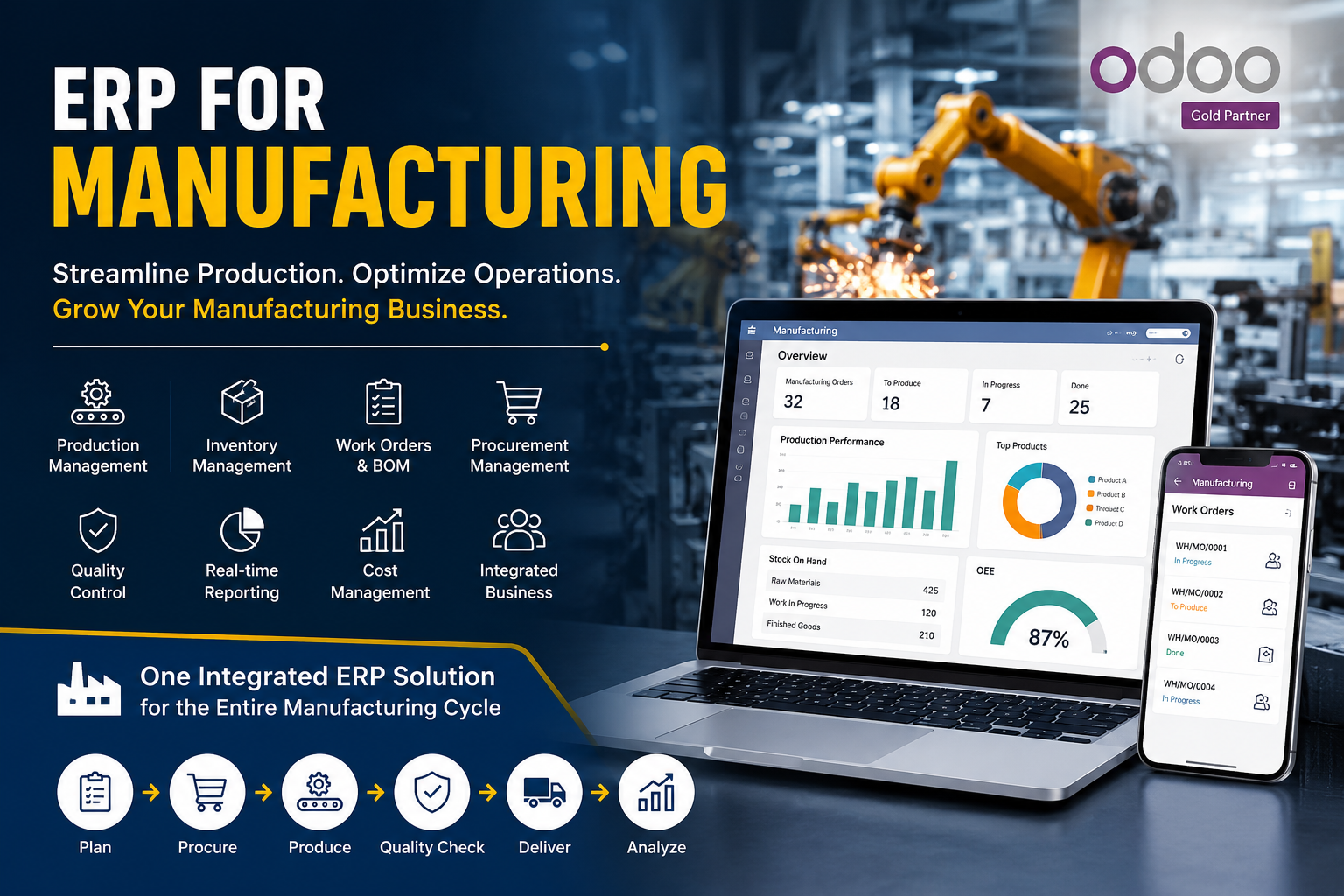
Manufacturing businesses today face increasing pressure to improve production efficiency, reduce operational costs, manage inventory accurately, and deliver products on time. Traditional systems and manual processes are no longer enough to handle the growing complexity of manufacturing operations. This is where ERP for manufacturing becomes essential.
A manufacturing ERP system integrates production planning, inventory management, procurement, finance, sales, and quality control into a single platform. It helps manufacturers gain real-time visibility into operations, automate repetitive tasks, and make better business decisions. Modern ERP platforms like Odoo are transforming the way manufacturers manage their operations by connecting every department through a centralized system.
What is ERP for Manufacturing?
ERP for manufacturing refers to enterprise resource planning software specifically designed to manage manufacturing processes. It allows businesses to automate and monitor the entire production lifecycle — from raw material procurement to finished product delivery.
Unlike generic business software, manufacturing ERP solutions include specialized modules for:
-
Bill of Materials (BOM)
-
Work Order Management
-
Production Planning
-
Inventory Control
-
Supply Chain Management
-
Quality Assurance
-
Maintenance Tracking
-
Procurement Automation
Manufacturing ERP software acts as a centralized database where all departments share real-time information, improving operational efficiency and reducing communication gaps.
Why Manufacturing Businesses Need ERP Software
Many manufacturing companies still rely on spreadsheets, disconnected systems, and manual workflows. As businesses grow, these outdated processes create inefficiencies that impact profitability and customer satisfaction.
Some common manufacturing challenges include:
-
Production delays
-
Inventory mismatches
-
Lack of real-time visibility
-
High operational costs
-
Poor demand forecasting
-
Supply chain disruptions
-
Inefficient resource allocation
ERP software solves these problems by integrating all manufacturing operations into one intelligent system. It enables manufacturers to track production activities in real time and make faster, data-driven decisions.
According to industry ERP providers, manufacturing ERP systems improve operational visibility, automate production workflows, and optimize inventory planning for better productivity.
Key Features of Manufacturing ERP Software
1. Production Planning and Scheduling
Production planning is one of the most important components of manufacturing ERP software. It helps businesses create accurate production schedules based on demand forecasts, machine availability, labor capacity, and raw material stock.
ERP systems automate production scheduling to reduce downtime and improve manufacturing efficiency.
Modern ERP platforms also provide:
-
Work center management
-
Production routing
-
Capacity planning
-
Manufacturing order tracking
-
Real-time production monitoring
This ensures manufacturers can meet deadlines while optimizing resources effectively.
2. Inventory Management
Inventory management is critical in manufacturing. Excess inventory increases storage costs, while low inventory can stop production completely.
Manufacturing ERP software provides real-time inventory visibility across warehouses and production units. Businesses can track:
-
Raw materials
-
Semi-finished goods
-
Finished products
-
Warehouse stock levels
-
Supplier deliveries
ERP systems also automate stock replenishment and reduce inventory wastage.
3. Bill of Materials (BOM) Management
A Bill of Materials defines all components, materials, and processes required to manufacture a product.
ERP systems simplify BOM creation and management by supporting:
-
Multi-level BOM structures
-
Product variants
-
Engineering changes
-
Material consumption tracking
This helps manufacturers improve production accuracy and reduce material wastage.
4. Work Order Management
Manufacturing ERP software automatically generates work orders based on production requirements. These work orders guide production teams through every manufacturing stage.
Work order management helps businesses:
-
Track production progress
-
Monitor machine performance
-
Reduce delays
-
Improve shop floor coordination
ERP solutions also provide real-time status updates for ongoing production activities.
5. Quality Control Management
Quality assurance is essential in manufacturing industries. ERP systems help businesses maintain product consistency and compliance standards through automated quality checks.
Key quality management features include:
-
Inspection planning
-
Quality checkpoints
-
Defect tracking
-
Rejection analysis
-
Compliance reporting
This improves customer satisfaction while reducing production defects.
6. Procurement and Supply Chain Management
ERP software streamlines procurement by automating supplier management and purchase workflows.
Manufacturers can:
-
Manage supplier databases
-
Track purchase orders
-
Monitor material deliveries
-
Analyze supplier performance
-
Automate procurement approvals
Integrated supply chain management improves coordination between procurement, production, and logistics teams.
Benefits of ERP for Manufacturing Industry
Improved Operational Efficiency
ERP software eliminates repetitive manual tasks and automates manufacturing workflows. This reduces errors, saves time, and increases productivity across departments.
Real-Time Visibility
Manufacturers gain complete visibility into production, inventory, procurement, and sales activities through real-time dashboards and reporting tools.
Better Decision-Making
ERP systems provide accurate data analytics and reports, helping business owners make informed decisions faster.
Reduced Operational Costs
Automation and optimized resource planning help businesses reduce production costs, inventory carrying costs, and wastage.
Enhanced Customer Satisfaction
Faster production cycles and accurate order management improve delivery timelines and customer experience.
Scalability
Modern cloud ERP solutions grow with the business, making them ideal for both small manufacturers and large enterprises.
Why Odoo ERP is Ideal for Manufacturing Businesses
Odoo has become one of the most popular ERP solutions for manufacturing companies due to its flexibility, scalability, and modular architecture.
Odoo Manufacturing ERP includes powerful features such as:
-
Production management
-
Inventory automation
-
MRP planning
-
Quality management
-
Maintenance management
-
Procurement integration
-
Real-time reporting
One of Odoo’s biggest advantages is its ability to integrate multiple business functions into one platform. Manufacturers can manage accounting, CRM, HR, procurement, and manufacturing operations from a single system.
Cloud ERP vs Traditional Manufacturing ERP
Modern manufacturers are increasingly adopting cloud ERP solutions instead of traditional on-premise systems.
Cloud ERP Benefits
-
Lower infrastructure costs
-
Remote accessibility
-
Automatic updates
-
Better scalability
-
Faster implementation
-
Enhanced data security
Cloud ERP is especially beneficial for growing manufacturing businesses that need flexibility and real-time collaboration across multiple locations.
Industries That Use Manufacturing ERP
ERP software is widely used across different manufacturing sectors, including:
-
Automotive Manufacturing
-
Electronics Manufacturing
-
Textile Industry
-
Food and Beverage
-
Chemical Manufacturing
-
Pharmaceutical Industry
-
Industrial Equipment Manufacturing
-
Furniture Manufacturing
Each industry benefits from ERP customization based on its production workflows and compliance requirements.
How to Choose the Right ERP for Manufacturing
Selecting the right ERP solution depends on several business factors.
Key considerations include:
-
Business size
-
Production complexity
-
Scalability requirements
-
Budget
-
Industry-specific features
-
Integration capabilities
-
Customization options
-
Vendor support
Businesses should choose ERP software that can adapt to future growth while meeting current operational needs.
Future of ERP in Manufacturing
The future of manufacturing ERP is driven by automation, artificial intelligence, IoT integration, and predictive analytics.
Modern ERP platforms are evolving to support:
-
Smart manufacturing
-
Industry 4.0
-
Predictive maintenance
-
AI-powered forecasting
-
Real-time machine monitoring
-
Advanced business intelligence
Manufacturers adopting digital ERP solutions gain a competitive advantage by improving agility, efficiency, and operational control.
Conclusion
ERP for manufacturing is no longer optional for businesses aiming to stay competitive in today’s fast-changing industrial environment. A modern manufacturing ERP system helps businesses streamline production, improve inventory accuracy, automate workflows, and increase profitability.
Solutions like Odoo provide manufacturers with a scalable and flexible platform to manage operations efficiently while preparing for future growth. Whether you are a small manufacturing company or a large industrial enterprise, implementing the right ERP software can significantly transform your business operations and long-term success.

 English
 Arabic
 Français
 Español
 Deutsch
 Türkçe
 Dutch
Dutch
 Italiano
 Russian
 Romaian