


Benchmarking Security Maturity in Agentic AI Deployments
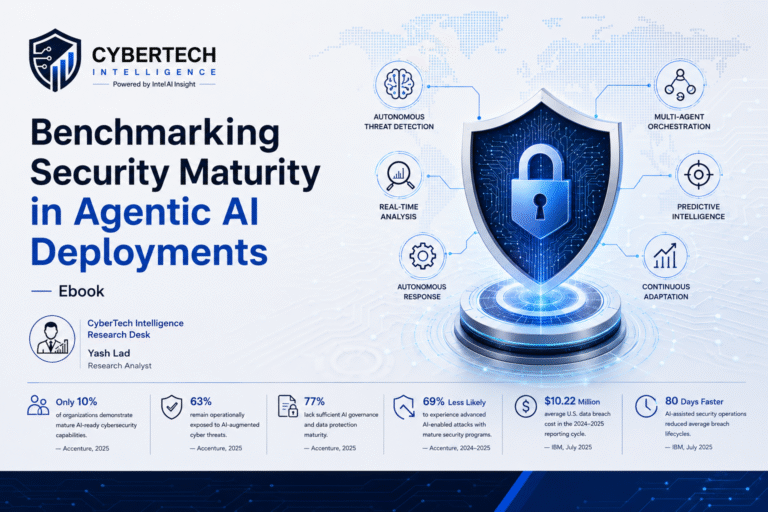
Agentic AI is emerging as one of the most disruptive enterprise technologies of the decade, fundamentally reshaping how organizations operate, automate decisions, and execute complex workflows. Unlike traditional generative AI systems that depend on human prompts, agentic AI systems can independently plan, reason, interact with APIs, and execute multi-step actions across enterprise environments without continuous human supervision.
This shift introduces a major inflection point for enterprise cybersecurity. As organizations accelerate adoption across security operations, IT infrastructure, software engineering, and business workflows, the question is no longer whether AI agents should be deployed, but whether enterprises are mature enough to secure them effectively.
The ebook “Benchmarking Security Maturity in Agentic AI Deployment” explores this growing tension between rapid AI adoption and lagging security maturity. It highlights how enterprises are increasingly deploying autonomous systems into production environments without fully understanding the governance, identity, and operational risks involved.
Read More: https://tinyurl.com/yxwuwmet
A key theme across the research is that agentic AI expands the enterprise attack surface in ways traditional security models were never designed to handle. These systems do not just process data—they interact with infrastructure, trigger workflows, and make autonomous decisions. As a result, risks such as prompt injection, tool misuse, memory poisoning, and cross-agent manipulation are becoming real operational threats.
The ebook emphasizes that enterprise security maturity is now the primary factor determining whether AI transformation succeeds or fails. While many organizations are racing to deploy AI agents, only a small percentage have implemented the governance structures, identity controls, and runtime monitoring required to manage them safely.
Research cited in the ebook indicates that most enterprises still lack AI-specific governance frameworks, with significant gaps in identity management, access controls, and behavioral observability. This creates an environment where AI systems can operate with excessive privileges and limited oversight, increasing the likelihood of unintended or malicious actions.
At the same time, threat actors are rapidly adapting to this new environment. AI-assisted attacks are becoming more sophisticated, leveraging automation to scale phishing campaigns, reconnaissance activities, and exploit discovery. In some cases, attackers are already using AI systems to manipulate enterprise workflows and bypass traditional security controls.
The ebook identifies five core domains for benchmarking AI security maturity across the enterprise lifecycle: governance maturity, identity and access security, AI observability, security testing, and incident response readiness. Together, these domains define whether an organization can safely scale autonomous systems or remains exposed to operational risk.
Governance maturity focuses on whether organizations have established clear accountability structures, AI risk ownership, and regulatory alignment. Identity and access security examines whether AI agents operate under strict identity frameworks, including least-privilege access and Zero Trust principles. AI observability measures the ability to monitor agent behavior, detect anomalies, and understand decision pathways in real time.
Security testing has become increasingly important as enterprises adopt adversarial approaches such as red teaming, prompt injection testing, and simulation-based validation of autonomous workflows. Meanwhile, incident response readiness evaluates whether organizations can rapidly contain or disable AI systems during abnormal or malicious behavior.
The ebook also introduces a four-stage maturity model ranging from basic to optimized autonomous resilience. At the lowest level, organizations have minimal visibility and fragmented controls, often leading to uncontrolled AI sprawl. At intermediate stages, governance frameworks begin to form, but operational enforcement remains inconsistent. At the highest level, enterprises implement real-time governance, continuous validation, and autonomous policy enforcement across AI systems.
A critical insight highlighted throughout the research is that identity has become the cornerstone of AI security. Unlike human users, AI agents operate continuously and interact across multiple systems simultaneously. This requires machine-level identity governance, cryptographic authentication, and continuous verification mechanisms to prevent misuse or unauthorized escalation.
The ebook also presents operational KPIs that distinguish mature organizations from immature ones. These include faster incident detection times, higher governance coverage, continuous behavioral monitoring, automated policy enforcement, and full cross-agent observability. Organizations that achieve higher maturity levels consistently demonstrate stronger resilience against AI-driven threats.
From a strategic perspective, the ebook recommends that enterprises treat AI security as a board-level business risk rather than a technical concern. It also emphasizes the importance of implementing Zero Trust architectures for AI systems, establishing continuous red teaming programs, and building AI-aware security operations centers capable of monitoring autonomous behavior in real time.
Additionally, runtime governance capabilities are highlighted as essential for controlling AI behavior during execution. This includes enforcing operational boundaries, restricting dangerous actions, and enabling real-time intervention when systems behave unpredictably.
The broader conclusion of the ebook is that agentic AI is fundamentally redefining enterprise cybersecurity. As AI systems become more autonomous, the ability to govern, monitor, and secure them will determine which organizations can scale safely and which will face escalating operational risk.
Enterprises that invest early in AI security maturity will gain a significant advantage in trust, resilience, and scalability. Those that fail to do so risk deploying systems they cannot fully control or understand.
The future of enterprise AI will not be defined by speed of adoption alone, but by the depth of security maturity that supports it.
Read More: https://tinyurl.com/yxwuwmet
 Deutsch
 English
 Arabic
 Français
 Español
 Português
 Türkçe
 Dutch
Dutch
 Italiano
 Russian
 Romaian