


AI-Powered Brand Consistency: Why AI Memory Is Becoming Critical for Enterprise-Scale Customer Operations
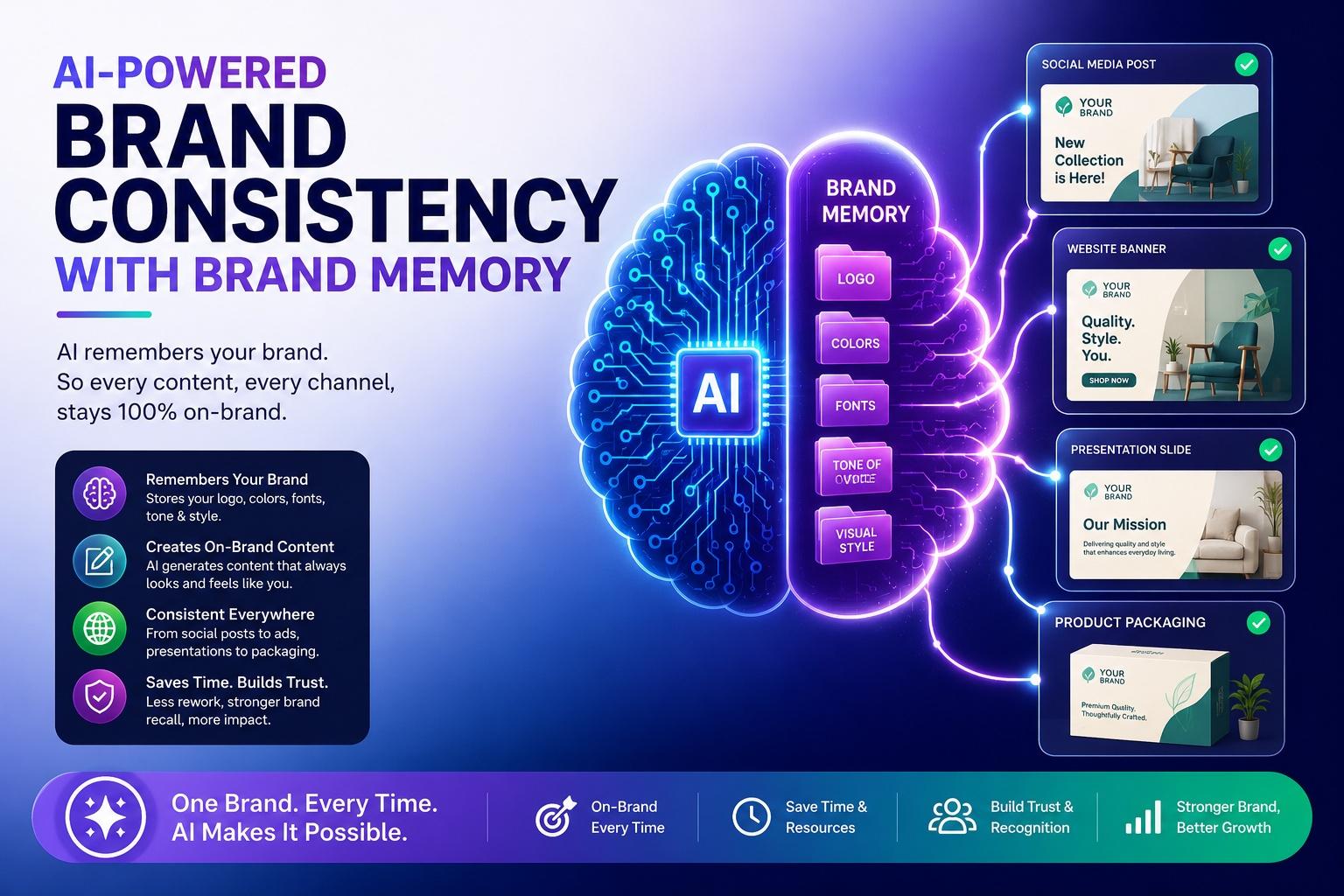
AI Is Becoming Operational Infrastructure
AI-Powered Brand Consistency is evolving from a marketing objective into a business-critical operational strategy. Organizations are no longer using AI only for isolated automation tasks. AI systems are now deeply embedded across customer experience management, sales enablement, lifecycle marketing, digital commerce, and enterprise support operations.
This shift is changing how businesses scale.
Companies are under pressure to improve operational agility, reduce communication bottlenecks, and deliver personalized customer experiences across increasingly fragmented digital ecosystems. AI helps solve these challenges by automating execution at scale.
But rapid automation introduces a new operational risk.
Most AI systems are designed for transactional output generation rather than long-term contextual intelligence. They respond to prompts effectively, but they often fail to retain institutional knowledge, customer history, and operational context over time.
As enterprises scale AI adoption across departments and customer touchpoints, communication consistency becomes harder to maintain without centralized memory infrastructure.
This is why AI memory systems are quickly becoming foundational to enterprise AI strategies.
Consistency Now Impacts Revenue Performance
AI-Powered Brand Consistency directly influences customer retention, conversion performance, and long-term brand equity.
Modern customer journeys are highly distributed. Customers move across marketplaces, websites, mobile apps, conversational AI platforms, support systems, and personalized marketing channels before making purchasing decisions.
Every interaction shapes brand perception.
When messaging becomes inconsistent across channels, customers lose confidence quickly. A business positioned around premium service may suddenly sound robotic during AI-generated support interactions. A company focused on expertise may provide conflicting guidance across customer touchpoints.
These inconsistencies create operational friction that impacts customer trust and purchasing behavior.
In competitive markets, fragmented communication does more than weaken branding. It affects revenue enablement, customer retention economics, and overall lifecycle value.
Consistency is no longer just a creative function. It is becoming an enterprise performance metric.
Traditional AI Architectures Create Fragmentation
Many businesses initially implemented AI systems independently across departments without creating unified operational intelligence layers.
As a result, traditional AI environments often function in silos.
Individual systems may perform specific tasks efficiently, but they typically lack shared memory and organizational continuity across workflows. This creates execution gaps throughout the customer experience.
Institutional Knowledge Gets Repeated
Teams repeatedly provide the same operational guidance, messaging frameworks, and workflow instructions because AI systems cannot retain historical context effectively.
Cross-Department Coordination Weakens
Marketing, support, and sales teams frequently operate separate AI tools without centralized governance, leading to fragmented customer communication.
Quality Control Becomes Expensive
As AI-generated outputs scale across departments, businesses spend increasing amounts of time reviewing, correcting, and aligning communication manually.
Without memory-driven infrastructure, AI systems remain isolated productivity tools rather than integrated operational ecosystems.
Memory Is Becoming A Strategic Layer
Persistent Memory for Agentic AI is rapidly becoming one of the most important capabilities within enterprise AI transformation initiatives.
Memory-enabled systems retain contextual understanding across interactions, workflows, and customer relationships instead of resetting after every task.
An enterprise AI system with persistent memory can retain:
- Customer interaction history
- Brand communication frameworks
- Product positioning strategies
- Workflow preferences
- Compliance requirements
- Internal governance standards
This creates operational continuity across customer-facing and internal workflows.
Instead of operating as disconnected automation engines, memory-driven systems become adaptive intelligence layers capable of supporting long-term organizational alignment.
Persistent Memory for Agentic AI allows businesses to move from reactive automation toward context-aware execution.
Commerce Is Becoming Conversation-Led
AI is increasingly becoming the interface between businesses and customers.
Consumers now rely on AI-powered recommendation systems, conversational commerce assistants, and intelligent support platforms throughout the purchasing journey. AI influences discovery, evaluation, engagement, and retention simultaneously.
This changes the role of communication consistency entirely.
AI systems are actively representing brands during revenue-generating interactions. Without contextual intelligence, customer experiences become inconsistent across channels and platforms.
AI Memory E-Commerce Solutions help solve this challenge by enabling AI systems to retain structured business intelligence across customer interactions.
For example, a premium B2B software provider may require every AI-generated interaction to reinforce reliability, technical expertise, and consultative positioning. Without persistent memory systems, communication standards can drift significantly across sales and support environments.
Memory-driven commerce infrastructure helps businesses maintain operational consistency while scaling customer engagement efficiently.
Scaling Increases Coordination Challenges
As organizations expand, operational complexity increases exponentially.
Customer interactions multiply across regions, product ecosystems grow larger, and additional AI tools are introduced across departments. Communication workflows become increasingly decentralized.
Without centralized intelligence systems, maintaining alignment becomes operationally expensive.
AI learning systems for brands help businesses create adaptive ecosystems capable of learning from operational feedback and real-world execution patterns.
Unlike static automation systems, these frameworks continuously evolve through:
- Customer interaction insights
- Workflow optimization feedback
- Approved communication outputs
- Team-level governance corrections
- Performance analytics
This creates measurable operational improvements across the business.
Organizations implementing AI learning systems for brands are improving workflow orchestration, reducing communication inefficiencies, and accelerating execution cycles while maintaining brand governance standards.
Brand Intelligence Needs Centralization
Traditional brand documentation was designed for slower, human-led execution environments. Modern AI-driven organizations require dynamic intelligence systems capable of supporting real-time operational workflows.
An AI brand knowledge system acts as a centralized intelligence layer across enterprise communication infrastructure.
This system may contain:
- Messaging frameworks
- Customer interaction records
- Product intelligence repositories
- Compliance protocols
- Operational governance rules
- Department-specific communication standards
Instead of depending entirely on prompts, AI systems can continuously reference structured organizational intelligence while generating outputs.
This creates stronger alignment across customer support, marketing operations, onboarding workflows, and sales communication simultaneously.
Businesses are increasingly treating brand knowledge as operational infrastructure rather than static documentation.
Agentic AI Needs Context Awareness
Agentic AI systems are designed to execute tasks autonomously across customer and operational workflows. However, autonomy without context retention creates fragmented execution.
Persistent Memory for Agentic AI enables systems to retain operational understanding over time, allowing AI agents to deliver more coordinated outcomes.
Imagine an enterprise customer returning to an AI-powered procurement system. Without memory infrastructure, the platform treats every interaction independently.
With persistent memory, the system can recognize historical purchasing patterns, workflow priorities, communication preferences, and previous engagement history.
This reduces operational friction while improving customer experience quality.
As businesses expand agentic AI adoption, contextual intelligence is becoming essential for enterprise-scale automation strategies.
Governance Still Requires Human Leadership
Despite advances in AI automation, human oversight remains essential.
AI can optimize workflows, accelerate execution, and improve scalability, but strategic alignment still depends on leadership, governance, and market understanding.
The most effective organizations are building collaborative operating models where AI handles execution while humans guide strategic direction.
Governance Protects Operational Standards
Businesses need structured oversight frameworks to ensure AI-generated outputs align with organizational policies and compliance requirements.
Feedback Strengthens AI Systems
AI learning systems for brands become significantly more effective when organizations continuously provide operational feedback and workflow corrections.
Leadership Creates Differentiation
AI improves efficiency, but competitive positioning still depends on human understanding of customer psychology, market dynamics, and long-term strategy.
The future of enterprise AI depends on intelligent collaboration between scalable systems and experienced leadership teams.
Competitive Advantage Is Shifting
Businesses once competed primarily through pricing, advertising scale, and distribution reach. AI-driven commerce is reshaping those dynamics.
Today, contextual intelligence and operational consistency are becoming strategic differentiators.
AI-Powered Brand Consistency allows businesses to scale communication while maintaining trust, governance, and execution quality. Organizations investing in AI Memory E-Commerce Solutions, Persistent Memory for Agentic AI, and AI brand knowledge system infrastructure are building stronger operational foundations for long-term growth.
As AI becomes more deeply embedded across enterprise workflows and customer journeys, businesses capable of creating continuity at scale will outperform those relying on disconnected automation environments.
The next generation of market leaders will not simply automate faster.
They will build intelligent systems capable of retaining organizational knowledge, adapting to customer behavior, and continuously improving execution quality over time.
Final Thoughts
AI-Powered Brand Consistency is becoming a strategic requirement for businesses navigating enterprise-scale AI transformation.
As AI systems influence more customer interactions and operational workflows, memory infrastructure will determine how effectively organizations maintain trust, scalability, and execution alignment. Businesses investing in AI learning systems for brands and memory-driven operational frameworks are positioning themselves for a future where contextual intelligence becomes a measurable competitive advantage.
The companies that succeed in the next phase of AI adoption will not simply deploy more automation. They will build intelligent ecosystems capable of remembering, adapting, and representing their brand consistently across every customer interaction.
FAQs
Q1. What is AI-Powered Brand Consistency?
AI-Powered Brand Consistency refers to using AI systems and memory-driven frameworks to maintain aligned messaging, customer experiences, and communication standards across digital channels.
Q2. Why is persistent memory important in enterprise AI?
Persistent memory allows AI systems to retain organizational context, customer history, and operational intelligence over time, improving continuity and execution quality.
Q3. How do AI Memory E-Commerce Solutions improve scalability?
AI Memory E-Commerce Solutions improve personalization, workflow automation, customer engagement, and communication consistency across digital commerce operations.
Q4. What is an AI brand knowledge system?
An AI brand knowledge system is a centralized intelligence framework that stores messaging standards, operational workflows, customer interaction history, and product intelligence for AI-powered systems.
Q5. Can AI learning systems replace human leadership?
No. AI learning systems improve scalability and efficiency, but human leadership remains essential for governance, strategic planning, and market positioning.

 English
 Arabic
 Français
 Español
 Português
 Deutsch
 Türkçe
 Italiano
 Russian
 Romaian