


The Enterprise AI Stack: Essential Components Every Organization Needs
Artificial intelligence has become a strategic priority for organizations seeking to improve efficiency, drive innovation, and gain a competitive advantage. From automating business processes and enhancing customer experiences to enabling data-driven decision-making, AI is transforming how modern enterprises operate.
However, successful AI adoption requires more than implementing individual AI tools or deploying machine learning models. Organizations need a well-structured AI ecosystem that supports data management, model development, deployment, governance, security, and continuous improvement.
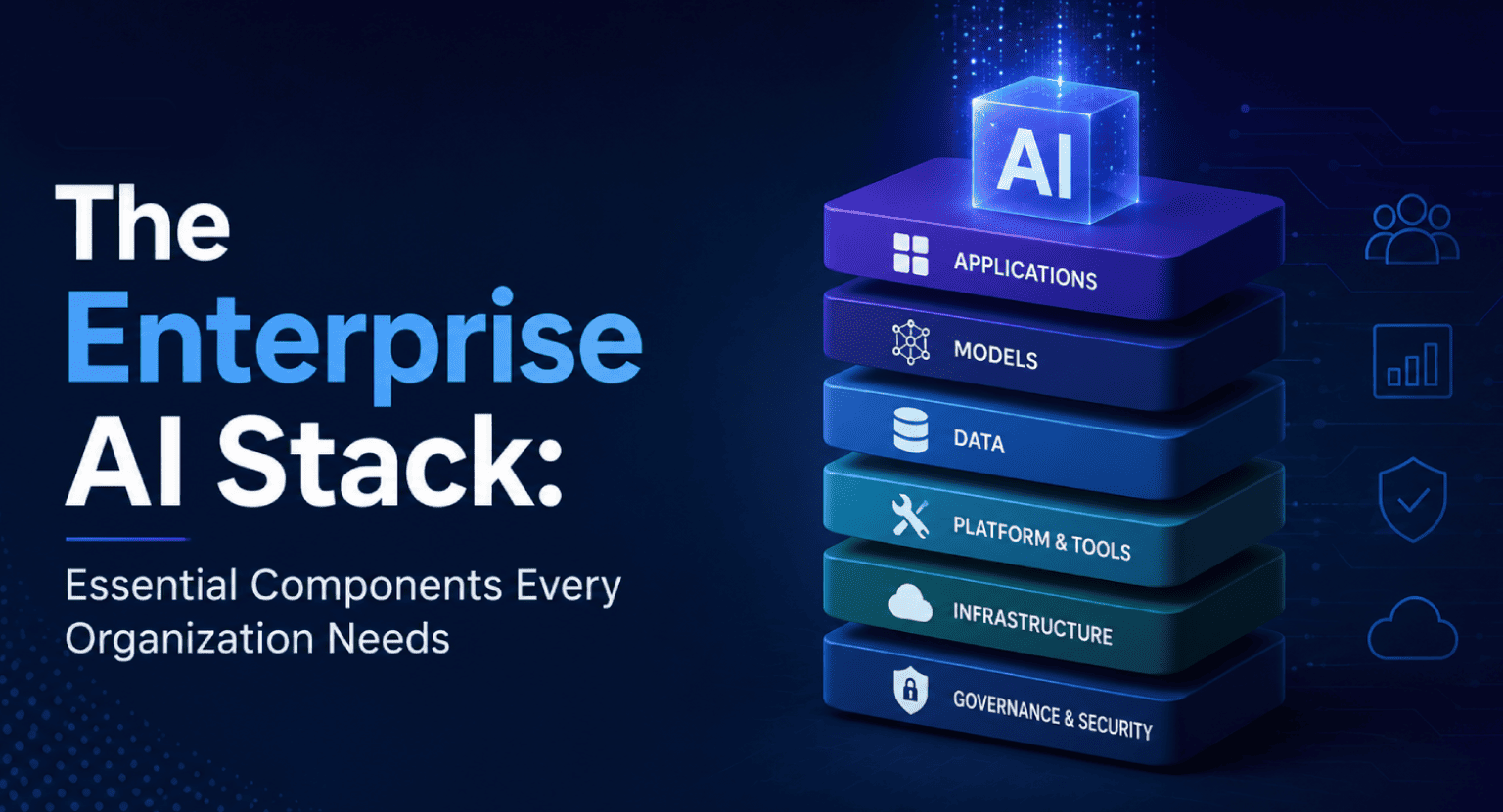
This ecosystem is commonly referred to as the Enterprise AI Stack. It consists of interconnected technologies, platforms, and processes that enable organizations to build, deploy, and scale AI solutions effectively.
Understanding the essential components of an enterprise AI stack is critical for businesses aiming to maximize the value of their AI investments and achieve long-term success.
Understanding the Enterprise AI Stack
What Is an Enterprise AI Stack?
An Enterprise AI Stack is the collection of technologies, infrastructure, frameworks, and operational processes that support the complete lifecycle of artificial intelligence initiatives within an organization.
The stack provides the foundation for:
- Data collection and management
- AI model development
- Machine learning operations
- AI deployment and monitoring
- Security and compliance
- Business integration
A robust AI stack ensures that AI solutions can scale efficiently while maintaining performance, reliability, and governance.
Why Organizations Need a Structured AI Stack
Many organizations begin their AI journey with isolated projects. While these initiatives may demonstrate value, they often struggle to scale due to fragmented infrastructure and disconnected workflows.
A structured AI stack helps organizations:
- Standardize AI development
- Accelerate deployment
- Improve collaboration
- Reduce operational complexity
- Ensure regulatory compliance
- Support enterprise-wide AI adoption
As AI becomes more deeply integrated into business operations, having a comprehensive AI stack becomes essential.
Core Components of the Enterprise AI Stack
Data Layer
The data layer forms the foundation of every AI initiative. AI systems rely on large volumes of high-quality data to generate accurate insights and predictions. Without reliable data, even the most advanced AI models will struggle to deliver meaningful results.
Key components of the data layer include:
- Data warehouses
- Data lakes
- Data pipelines
- Data integration tools
- Data governance platforms
- Master data management systems
Organizations must ensure that data is accurate, accessible, secure, and properly governed.
Data Processing and Engineering Layer
Raw data often requires significant preparation before it can be used for AI applications. The data engineering layer is responsible for:
- Data cleansing
- Data transformation
- Data enrichment
- Feature engineering
- Data validation
- Data orchestration
Efficient data processing enables AI models to learn from high-quality and consistent datasets.
AI and Machine Learning Development Layer
This layer provides the tools and frameworks required to build, train, and evaluate AI models. Data scientists and machine learning engineers use these platforms to develop intelligent solutions that address business challenges.
Common capabilities include:
- Model development
- Training environments
- Experiment tracking
- Hyperparameter optimization
- Model evaluation
- Version control
A strong development layer accelerates innovation while improving model quality and reproducibility.
Machine Learning Operations (MLOps)
What Are MLOps?
MLOps is the practice of applying DevOps principles to machine learning workflows. It enables organizations to manage the entire AI lifecycle efficiently, from development and deployment to monitoring and maintenance.
Key Functions of MLOps
MLOps platforms support:
- Automated model deployment
- Continuous integration and delivery
- Model version management
- Performance monitoring
- Automated retraining
- Workflow orchestration
By implementing MLOps practices, organizations can scale AI initiatives more effectively while reducing operational risks.
Benefits of MLOps
MLOps helps organizations:
- Accelerate AI deployment
- Improve collaboration between teams
- Ensure model consistency
- Reduce downtime
- Enhance operational efficiency
As AI adoption grows, MLOps becomes a critical component of the enterprise AI stack.
AI Infrastructure Layer
Computing Resources
AI workloads often require significant computational power. Organizations typically rely on:
- High-performance CPUs
- Graphics Processing Units (GPUs)
- AI accelerators
- Distributed computing environments
These resources support model training, inference, and large-scale data processing.
Cloud and Hybrid Infrastructure
Many enterprises use cloud-based environments to support AI initiatives due to their scalability and flexibility. Deployment options include:
- Public cloud environments
- Private cloud infrastructure
- Hybrid cloud architectures
- Multi-cloud strategies
The right infrastructure depends on organizational requirements, security needs, and workload characteristics.
Storage Systems
AI systems generate and consume large amounts of data.
Scalable storage solutions are essential for:
- Training datasets
- Model artifacts
- Operational logs
- Analytical outputs
Efficient storage management supports performance and scalability.
AI Deployment and Inference Layer
Model Deployment
Once an AI model is developed, it must be deployed into production environments where it can generate business value. Deployment options may include:
- Web applications
- Enterprise software
- Mobile applications
- APIs
- Business process automation platforms
A reliable deployment layer ensures consistent and scalable AI performance.
Real-Time and Batch Inference
Organizations often require different inference approaches depending on use cases. Real-time inference supports:
- Fraud detection
- Customer support
- Recommendation systems
- Predictive maintenance
Batch inference supports:
- Reporting
- Forecasting
- Data analysis
- Large-scale business processing
An effective AI stack should support both deployment models.
AI Governance and Compliance Layer
Importance of AI Governance
As AI adoption increases, organizations must ensure that AI systems operate responsibly and transparently. AI governance helps establish:
- Ethical AI practices
- Risk management frameworks
- Compliance controls
- Accountability mechanisms
- Operational standards
Strong governance reduces legal, operational, and reputational risks.
Regulatory Compliance
Organizations must comply with evolving regulations related to:
- Data privacy
- Security requirements
- Industry standards
- Ethical AI guidelines
Compliance should be integrated throughout the AI lifecycle.
Explainability and Transparency
Enterprise AI systems should provide visibility into how decisions are made. Explainable AI helps organizations:
- Build stakeholder trust
- Improve accountability
- Meet regulatory requirements
- Identify model bias
Transparency is becoming a critical requirement for enterprise AI adoption.
Security Layer
Protecting AI Systems
AI systems face many of the same cybersecurity risks as traditional applications, along with unique AI-specific threats. Organizations must secure:
- Training data
- Models
- APIs
- Infrastructure
- User access
Strong security controls protect sensitive information and maintain system integrity.
Identity and Access Management
Controlling access to AI systems is essential for reducing security risks. Organizations should implement:
- Role-based access controls
- Multi-factor authentication
- Privileged access management
- Audit logging
These measures strengthen overall AI security.
Business Integration Layer
Connecting AI with Enterprise Systems
AI solutions deliver the most value when integrated into existing business workflows. Integration may involve:
- Enterprise Resource Planning (ERP) systems
- Customer Relationship Management (CRM) platforms
- Business intelligence tools
- Collaboration software
- Operational applications
Seamless integration ensures that AI insights can be acted upon effectively.
Workflow Automation
AI-powered automation enables organizations to streamline operations and improve efficiency. Common applications include:
- Customer service automation
- Process optimization
- Intelligent document processing
- Predictive decision-making
Automation enhances productivity while reducing operational costs.
Monitoring and Continuous Improvement Layer
AI Performance Monitoring
AI models require continuous monitoring to ensure ongoing effectiveness. Organizations should track:
- Model accuracy
- Prediction quality
- System performance
- Resource utilization
- User feedback
Monitoring helps identify issues before they impact business outcomes.
Model Retraining and Optimization
Business conditions and data patterns change over time. Continuous improvement processes help organizations:
- Update models
- Improve accuracy
- Reduce drift
- Enhance reliability
- Maintain business relevance
Regular optimization ensures sustained AI value.
Benefits of a Well-Designed Enterprise AI Stack
Faster AI Adoption: A structured AI stack accelerates development and deployment across the organization.
Improved Scalability: Organizations can support growing AI workloads without significant operational disruption.
Better Governance and Compliance: Built-in governance capabilities reduce risk and support regulatory requirements.
Increased Operational Efficiency: Automation and standardized processes improve productivity and reduce costs.
Enhanced Business Value: A comprehensive AI stack enables organizations to deliver measurable business outcomes from AI investments.
Future Trends in Enterprise AI Stacks
Generative AI Integration
Generative AI capabilities will become a standard component of enterprise AI architectures.
AI Platform Consolidation
Organizations will increasingly adopt unified platforms that simplify AI development and management.
Autonomous AI Operations
AI systems will become more self-managing through advanced automation and intelligent orchestration.
Edge AI Expansion
More AI workloads will be processed closer to where data is generated, improving performance and reducing latency.
Responsible AI Frameworks
Governance, transparency, and ethical AI practices will play an increasingly important role in enterprise AI strategies.
Final Thoughts
Artificial intelligence is no longer a standalone technology initiative. It has become a core component of modern business strategy.
Building successful AI solutions requires a strong foundation supported by data infrastructure, machine learning platforms, deployment frameworks, governance controls, security measures, and continuous monitoring.
A well-designed enterprise AI stack enables organizations to scale AI initiatives efficiently, maintain compliance, improve operational performance, and maximize business value.
As AI adoption continues to accelerate, enterprises that invest in a comprehensive and future-ready AI stack will be better positioned to innovate, compete, and thrive in an increasingly intelligent digital economy.
Need Help Building an Enterprise AI Stack?
If your organization is planning to implement AI solutions or modernize its AI infrastructure, Swayam Infotech can help design, develop, and deploy scalable enterprise AI architectures tailored to your business objectives.

 English
 Arabic
 Français
 Español
 Português
 Deutsch
 Türkçe
 Italiano
 Russian
 Romaian