


The EOR calculation most CFOs are getting wrong
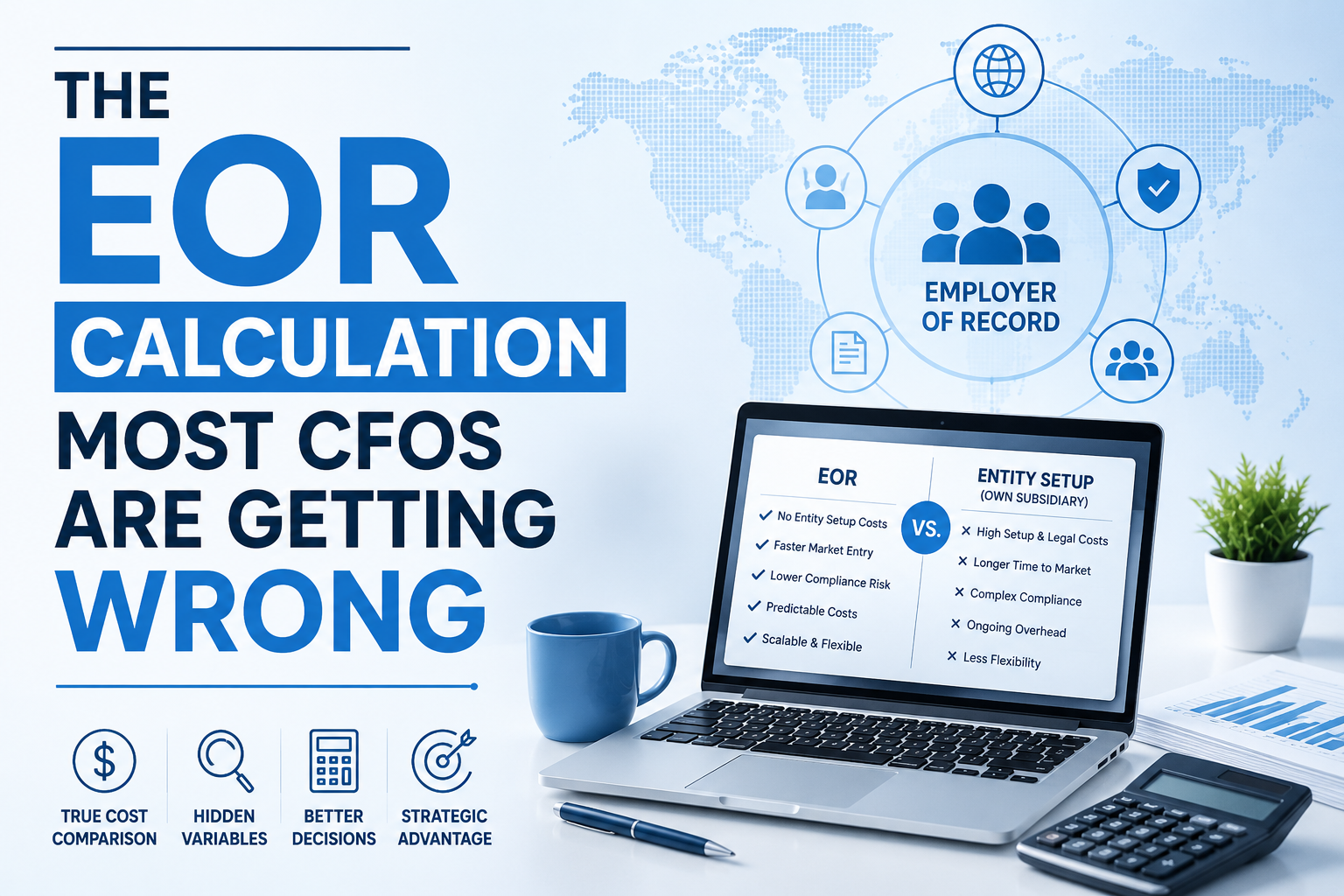
When a company wants to hire in a country where it doesn't have a legal entity, it faces a decision that looks simpler than it is: set up an entity, or use an Employer of Record.
Most CFOs run this analysis. Most of them run it incompletely. The result is either an entity setup that cost three times the projection and took nine months longer than expected, or an EOR arrangement that was dismissed as "too expensive" based on a narrow cost comparison that missed most of the actual costs on both sides of the ledger.
Here's how to run the analysis properly.
What entity setup actually costs
The quoted cost of incorporating a foreign entity is usually the registration and legal fees. It's also usually the smallest part of what you'll actually spend.
The full cost of operating a foreign entity includes local registered agent fees, local accounting and payroll compliance costs, annual audit requirements in many jurisdictions, local tax counsel, local HR support, banking infrastructure, local employment law compliance on an ongoing basis, and the internal management time of whoever owns all of the above. In most Western European countries, this runs $75,000–$150,000 per year in operational overhead, exclusive of the initial setup costs, which typically range from $20,000–$50,000 depending on jurisdiction.
That's before you account for the opportunity cost: entity setup typically takes four to nine months. Whatever business outcome you were trying to accelerate by hiring local talent is delayed by that window.
And there's a less-quantifiable cost that rarely makes it into the model: the governance burden. Every entity is a legal presence that requires ongoing management. When you have entities in six countries and the business strategy shifts, you now have six entities to unwind. That process takes roughly as long as setup and costs roughly as much.
What EOR actually costs
The honest case for EOR includes its own full-cost picture, which is also often presented incompletely.
EOR pricing is typically presented as a per-employee-per-month fee. For a single mid-level professional in Germany, that might run $1,200–$1,800 per month in EOR fees. That number makes CFOs wince, especially when compared against the marginal cost of adding another employee to an existing entity in a market where you're already operating.
But the comparison to "marginal cost on an existing entity" is a false comparison. The relevant comparison is to the alternative: what it would actually cost to establish and operate that entity, spread across however many employees will be hired there over the relevant time horizon.
For a company with five employees or fewer in a given country, EOR almost always wins on cost. The crossover point where entity setup becomes economically rational varies by jurisdiction, but a useful rule of thumb is around 15–25 employees on a sustained basis. Below that threshold, the overhead of owning the entity eats the "savings."
The variables most models miss
There are five factors that consistently produce inaccurate entity-vs-EOR analyses:
Time value. The four-to-nine-month entity setup timeline represents real business delay. If the hire you're trying to make is revenue-generating — a sales leader, a key client relationship manager, a technical lead for a market expansion — every month of delay has a quantifiable revenue cost. Almost no entity-vs-EOR models include this.
Reversal cost. EOR is inherently reversible. If the market doesn't develop as planned, you close the engagement. An entity requires formal dissolution, which takes months, costs money, and requires ongoing compliance until completion. The optionality value of EOR is real and large — particularly in markets where business plans carry meaningful uncertainty.
Management distraction cost. Someone in your finance and legal teams will own every foreign entity you establish. Their time has an opportunity cost. For smaller entities in complex jurisdictions, the management burden can consume 15–25% of a senior employee's annual time. This rarely appears in entity cost models.
Compliance risk. Operating a foreign entity without deep local expertise in employment law, payroll, benefits, and tax creates compliance risk. In markets with strong worker protections — France, Germany, Netherlands, Spain — non-compliance can result in substantial penalties. A credible EOR absorbs this risk; a self-managed entity carries it.
Speed to capability. EOR providers with established infrastructure in target markets can onboard an employee in days. Entity setup cannot. For companies moving quickly, this isn't a soft benefit — it's the difference between landing a key hire and losing them to a competitor who moved faster.
The right framework for the decision
Entity setup makes sense when:
- You plan to employ 20 or more people in the market on a sustained, multi-year basis
- The market represents a core, long-term strategic priority
- You have the internal capability to manage local compliance and HR without significant external support
- You have reason to believe the market will remain stable
EOR makes sense when:
- You're hiring fewer than 15–20 people in the market
- The market is new territory you're testing rather than an established strategic priority
- Speed to hire matters more than marginal per-employee cost savings
- You want compliance risk transferred rather than managed internally
- Your business plans carry meaningful uncertainty about the long-term scale of that market
Firms like Compunnel that operate EOR and payrolling services across the US, Canada, UK, and India regularly help enterprises run through this framework in specific market contexts — because the right answer is highly jurisdiction-dependent.
The question nobody asks until too late
The most expensive entity setup decisions aren't the ones that went wrong for compliance reasons. They're the ones that went right operationally but wrong strategically — where the entity was established, the employees were hired, and then the business case shifted.
Unwinding a legal presence in a market you're exiting is painful and expensive. The CFOs who've been through it once tend to hold EOR options in much higher regard the second time around.
The calculation isn't just "build versus buy." It's "own versus rent the option to change your mind." In fast-moving markets, that option is worth more than most models suggest.

 Arabic
 Français
 Español
 Português
 Deutsch
 Türkçe
 Dutch
Dutch
 Italiano
 Russian
 Romaian