


What Makes Agentic AI Different From LLMs?
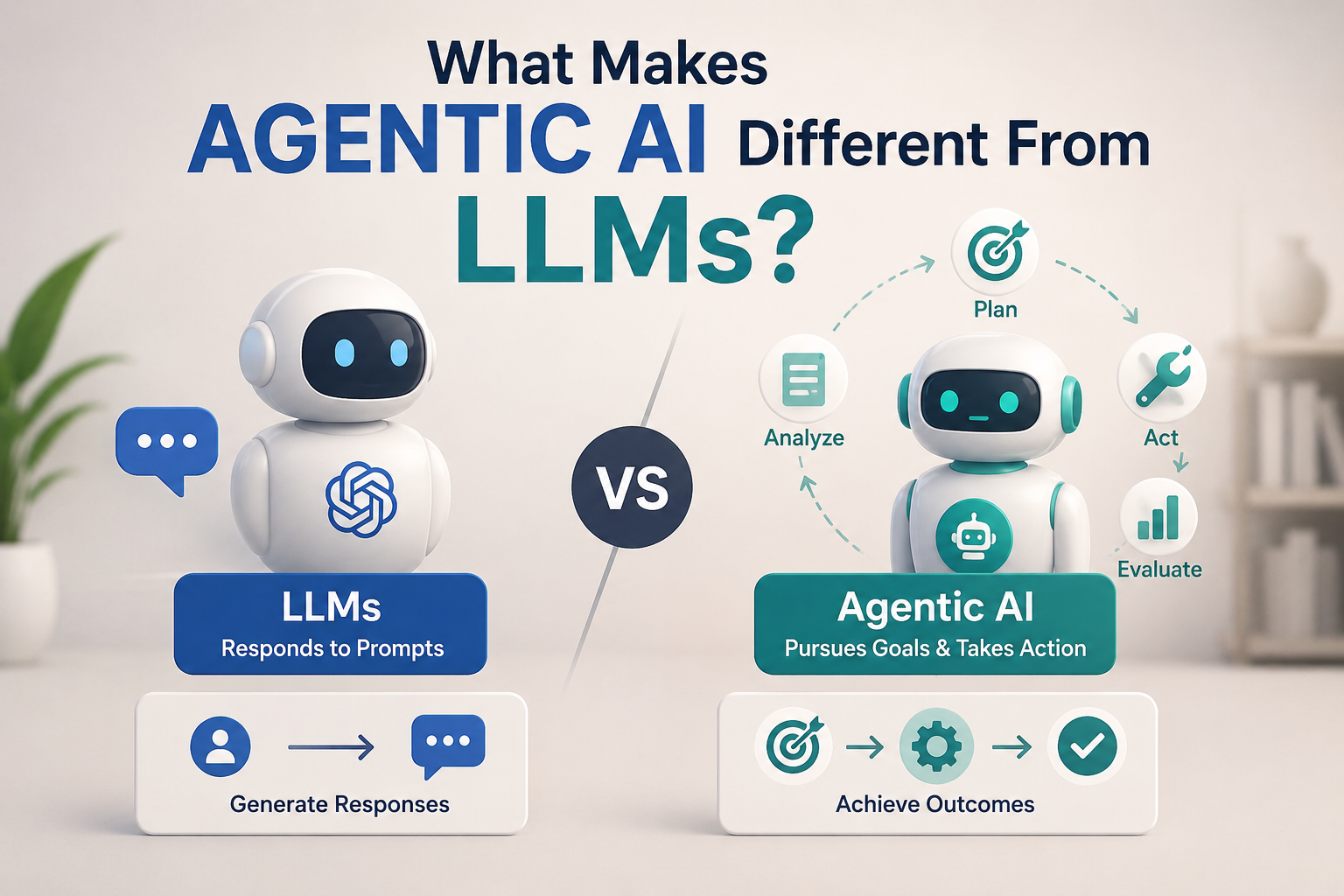
Quick Answer: Agentic AI differs from LLMs because it can plan, make decisions, and take actions to achieve goals, while LLMs primarily generate responses based on user prompts.
If you've been following the AI space, you've probably noticed a shift in the conversation. Everyone was talking about large language models (LLMs) a year ago. Now, the spotlight has moved — and it's landing squarely on Agentic AI.
But what's the actual difference? And why does it matter so much right now?
Let's break it down in a way that actually makes sense.
LLMs Respond. Agentic AI Acts.
This is the single most important distinction you need to understand. An LLM, no matter how powerful, is essentially a very sophisticated text predictor. You give it a prompt; it gives you a response — and then it stops.
Agentic AI doesn't stop. It plans, executes, evaluates outcomes, and adapts — all on its own. It doesn't wait for your next prompt to move forward. It sets a goal and works toward it through a sequence of autonomous actions.
Think of an LLM as a brilliant advisor sitting across the table. You ask a question; they answer it. Agentic AI, on the other hand, is the person who takes that advice, goes out, completes the task, comes back with results, and asks what's next.
How Agentic AI Thinks and Plans Differently Than LLMs?
LLMs operate within a single context window. Every conversation starts fresh, and the model has no real concept of multi-step reasoning beyond what you put in the prompt. It generates text — that's its world.
Agentic AI on the other hand breaks down a complex goal into subtasks, prioritizes them, uses tools, checks results and reroutes when something goes wrong. This is not a small upgrade this is a completely different architecture of intelligence.
When you enroll in an Agentic AI course, one of the first things you'll learn is how this reasoning loop works and why it changes everything about how we build AI-powered systems.
Also Check Out: Which is the best course to learn Agentic AI?
Key Capabilities That Set Agentic AI Apart From LLMs
Here's where real technical differentiation lives. Agentic AI brings a set of capabilities to the table that LLMs simply were not designed to handle:
-
Memory across sessions: Unlike LLMs, agentic systems maintain memory, both short-term and long-term, allowing them to build context over time and make smarter decisions in the future.
-
Multi-agent collaboration: Agentic AI can spin up sub-agents, delegate tasks, and coordinate outputs across multiple AI systems simultaneously — something a standalone LLM cannot do.
-
Feedback and self-correction: When an action fails, an agentic system evaluates what went wrong and adjusts its approach. LLMs don't have this loop — they just respond to whatever prompt they receive.
-
Goal persistence: Agentic AI keeps working toward an objective across multiple steps and sessions, without requiring constant human input to stay on track.
These capabilities are what make Agentic AI a genuinely new paradigm — not just a smarter chatbot.
Why LLMs Hit a Ceiling That Agentic AI Breaks Through?
LLMs are extraordinary at natural language tasks — summarizing, writing, translating, and coding. But they hit hard limits when you put them in front of real-world workflows that require sustained action.
Here's exactly where LLMs fall short — and where Agentic AI steps in:
-
Static output vs Dynamic execution: LLMs produce text. Agentic AI produces outcomes. The difference between describing a process and actually running it is enormous in production environments.
-
No environment awareness: An LLM has no awareness of what's happening outside the conversation. Agentic AI can observe its environment, interact with it, and respond to changes in real time.
-
Single-turn limitations: LLMs are optimized for single-turn or short multi-turn interactions. Complex tasks that unfold over minutes, hours, or days are outside their scope. Agentic AI on the other hand, can go beyond that limitation.
-
Dependency on human orchestration: Every time you want an LLM to do something new, a human must prompt it. Agentic AI reduces that dependency dramatically by orchestrating its own next steps.
This ceiling is exactly why enterprises are racing to build and deploy agentic systems — and why professionals who understand them are in enormous demand right now.
Real-World Scenarios Where Agentic AI Outperforms LLMs
Let's make this concrete. Here are scenarios where Agentic AI delivers results that an LLM simply cannot:
-
Automated research pipelines: An agentic system can search the web, read documents, extract key data, synthesize findings, and deliver a formatted report — all without human prompting at each step.
-
Software development workflows: Agentic AI can write code, run it, identify bugs, fix them, re-run tests, and push changes iteratively — turning what used to take hours into a near-autonomous process.
-
Customer support automation: Rather than just answering a query, an agentic system can pull up an account, check order history, initiate a refund, and send a confirmation email — completing the entire resolution loop.
-
Financial analysis and monitoring: Agentic AI can continuously monitor data sources, trigger alerts, generate reports, and even execute predefined actions based on what it observes.
These aren't future possibilities. These are deployments happening right now across healthcare, finance, logistics, and tech.
Will Agentic AI Replace Traditional LLMs?
The short answer is no.
Agentic AI and LLMs serve different purposes and are most effective when used together.
LLMs provide the intelligence needed to understand language and generate responses. And Agentic AI provides the autonomy needed to execute tasks and achieve objectives.
Future AI systems will likely combine both capabilities to create solutions that can communicate effectively while also taking meaningful action.
This combination has the potential to redefine how businesses automate operations and deliver value.
Conclusion
Agentic AI isn't LLMs with extra features bolted on. It's a fundamentally different model of how AI operates in the world — one built around action, autonomy, and real outcomes rather than just generating responses.
LLMs changed how we interact with information. Agentic AI is changing how work actually gets done. The gap between the two isn't a matter of scale — it's a matter of kind. One answers questions. The other solves problems end to end, without waiting to be asked.
As agentic systems move deeper into enterprise workflows, healthcare, finance, and software development, the professionals who understand Full Stack Agentic AI will be the ones driving it.

 English
 Arabic
 Français
 Español
 Português
 Deutsch
 Türkçe
 Dutch
Dutch
 Russian
 Romaian