


Best Practices for Implementing Dynamics 365 Supply Chain Management
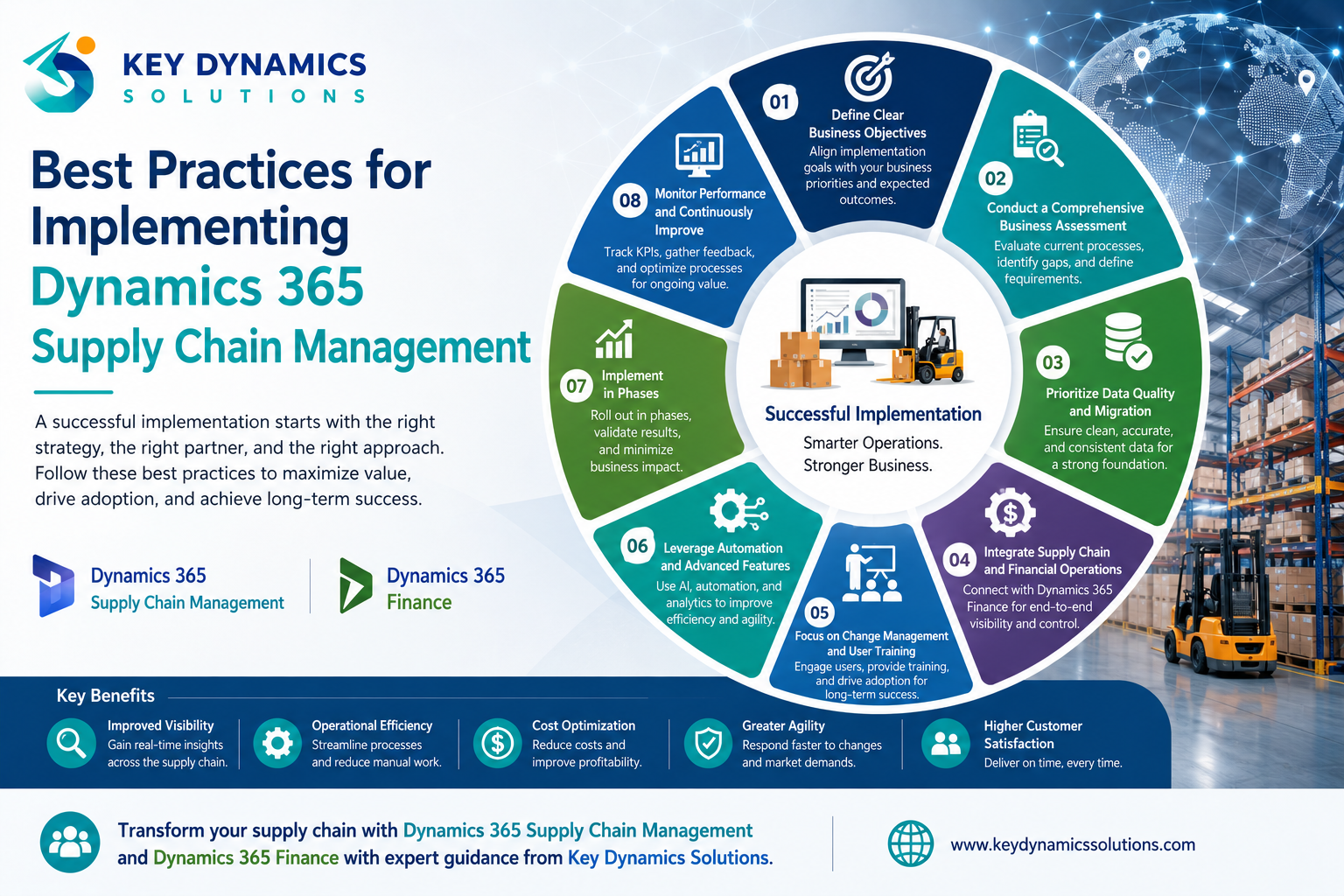
Implementing a modern supply chain solution is a strategic investment that can transform business operations, improve efficiency, and enhance customer satisfaction. However, achieving the full benefits of Dynamics 365 Supply Chain Management requires careful planning, clear objectives, and a structured implementation approach. Organizations that follow best practices can reduce deployment risks, accelerate user adoption, and maximize their return on investment.
At Key Dynamics Solutions, we help businesses successfully implement Dynamics 365 Supply Chain Management and Dynamics 365 Finance to streamline operations, improve visibility, and support long-term growth.
Define Clear Business Objectives
Before starting the implementation process, organizations should identify their specific business goals. Every company faces unique supply chain challenges, whether related to inventory management, warehouse operations, procurement, production planning, or supplier collaboration.
Establishing clear objectives helps ensure that the implementation aligns with business priorities and delivers measurable outcomes. Common goals include:
-
Improving inventory accuracy
-
Reducing operational costs
-
Enhancing demand forecasting
-
Streamlining procurement processes
-
Increasing supply chain visibility
A well-defined strategy provides a roadmap for successful deployment and future growth.
Conduct a Comprehensive Business Assessment
A thorough assessment of existing processes is essential before implementing Dynamics 365 Supply Chain Management. Organizations should evaluate current workflows, identify inefficiencies, and document operational requirements.
This assessment helps businesses understand where improvements are needed and ensures that the new solution is configured to support real-world operations. It also helps uncover potential integration requirements with other business systems, including Microsoft Dynamics 365 Finance.
By understanding current challenges and future goals, organizations can design a solution that delivers maximum value.
Prioritize Data Quality and Migration
Data is the foundation of any successful ERP and supply chain implementation. Poor-quality data can lead to inaccurate reporting, inventory discrepancies, and operational disruptions.
Before migrating information into Dynamics 365 Supply Chain Management, organizations should clean, validate, and standardize their data. Key data categories include:
-
Product information
-
Inventory records
-
Supplier data
-
Customer records
-
Financial information
A well-planned data migration strategy helps ensure accuracy, minimizes errors, and supports smooth system adoption.
Integrate Supply Chain and Financial Operations
One of the greatest advantages of implementing Dynamics 365 Supply Chain Management alongside Dynamics 365 Finance is the ability to create a connected business ecosystem.
Integration between supply chain and finance functions provides greater visibility into operational and financial performance. Businesses can track inventory costs, procurement spending, production expenses, and overall profitability in real time.
This unified approach improves decision-making, enhances collaboration between departments, and ensures consistency across the organization.
Focus on Change Management and User Training
Technology alone does not guarantee success. Employees must understand how to use the system effectively to achieve desired results.
Organizations should invest in comprehensive training programs that prepare users for new processes and workflows. Training should be role-specific and provide practical guidance for daily tasks.
Effective change management includes:
-
Communicating project goals
-
Engaging stakeholders early
-
Providing hands-on training
-
Offering ongoing support
-
Encouraging user feedback
Strong user adoption significantly increases the likelihood of a successful implementation.
Leverage Automation and Advanced Features
Dynamics 365 Supply Chain Management includes powerful automation capabilities that help reduce manual work and improve operational efficiency. Organizations should take full advantage of features such as:
-
Automated inventory replenishment
-
Demand forecasting
-
Warehouse automation
-
Supplier collaboration tools
-
AI-driven insights and analytics
Utilizing these advanced capabilities allows businesses to improve productivity and gain greater control over supply chain operations.
Implement in Phases
Large-scale implementations can become complex if too many processes are introduced simultaneously. A phased implementation approach reduces risk and allows organizations to focus on critical business functions first.
Businesses can begin with core modules such as inventory management, procurement, or warehouse operations before expanding to advanced capabilities.
A phased rollout enables teams to identify issues early, make adjustments, and ensure smoother adoption across the organization.
Monitor Performance and Continuously Improve
Implementation is only the beginning of the digital transformation journey. Organizations should regularly monitor system performance and measure results against established objectives.
Key performance indicators (KPIs) may include:
-
Inventory turnover
-
Order fulfillment rates
-
Warehouse efficiency
-
Supplier performance
-
Operational costs
Continuous evaluation helps businesses identify opportunities for improvement and maximize the long-term value of their investment.
Why Partner with Key Dynamics Solutions?
Successful implementation requires technical expertise, industry knowledge, and a clear understanding of business processes. Key Dynamics Solutions provides end-to-end support for Dynamics 365 Supply Chain Management and Dynamics 365 Finance implementations.
Our team works closely with organizations to plan, deploy, customize, and optimize solutions that align with business goals while ensuring minimal disruption to operations.
Conclusion
Implementing Dynamics 365 Supply Chain Management can significantly improve operational efficiency, visibility, and supply chain resilience. By following best practices such as defining clear objectives, ensuring data quality, integrating financial operations, investing in user training, and leveraging automation, organizations can achieve a successful deployment and long-term business value.
With expert guidance from Key Dynamics Solutions, businesses can confidently implement Dynamics 365 Supply Chain Management and Dynamics 365 Finance to build a smarter, more agile, and future-ready supply chain.

 Arabic
 Français
 Español
 Português
 Deutsch
 Türkçe
 Dutch
Dutch
 Italiano
 Russian
 Romaian