


AI Data Pipelines: Preparing Enterprise Data for Intelligent Applications
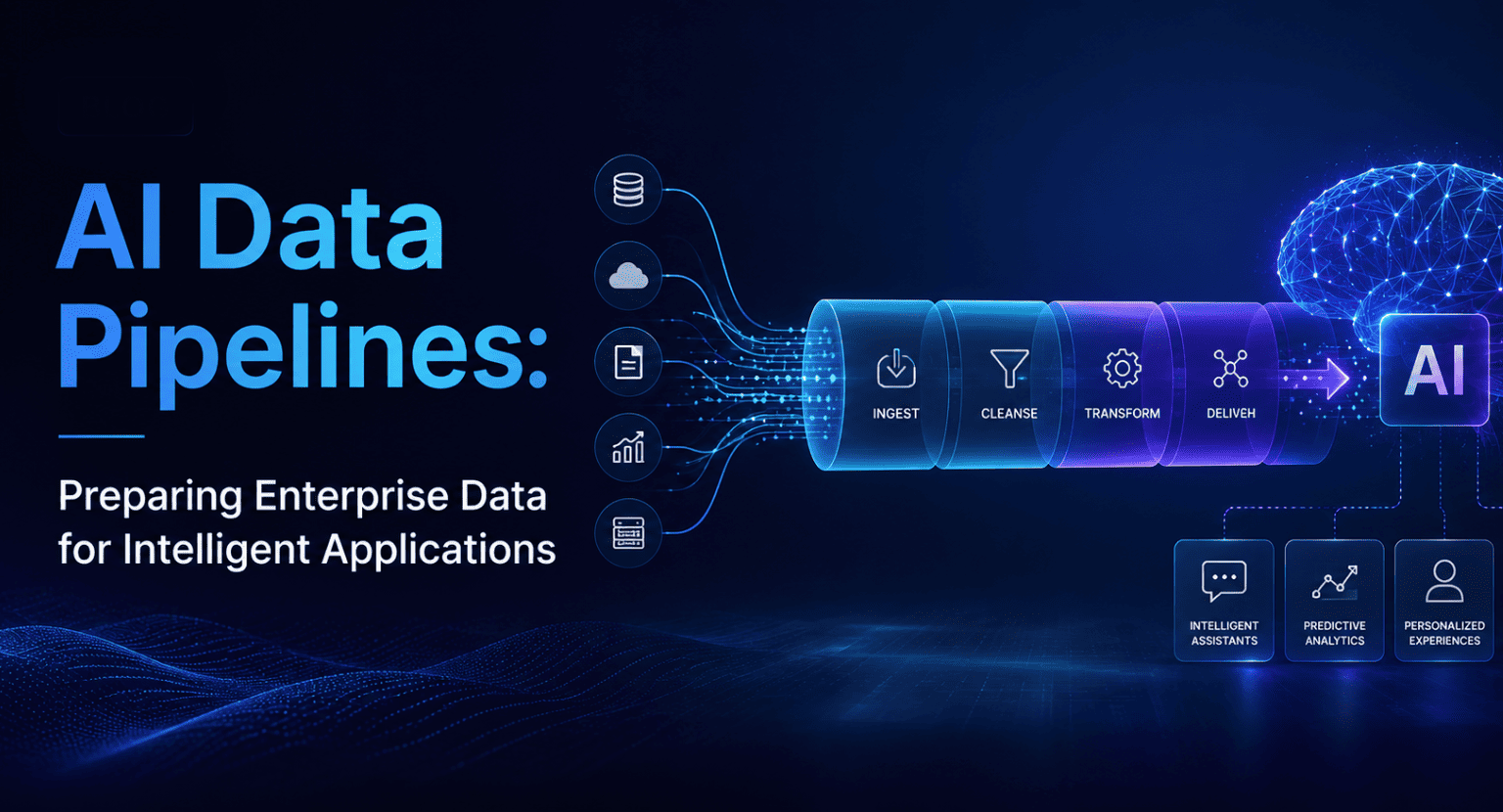
Artificial intelligence is transforming how organizations operate, make decisions, and deliver value to customers. From predictive analytics and intelligent automation to generative AI and machine learning models, modern AI applications rely heavily on data as their foundation.
However, simply collecting large volumes of data is not enough. Enterprise data often exists across multiple systems, formats, and environments, making it difficult to use effectively for AI initiatives. Poor data quality, fragmented data sources, and inconsistent processing can significantly impact the performance of AI models and intelligent applications.
This is where AI data pipelines play a critical role. By automating the collection, transformation, validation, and delivery of data, AI data pipelines ensure that organizations have access to accurate, reliable, and AI-ready information.
As enterprises increasingly invest in AI technologies, building robust data pipelines has become essential for achieving scalable and successful AI outcomes.
Understanding AI Data Pipelines
What Is an AI Data Pipeline?
An AI data pipeline is a structured process that collects, processes, transforms, and delivers data from various sources to AI and machine learning systems. The primary objective of a data pipeline is to ensure that data is:
- Accurate
- Consistent
- Reliable
- Timely
- Secure
- Ready for AI consumption
Data pipelines automate complex workflows that would otherwise require significant manual effort, enabling organizations to scale their AI initiatives efficiently.
Why AI Data Pipelines Matter
AI systems are only as effective as the data they receive. Incomplete, outdated, or inaccurate data can lead to poor predictions, unreliable insights, and ineffective decision-making.
AI data pipelines help organizations:
- Improve data quality
- Reduce manual data preparation
- Accelerate AI model development
- Enable real-time analytics
- Support data governance
- Enhance operational efficiency
Without a well-designed data pipeline, even the most advanced AI technologies may fail to deliver meaningful business value.
The Challenges of Enterprise Data
Data Silos
Many organizations store data across multiple systems, departments, and applications. Common sources include:
- Enterprise Resource Planning (ERP) systems
- Customer Relationship Management (CRM) platforms
- Cloud applications
- Databases
- IoT devices
- Business intelligence tools
When these systems operate independently, data becomes fragmented and difficult to access.
Data Quality Issues
Enterprise data often contains:
- Duplicate records
- Missing values
- Inconsistent formats
- Outdated information
- Human errors
Poor data quality can significantly impact AI model accuracy and reliability.
Large Data Volumes
Modern enterprises generate enormous amounts of structured and unstructured data every day. Managing this volume efficiently requires scalable infrastructure and automated processing capabilities.
Real-Time Data Requirements
Many AI applications depend on real-time or near-real-time information. Examples include:
- Fraud detection
- Predictive maintenance
- Recommendation engines
- Customer service automation
Traditional batch processing methods may not be sufficient for these use cases.
Core Components of an AI Data Pipeline
Data Ingestion Layer
The first stage of any AI data pipeline involves collecting data from various sources. Data ingestion can occur through:
- APIs
- Databases
- Cloud storage systems
- Streaming platforms
- IoT devices
- Enterprise applications
The ingestion layer ensures that relevant data is captured and made available for processing.
Data Integration Layer
Enterprise data often comes from multiple systems with different formats and structures. Data integration combines these sources into a unified view that can be used by AI applications. This process helps eliminate data silos and improve accessibility across the organization.
Data Transformation Layer
Raw data is rarely suitable for direct use in AI systems. Transformation processes may include:
- Data cleansing
- Standardization
- Aggregation
- Normalization
- Feature engineering
- Data enrichment
These activities improve data quality and prepare information for machine learning workflows.
Data Storage Layer
Processed data must be stored efficiently for analysis and model training. Common storage solutions include:
- Data lakes
- Data warehouses
- Cloud storage platforms
- Distributed file systems
The storage layer provides scalability and accessibility for AI workloads.
Data Delivery Layer
The final stage of the pipeline delivers prepared data to AI models, analytics platforms, and business applications. This enables intelligent systems to generate predictions, recommendations, and insights in a timely manner.
Data Preparation for AI Applications
Data Cleaning
Data cleaning is one of the most important steps in preparing enterprise data for AI. This process involves:
- Removing duplicates
- Correcting errors
- Filling missing values
- Eliminating irrelevant information
Clean data improves model accuracy and reduces operational risks.
Data Labeling
Many machine learning models require labeled datasets for training. Labeling involves assigning meaningful categories or outcomes to data points so that AI systems can learn patterns effectively. Accurate labeling is essential for supervised learning applications.
Feature Engineering
Feature engineering transforms raw data into meaningful variables that improve model performance. Examples include:
- Creating new data attributes
- Combining related variables
- Calculating derived metrics
- Extracting patterns from text or images
Well-designed features often have a significant impact on AI outcomes.
Data Validation
Validation ensures that data meets predefined quality standards before it is used by AI systems. Organizations can implement automated checks to identify:
- Missing fields
- Invalid values
- Data inconsistencies
- Processing errors
This helps maintain data reliability throughout the pipeline.
AI and Automation in Data Pipelines
Intelligent Data Processing
Artificial intelligence can improve pipeline efficiency by automatically identifying patterns, anomalies, and quality issues within datasets. This reduces manual intervention and improves processing accuracy.
Automated Data Classification
AI-powered systems can classify and organize large datasets automatically. This is particularly useful for handling unstructured data such as:
- Documents
- Images
- Audio files
- Customer communications
Automation accelerates data preparation and analysis.
Real-Time Data Monitoring
AI can continuously monitor data pipelines to detect anomalies, bottlenecks, and performance issues. Proactive monitoring helps organizations maintain reliable and uninterrupted data operations.
Self-Optimizing Pipelines
Advanced AI systems can optimize data workflows by automatically adjusting processing strategies based on workload patterns and performance metrics. This improves scalability and operational efficiency.
Enterprise Use Cases
Customer Analytics
AI data pipelines help organizations consolidate customer information from multiple touchpoints, enabling personalized experiences and targeted marketing.
Predictive Maintenance
Industrial organizations use data pipelines to process equipment sensor data and predict potential failures before they occur.
Financial Risk Management
Financial institutions rely on AI-ready data to support fraud detection, risk assessment, and regulatory compliance initiatives.
Supply Chain Optimization
AI-powered data pipelines enable real-time visibility into inventory, logistics, and demand forecasting processes.
Healthcare Analytics
Healthcare providers use data pipelines to prepare clinical, operational, and patient data for advanced analytics and AI-driven decision-making.
Benefits of AI Data Pipelines
Improved Data Quality: Automated validation and cleansing processes ensure consistent and reliable information.
Faster AI Development: Well-prepared data accelerates model training, testing, and deployment.
Enhanced Scalability: Automated pipelines can process growing data volumes without significant manual effort.
Better Decision-Making: High-quality data enables more accurate insights and predictions.
Reduced Operational Costs: Automation reduces the time and resources required for data preparation and management.
Challenges and Considerations
Data Security and Privacy
Organizations must protect sensitive information throughout the pipeline lifecycle. Strong encryption, access controls, and compliance measures are essential.
Integration Complexity
Connecting diverse enterprise systems can be technically challenging and may require specialized expertise.
Data Governance
Organizations need clear governance policies to maintain data quality, ownership, and compliance.
Infrastructure Requirements
Large-scale AI data pipelines require scalable computing, storage, and networking resources. Proper infrastructure planning is critical for long-term success.
Technologies Powering AI Data Pipelines
Extract, Transform, Load (ETL) Platforms: ETL tools automate the movement and preparation of data across systems.
Data Streaming Technologies: Streaming platforms support real-time data processing and analytics.
Cloud Data Platforms: Cloud environments provide scalable storage and processing capabilities for AI workloads.
Machine Learning Operations (MLOps): MLOps platforms integrate data pipelines with machine learning workflows and model management processes.
Data Observability Tools: Data observability solutions monitor pipeline health, quality, and performance to ensure reliability.
Future Trends in AI Data Pipelines
Real-Time AI Data Processing
Organizations will increasingly adopt real-time pipelines to support immediate decision-making and intelligent automation.
Data-Centric AI Strategies
Greater emphasis will be placed on improving data quality rather than focusing solely on model complexity.
Autonomous Data Pipelines
AI-powered systems will automate data preparation, validation, and optimization with minimal human intervention.
Unified Data Platforms
Enterprises will move toward integrated platforms that combine data management, analytics, and AI capabilities within a single ecosystem.
Enhanced Governance and Compliance
As regulations evolve, organizations will strengthen governance frameworks to ensure responsible data management and AI usage.
Final Thoughts
Data is the foundation of every successful AI initiative, and AI data pipelines are the infrastructure that transforms raw enterprise information into valuable business intelligence.
By automating data ingestion, integration, transformation, validation, and delivery, organizations can ensure that their AI systems operate on accurate, reliable, and high-quality information.
As enterprises continue to expand their use of artificial intelligence, investing in robust data pipeline architectures will become increasingly important for scalability, efficiency, and long-term success.
Organizations that build strong AI data pipelines will be better positioned to develop intelligent applications, improve decision-making, and unlock the full value of their data assets.
Need Help Building AI-Ready Data Pipelines?
If your organization is looking to modernize its data infrastructure, implement AI-ready data pipelines, or optimize enterprise data workflows, Swayam Infotech can help design and deploy scalable solutions tailored to your business requirements.
 Deutsch
 English
 Arabic
 Français
 Español
 Português
 Türkçe
 Dutch
Dutch
 Italiano
 Russian
 Romaian