


GEO Ranking Factors That Influence Brand Visibility In AI Commerce
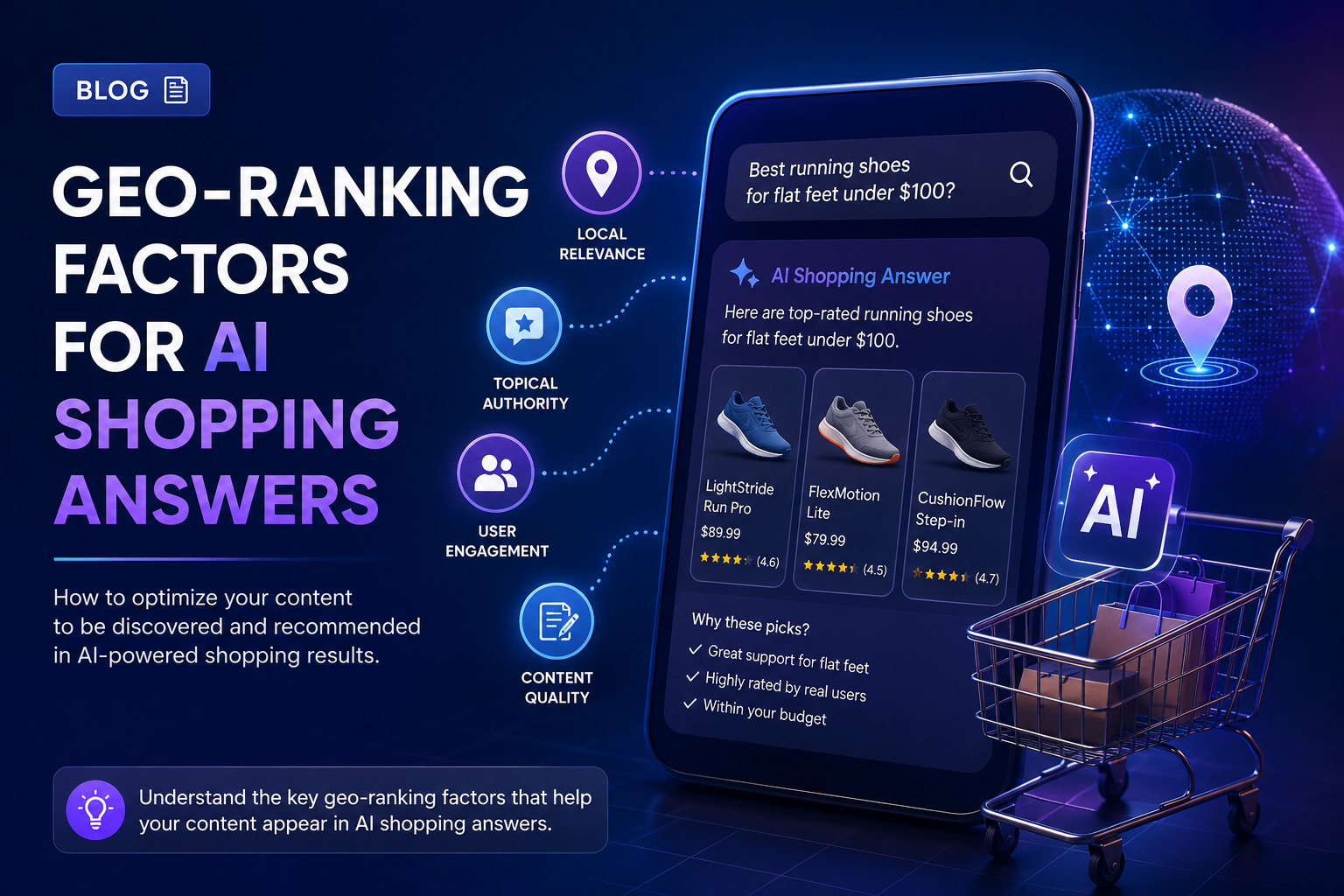
GEO Ranking Factors Are Driving A New Search Landscape
The rise of generative AI is changing how people discover products, compare services, and evaluate brands. Instead of reviewing dozens of webpages, consumers can now ask AI assistants specific questions and receive curated recommendations in seconds. As these experiences become increasingly common, GEO ranking factors are emerging as one of the most important influences on digital visibility.
Unlike traditional search engines that primarily rank webpages, generative platforms focus on delivering the best possible answer. To do this, they assess information from multiple sources, identify trustworthy content, and determine which brands deserve inclusion in recommendations. Businesses that understand how these systems evaluate information will be better positioned to compete in an AI-driven marketplace.
Why GEO Ranking Factors Matter For Long-Term Growth
Businesses that want to remain visible in evolving search environments must understand how GEO ranking factors influence AI-generated recommendations. Visibility is no longer determined solely by search rankings. Instead, it increasingly depends on whether AI systems consider a brand reliable, authoritative, and relevant.
When customers ask AI assistants for product recommendations or business solutions, only a limited number of brands are typically mentioned. This makes inclusion highly valuable. Companies that establish trust and expertise can position themselves directly in front of potential customers at critical decision-making moments.
As AI-powered search becomes more integrated into everyday commerce, GEO will continue influencing how brands acquire customers and build market presence.
AI Is Reshaping Product Research
Research behavior has changed dramatically over the last few years. Consumers now expect fast, personalized answers that help them make decisions without extensive manual research.
For example, a shopper looking for project management software may ask an AI assistant to compare leading platforms based on scalability, ease of use, and collaboration features. Rather than visiting multiple websites, the user receives a concise summary.
This change is one reason businesses are investing more resources into generative AI search engine optimization. Appearing in AI-generated recommendations can influence purchasing decisions earlier in the customer journey.
Educational Content Builds Stronger Authority
Generative engines are designed to prioritize information that helps users understand topics and solve problems. Businesses that publish educational content often create stronger authority signals than those focused solely on product promotion.
Content that explains industry challenges, implementation processes, best practices, and real-world applications provides additional value to both users and AI systems. Over time, this helps establish a reputation for expertise.
Organizations that consistently educate their audience often build stronger digital authority, improving their chances of being referenced within AI-generated answers.
Relevance Is Becoming More Sophisticated
Traditional SEO often emphasized keyword targeting. While keywords still matter, AI-powered systems place greater emphasis on contextual relevance.
Generative engines attempt to understand the intent behind a query and evaluate whether content addresses the user's underlying objective. A business searching for marketing automation software may actually be looking for better lead nurturing, campaign efficiency, or customer segmentation.
Content that addresses these broader goals often performs better because it aligns more closely with user expectations and decision-making processes.
Common GEO Obstacles For Organizations
Many businesses understand the importance of AI visibility but encounter practical challenges during implementation.
Content Fragmentation
Large organizations frequently manage content across multiple teams and platforms. This can lead to inconsistencies in messaging and information quality.
Outdated Information
Product details, service offerings, and industry trends evolve rapidly. Outdated content can weaken trust signals and reduce visibility.
Limited Strategic Alignment
Without a unified approach, content, marketing, and product teams may pursue different objectives, creating gaps that affect overall authority.
Addressing these issues requires ongoing collaboration and content governance rather than isolated optimization efforts.
User Intent Has Become A Core Ranking Signal
Understanding customer intent is becoming one of the most valuable capabilities in modern search optimization. AI systems aim to identify what users are trying to achieve rather than focusing only on keywords.
A company evaluating supply chain software may be seeking cost reduction, process automation, inventory accuracy, or operational visibility. Businesses that address these objectives often provide more useful information and create stronger relevance signals.
Many generative engine optimization best practices focus on understanding customer goals and creating resources that support informed decision-making.
Structured Information Supports Better Results
Well-organized content helps AI systems process information more effectively. Clear structures improve readability and make it easier for generative engines to identify important insights.
Businesses can improve content quality through:
- Clear topic organization
- Detailed product information
- Customer-focused FAQs
- Practical examples
- Consistent formatting
These elements help both users and AI systems understand content more efficiently, increasing the likelihood of inclusion in generated recommendations.
Building Authority Beyond Owned Media
Authority is no longer built exclusively through company websites. AI systems evaluate credibility across a broad range of digital sources before generating recommendations.
Industry publications, customer reviews, expert commentary, analyst reports, and professional communities all contribute to a brand's authority profile. Consistent visibility across trusted channels strengthens credibility and reinforces trust signals.
Several effective generative engine optimization techniques involve expanding influence through thought leadership, industry engagement, and strategic content distribution.
Consistency Creates Sustainable Visibility
One of the most important aspects of GEO is consistency. Businesses that maintain accurate information, regularly update content, and reinforce expertise over time often achieve stronger results.
Consistency helps generative systems develop confidence in a source and improves customer trust. It also supports long-term authority building by ensuring that information remains reliable across all channels.
Organizations that focus on sustained quality rather than short-term tactics often create more durable visibility advantages.
Preparing For The Future Of AI Search
The influence of AI-powered search is expected to grow significantly as consumers become increasingly comfortable relying on conversational interfaces. Businesses that begin strengthening authority and trust today will be better positioned as adoption accelerates.
Many of the top generative engine optimization strategies for AI visibility focus on timeless principles such as expertise, customer value, relevance, and credibility. These factors are likely to remain important regardless of how search technology evolves.
Companies that embrace these principles now can build a strong foundation for future growth.
Final Thoughts
The increasing adoption of AI-generated recommendations is making GEO ranking factors a critical part of digital visibility strategies. Businesses that focus on authority, educational content, relevance, and trust are more likely to appear in AI-powered search experiences.
As generative search continues transforming how customers discover information, organizations must adapt by creating content that helps users make informed decisions. Brands that consistently provide value and maintain credibility will be best positioned to succeed in the future of AI commerce.
FAQs
1. How do GEO ranking factors affect AI recommendations?
They help AI systems determine which sources are trustworthy and relevant enough to be included in generated answers.
2. Is educational content important for GEO?
Yes. Educational content demonstrates expertise and provides context that AI systems use when evaluating authority.
3. Can GEO improve visibility for service-based businesses?
Absolutely. Service providers can benefit from AI-generated recommendations by building authority and publishing helpful content.
4. Why is consistency important for GEO?
Consistent information strengthens trust signals and helps AI systems evaluate content more confidently.
5. How can businesses start improving GEO performance?
They can begin by auditing content quality, improving information accuracy, strengthening authority, and focusing on user intent.

 English
 Arabic
 Français
 Español
 Português
 Deutsch
 Türkçe
 Dutch
Dutch
 Russian
 Romaian