


CTF for Beginners: Complete Guide to Capture The Flag Hacking
CTF (Capture The Flag) is a hands-on cybersecurity competition where participants solve security challenges to find hidden strings of text called "flags." Each flag you retrieve earns points. The team or individual with the most points at the end wins.
Unlike textbook learning, CTF for Beginners drops you into realistic scenarios: a vulnerable web application, an encoded binary file, an encrypted message and asks you to break through using real offensive security techniques. That direct, problem first format is why CTF competitions are now one of the primary pipelines for entry level security talent at companies like Google, Microsoft, and Cloudflare.
The term comes from the classic outdoor game where two teams try to steal each other's flags. In the digital version, flags are usually formatted strings like flag{th1s_1s_4_fl4g} hidden inside vulnerable systems, encoded files, or exploitable applications.
CTFs broadly fall into two formats:
Jeopardy style: A board of challenges across multiple categories (web, cryptography, forensics, binary exploitation). Teams solve challenges independently and earn points per flag. Most beginner CTF competitions use this format.
Attack/Defense: Teams defend their own servers while actively attacking opponents' infrastructure. This format demands greater skill and is more common at professional level events.
Why CTF Challenges Are the Fastest Way to Learn Hacking
Security certifications teach you what vulnerabilities are. CTF challenges make you exploit them. That gap in practical application is significant and it's exactly what employers test during technical interviews.
Consider a few facts that explain the surge in CTF participation:
|
Metric |
Data Point |
|
Global cybersecurity job openings |
3.5 million unfilled positions (ISC² 2023 Workforce Study) |
|
Employers requiring hands-on lab experience |
67% of security hiring managers (SANS 2024 survey) |
|
CTF participants who landed security roles faster |
Reported by over 50% of HTB community members |
|
Annual CTF events tracked on CTFtime |
Over 400 competitions per year |
|
OWASP Top 10 categories covered by CTF challenge types |
8 out of 10 |
When you solve a beginner CTF challenge involving SQL injection, you are not memorizing a definition, you are writing a payload, watching a database respond, and extracting data. That muscle memory is what makes CTF training so effective compared to passive study.
Neuroscience research consistently shows that active, problem based learning produces dramatically better long term skill retention than passive reading or lecture, a principle that applies directly to cybersecurity education.
CTF Challenge Categories Explained
Every beginner needs to understand what they will actually face inside a CTF competition. Here are the core categories, what skill each one builds, and how that skill transfers to a security career.
Web Exploitation
Web challenges are the most beginner friendly CTF category. You are given a URL to a vulnerable web application and tasked with finding and exploiting a flaw SQL injection, cross site scripting (XSS), insecure direct object references (IDOR), or authentication bypasses are common starting points.
These challenges directly map to the OWASP Top 10, the industry standard framework for web application vulnerabilities. Practicing web exploitation in CTF environments teaches you both the attacker's perspective and critically how to write code that doesn't have those flaws in the first place.
If SQL injection challenges interest you, the hands-on SQL Injection lab at AppSecMaster lets you practice this exact vulnerability class in a structured, guided environment designed for developers and security learners alike.
Cryptography Challenges
Cryptography challenges test your ability to identify weak cipher implementations, decode encoded messages, and break encryption schemes with known vulnerabilities. You might encounter Caesar ciphers, Base64 encoding, weakly generated RSA keys, or poorly implemented hashing functions.
These challenges develop an understanding of why strong cryptography matters and how developers inadvertently introduce cryptographic weaknesses by misusing libraries or implementing custom encryption.
Reverse Engineering for Beginners
Reverse engineering challenges provide a compiled binary or obfuscated code and ask you to determine what it does. Tools like Ghidra (free, open source) and IDA Pro are standard. Beginners start with simple assembly language analysis; more advanced challenges involve anti debugging techniques and obfuscated executables.
This category builds foundational skills for malware analysis, secure software design, and understanding how compilers transform source code directly relevant to the kind of deep analysis practiced in professional source code review.
Binary Exploitation (Pwn)
Binary exploitation often called "pwn" in CTF terminology involves finding and leveraging memory safety vulnerabilities like buffer overflows, use after free bugs, and format string flaws to execute arbitrary code or escalate privileges on a target system.
These challenges are more technically demanding and typically appear in intermediate to advanced CTF tracks. However, understanding binary exploitation fundamentals is enormously valuable for secure software development because it makes the consequences of memory management errors viscerally clear.
Forensics Challenges
Forensics CTF challenges ask you to analyze disk images, network packet captures (PCAPs), log files, or file metadata to reconstruct an incident or extract hidden data. Steganography hiding data inside images or audio files is a common sub category within forensics.
OSINT (Open Source Intelligence)
OSINT challenges test your ability to gather and correlate publicly available information to answer specific questions. These challenges require no coding knowledge, making them an excellent entry point for absolute beginners. They build research skills directly applicable to threat intelligence and social engineering defense.
How to Start CTF as a Complete Beginner
The most common mistake new learners make is trying to enter a competitive CTF before building any foundational skills. Here is a practical approach that actually produces results.
Step 1: Learn the basics of how web applications work. You cannot exploit what you do not understand. Spend time learning HTTP requests and responses, how cookies and sessions function, how databases interact with application code, and what a server side vs. client side operation looks like. Free resources like PortSwigger's Web Security Academy cover these fundamentals well.
Step 2: Set up your practice environment. Install a Linux virtual machine (Kali Linux or Parrot OS are the standard choices for security practice). Both distributions come pre loaded with tools used in CTF competitions. Familiarity with the Linux command line is a prerequisite even basic navigation, file permissions, and networking commands make a substantial difference.
Step 3: Start with web and OSINT challenges only. Resist the temptation to attempt binary exploitation or advanced cryptography immediately. Web and OSINT challenges have the lowest barrier to entry and deliver the fastest confidence building wins. Solving your first beginner CTF challenge, even a simple one, is motivating in a way that failing a hard binary exploitation challenge is not.
Step 4: Read write ups after attempting challenges. A write up is a walkthrough of how someone solved a specific CTF challenge. Reading write ups after your own attempt (whether you succeeded or failed) accelerates learning dramatically. CTFtime.org maintains an extensive archive of write ups for past competitions.
Step 5: Move to structured lab platforms. After you've solved a handful of standalone challenges, move to platforms that offer guided, progressive difficulty tracks. Structured environments contextualize individual vulnerability classes within broader application security frameworks, giving your skills more professional applicability.
The App Security Master platform combines source code review challenges with hands-on vulnerability labs, a pairing that helps learners understand both how to find flaws and how those flaws appear in real code. That dual perspective (attacker and developer) is what distinguishes strong security practitioners from those who only know how to run tools.
The Beginner CTF Skill Roadmap
The following roadmap is structured to take a complete beginner from zero knowledge to competing confidently in entry level CTF events over approximately 8–12 weeks of consistent practice.
Weeks 1–2: Foundations
-
Linux command line basics (file navigation, permissions, networking commands)
-
HTTP fundamentals: how requests, responses, headers, and cookies work
-
Introduction to browser developer tools (Network tab, Console, Source)
-
First OSINT challenge on any beginner friendly platform
Weeks 3–4: Web Exploitation Basics
-
SQL injection: UNION based, error based, and blind injection techniques
-
Cross site scripting (XSS): reflected vs. stored, cookie theft concepts
-
Authentication flaws: weak passwords, predictable tokens, session fixation
-
Solve 5–10 beginner web challenges; read write ups for every challenge you attempt
Weeks 5–6: Cryptography and Encoding
-
Encoding schemes: Base64, hex, URL encoding, HTML entities
-
Classic ciphers: Caesar, Vigenère, ROT13, frequency analysis
-
Hashing basics: MD5/SHA families, rainbow tables, why salting matters
-
Introduction to RSA and asymmetric cryptography concepts
Weeks 7–8: Forensics and Steganography
-
Network packet analysis using Wireshark
-
File format analysis: magic bytes, file carving, metadata extraction
-
Basic steganography: LSB encoding in images, hidden data in audio files
-
EXIF data extraction and file metadata investigation
Weeks 9–10: Introduction to Reverse Engineering
-
Assembly language basics: registers, stack operations, function calls
-
Static analysis using Ghidra or Binary Ninja (free tier)
-
Understanding how C programs compile to executable code
-
Deobfuscating simple scripts in Python, JavaScript, and Bash
Weeks 11–12: First CTF Competition
-
Select a beginner rated event on CTFtime.org (look for events labeled "beginner" or rated below 20 difficulty)
-
Compete as a team if possible collaboration accelerates learning
-
Document every challenge you attempt, even unsuccessful ones
-
After the competition, read all available write ups and rebuild your notes
Tools Every Beginner CTF Player Needs
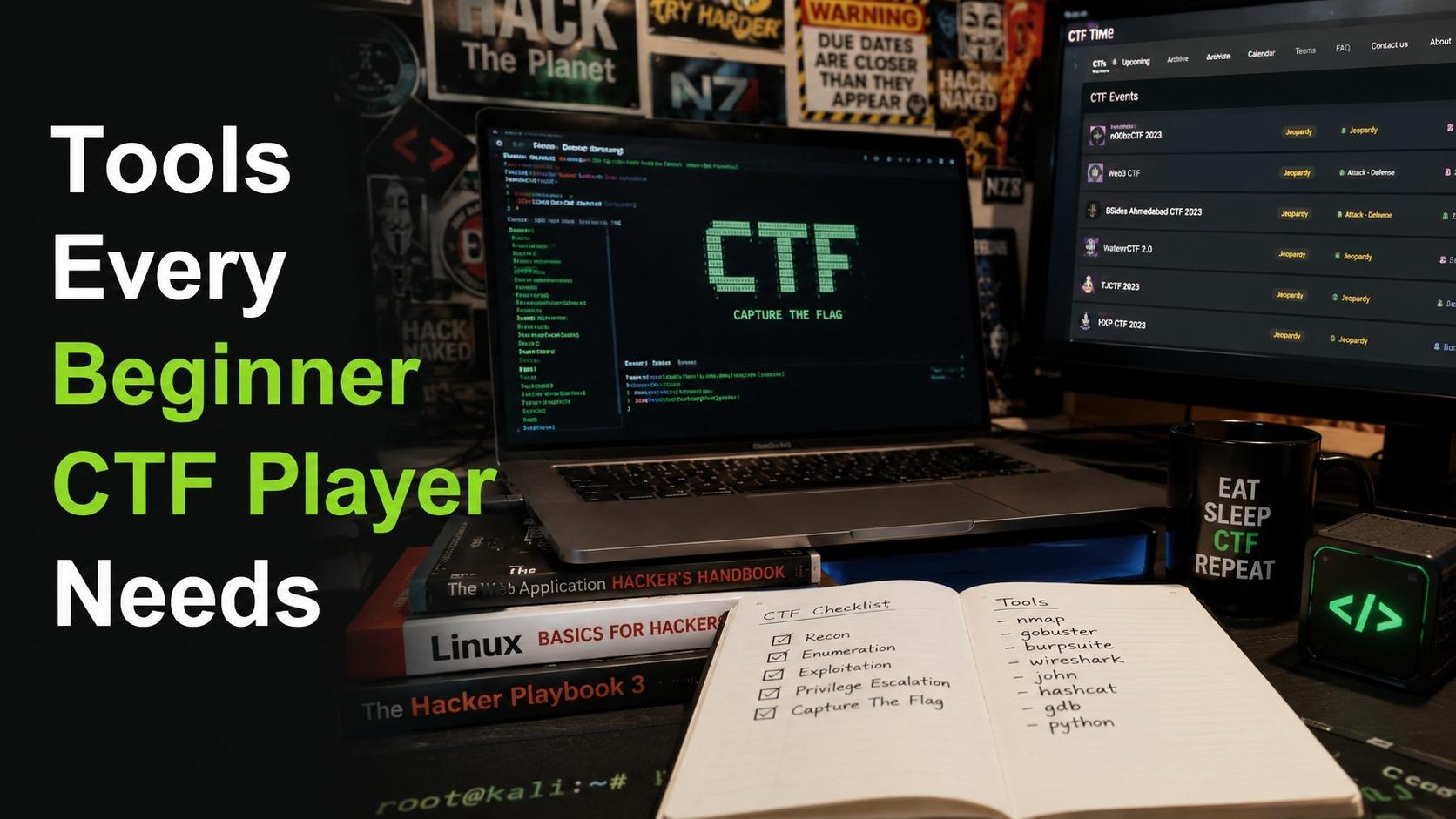
You do not need an expensive toolkit to start competing in CTF challenges. The following free tools cover the majority of beginner challenge categories:
For Web Exploitation:
-
Burp Suite Community Edition intercept and modify HTTP traffic, replay requests, and test injection points
-
Firefox or Chrome developer tools inspect page source, monitor network requests, manipulate cookies
-
SQL map automated SQL injection detection (use in practice environments only)
For Cryptography:
-
CyberChef a browser based tool for encoding, decoding, and cipher operations; invaluable for beginner cryptography challenges
-
hashcat or John the Ripper password hash cracking for challenges involving weak credential storage
For Forensics:
-
Wireshark network packet capture analysis
-
Binwalk analyze and extract files embedded in firmware images or binary files
-
ExifTool extract metadata from images, documents, and other files
-
Stegsolve apply visual filters to images to reveal hidden steganographic content
For Reverse Engineering:
-
Ghidra (NSA) free, powerful decompiler and disassembler
-
GDB GNU debugger for analyzing binary behavior at runtime
-
strings command extract readable text from binary files; often finds flags in simple challenges
For General Use:
-
A Kali Linux or Parrot OS virtual machine (VMware or VirtualBox)
-
Python 3 for writing quick scripts to automate encoding/decoding operations
How CTF Competitions Connect to Real Security Jobs
CTF skills are not just academic; they directly translate into the technical capabilities employers test during security hiring.
Penetration testers use web exploitation techniques daily. Application security engineers need deep familiarity with how vulnerabilities like those covered in OWASP Top 10 actually manifest in code. Incident responders use forensics skills from CTF forensics challenges to reconstruct attacks. Malware analysts draw on reverse engineering fundamentals.
Bug bounty programs where researchers earn money finding vulnerabilities in real applications are essentially CTF competitions with real world targets and financial rewards. Many successful bug bounty hunters credit CTF practice as the foundation of their skills.
CVE data from 2023 shows that web application vulnerabilities (injection, XSS, authentication flaws) remain the dominant category across reported security incidents, accounting for over 40% of breach entry points. The challenge categories in CTF competitions are not arbitrary; they reflect where real world security failures actually occur.
For developers specifically, understanding how attackers approach code is a transformative experience. The AppSecMaster source code review labs are designed to bridge that exact gap: giving developers and security learners the experience of identifying vulnerabilities directly in source code, not just in running applications. If you have experience with Java, the Java Security Code Review guide is a practical next step after completing beginner web CTF challenges.
The App Security Master leaderboard tracks community progress across challenges, creating the same competitive motivation that makes CTF competitions so effective at driving skill development.
Beginner CTF Platforms Compared
|
|
Best For |
Cost |
Difficulty Range |
Code Review Focus |
|
picoCTF |
Absolute beginners, students |
Free |
Beginner |
No |
|
CTFlearn |
Solo self-paced practice |
Free |
Beginner–Intermediate |
No |
|
HackTheBox (free tier) |
Structured learning paths |
Free/Paid |
Intermediate+ |
No |
|
TryHackMe |
Guided beginner onboarding |
Free/Paid |
Beginner–Intermediate |
No |
|
OverTheWire |
Linux/systems fundamentals |
Free |
Beginner |
No |
|
AppSecMaster |
Web security + code review |
Platform |
Beginner–Advanced |
Yes |
The most significant gap across general CTF platforms is the absence of source code review as a discipline. Most platforms teach you to find vulnerabilities in running applications but not to identify them directly in code before deployment, which is the earlier and more cost effective intervention in a real software development lifecycle.
Common Beginner Mistakes to Avoid
Trying too many categories at once. Focus is more productive than breadth at the start. Pick web exploitation or OSINT, and go deep for at least a month before expanding to other categories.
Skipping write ups because you solved the challenge. Even when you find a flag, reading other players' write ups shows alternative approaches you would not have considered. There are almost always multiple valid solution paths.
Using automated tools before understanding manual techniques. Running SQLmap before you understand how SQL injection works produces no lasting skill. Learn the manual technique first; use the tool to scale later.
Competing alone indefinitely. Solo practice builds skills, but competing in a team introduces you to specializations you haven't developed yet and accelerates learning through collaboration. Most beginner CTF events explicitly welcome small teams.
Ignoring the developer side of security. CTF challenges teach you to attack. But the most valuable security practitioners understand both attack and defense which means understanding how secure code is written, not just how vulnerable code is exploited. This is where combining CTF practice with structured application security training, including hands-on code review, produces practitioners who can contribute across the full software development lifecycle rather than only in a specialized offensive role.
Frequently Asked Question (FAQs)
What is CTF for beginners in cybersecurity?
CTF (Capture The Flag) is a cybersecurity competition format in which participants solve security challenges across categories such as web exploitation, cryptography, and forensics to find hidden "flag" strings. Beginner CTFs are designed for learners with minimal prior experience and use simplified, guided scenarios to build foundational hacking skills.
Do I need programming knowledge to start CTF challenges?
No, OSINT and basic forensics CTF challenges require no programming knowledge at all. As you progress into web exploitation and reverse engineering, basic scripting in Python becomes useful, but it is not a prerequisite for getting started. Many successful CTF competitors learned programming through competing, not before.
How long does it take to get good at CTF competitions?
Most beginners can solve their first beginner CTF challenges within 2–4 weeks of focused practice. Reaching a competitive level in intermediate difficulty events typically takes 3–6 months of regular practice, depending on background knowledge and practice frequency. Consistency matters more than intensity.
What is the best first CTF platform for beginners?
picoCTF (from Carnegie Mellon University) is widely recommended as the most beginner accessible starting point due to its structured difficulty progression and extensive hint system. CTFlearn is a good parallel option for self paced, category specific practice.
How do CTF skills connect to application security?
CTF web challenges directly practice the same vulnerability classes that application security teams defend against SQL injection, XSS, authentication bypasses, and insecure deserialization all appear both in CTF competitions and in real world security audits. Combining CTF practice with structured source code review training creates practitioners who understand the full vulnerability lifecycle from introduction in code to exploitation in production.

 English
 Arabic
 Français
 Português
 Deutsch
 Türkçe
 Dutch
Dutch
 Italiano
 Russian
 Romaian