


Recovery Timeline After Knee Replacement Surgery: Week-by-Week Guide
Severe knee pain can make even the simplest tasks, like walking to the next room or climbing stairs, feel like a mountain to climb. When conservative treatments like medications and physiotherapy stop giving relief, undergoing a total knee replacement in Patna becomes the most effective way to regain your mobility and live pain-free.
However, deciding to undergo surgery is only the first step. For a truly successful outcome, understanding the knee replacement surgery recovery period is absolutely essential. While the surgical procedure lays the foundation, your dedication to rehabilitation dictates how quickly you get back on your feet. It is important to remember that recovery is a gradual journey that varies from person to person depending on your age, overall health, and commitment to rehabilitation.
Choosing an experienced knee replacement specialist in Patna ensures you have the right medical guidance at every stage. Dr Ashwini Gaurav, a highly trusted and top-rated orthopedic doctor in Patna, specializes in advanced joint reconstruction, helping patients navigate their recovery smoothly and safely.
What to Expect After Knee Replacement Surgery
The entire knee replacement surgery process is highly structured, designed to get you moving as quickly as safely possible.
-
Hospital Stay: Typically, a patient spends about 2 to 5 days at the best knee replacement hospital in Patna, depending on how quickly their vitals stabilize and how well they manage initial mobility.
-
The Role of Physiotherapy: Rehabilitation starts almost immediately. Dedicated physical therapy is non-negotiable to prevent joint stiffness and build muscle strength around the new implant.
-
Key Factors Influencing Your Recovery:
-
Age: Younger patients often have more muscle reserve, while elderly patients may require a slightly more gradual pace.
-
Overall Health: Managing pre-existing conditions like diabetes or hypertension effectively speeds up tissue healing.
-
Type of Surgery: Advanced, minimally invasive techniques can reduce immediate post-operative trauma.
-
Commitment to Exercises: Your daily dedication to home exercises is the single biggest factor in determining your long-term joint flexibility.
-
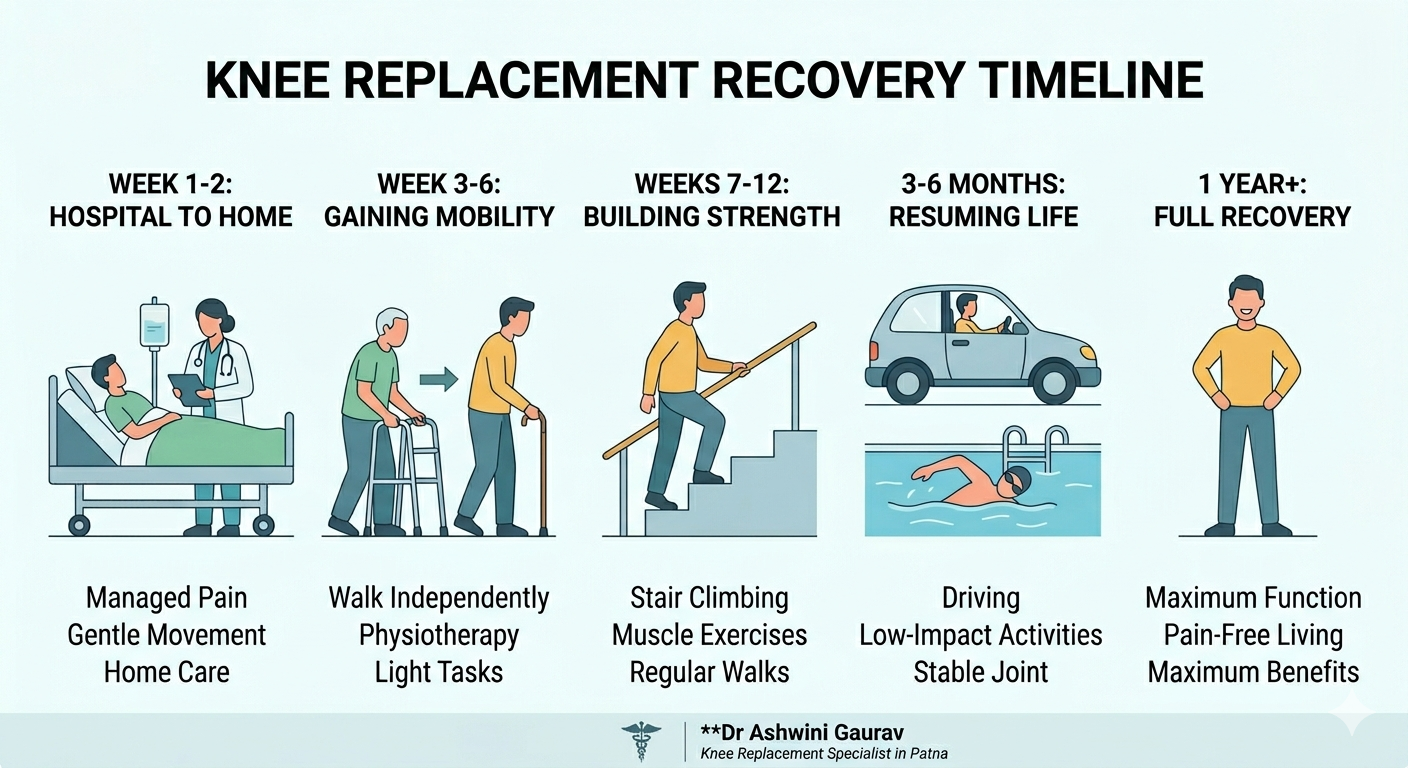
Week 1: Immediate Recovery (Days 1–7)
What Happens?
The first week is all about managing post-surgical adjustments. Some amount of pain and swelling is entirely expected as your body begins to heal. Surprisingly, your mobilization starts almost immediately—most patients are encouraged to take their first few steps with support within 24 hours of surgery. Discharge from the hospital generally happens between days 2 and 5 once you can safely transition to a bed and use the washroom with an assistive device.
Goals During Week 1
-
Keep surgical pain well under control.
-
Begin gentle, passive knee movements to prevent blood clots.
-
Safely stand and walk short distances using a walker or crutches.
Tips for Patients
-
Take all prescribed pain medications strictly on time; do not wait for the pain to become severe.
-
Elevate your leg above heart level and use ice packs to bring down the swelling.
-
Regularly perform the basic ankle pumps and breathing exercises taught at the hospital.
Week 2: Regaining Mobility (Days 8–14)
Improvements You May Notice
By the second week, the intense surgical pain begins to transition into a dull ache, and localized swelling should start decreasing. You will find yourself navigating short distances around your house with greater ease and confidence.
Rehabilitation Focus
-
Attend your home or outpatient physiotherapy sessions diligently.
-
Focus heavily on knee straightening (extension) and bending (flexion) exercises.
-
Gradually increase the distance you walk around the house, ensuring an even gait.
Activities to Avoid
-
Sudden twisting or pivoting movements on the operated leg.
-
Prolonged standing in the kitchen or balcony.
-
High-impact movements or lifting heavy objects.
Weeks 3–6: Building Strength and Independence
Common Milestones
This is the phase where you truly start reclaiming your independence. Your reliance on walking aids like walkers or crutches will decrease, and many patients transition to using a simple walking stick or walking completely unaided. Your dependency on strong prescription painkillers will also reduce significantly.
Recommended Exercises
-
Straight Leg Raises: To build strength in your quadriceps (thigh muscles).
-
Heel Slides: To safely increase the bending range of your knee.
-
Targeted Quadriceps Strengthening: To ensure your knee can support your full body weight without buckling.
Returning to Daily Activities
-
You can start climbing stairs one step at a time, using the handrail for support.
-
Light household tasks that do not involve heavy lifting are perfectly fine.
-
If you have a desk job, you may consider resuming work remotely or in a limited capacity, depending on your comfort.
Weeks 7–12: Returning to Normal Life
Recovery Progress
At this stage of the knee replacement recovery timeline, you will experience a dramatic reduction in daily pain and an impressive boost in mobility. For most routine indoor and outdoor movements, you will be walking independently.
Activities You Can Usually Resume
-
Driving: You can typically get back behind the wheel if your reflexes are sharp and you are no longer taking strong medications (always seek your doctor's explicit approval first).
-
Moderate Outings: Going to nearby local markets or family gatherings.
-
Longer Walks: Enjoying continuous walks in a park to build cardiovascular endurance.
Continue Physiotherapy
Do not stop your exercises just because you feel better. This period is critical for fine-tuning the stabilizing muscles around the knee, correcting any lingering limp, and improving your overall balance and flexibility.
3–6 Months After Surgery
What to Expect
By this time, the new joint feels highly stable, and most patients easily return to their core daily routines. Any lingering stiffness usually clears up within a few minutes of moving around in the morning. Your confidence in your physical capabilities will skyrocket during this window.
Safe Activities Include
-
Brisk walking on even surfaces
-
Low-impact swimming
-
Stationary cycling to maintain joint fluidity
-
Gentle, modified light yoga stretches
6 Months to 1 Year: Full Recovery Phase
The 6-month to 1-year mark represents the final stretch of your knee replacement surgery recovery. While you will feel "normal" much earlier, your internal tissues, ligaments, and bone remodeling continue to mature for up to a full year. Achieving maximum joint function, complete reduction of deep tissue pain, and a vastly improved quality of life are the long-term rewards of this journey.
Warning Signs: When to Contact Your Doctor
While minor aches are part of healing, you must stay vigilant. Contact your specialist immediately if you notice any of the following red flags:
-
Persistent, severe, or worsening pain that isn't relieved by medication.
-
Sudden, excessive swelling, redness, or warmth around the surgical site.
-
High fever, chills, or fluid discharge from the incision lines.
-
Shortness of breath or unexpected chest pain.
-
Sudden, severe pain or swelling in your calf muscle (which could indicate a deep vein blood clot).
Tips for Faster Recovery After Knee Replacement Surgery
-
Stick to the Plan: Never skip your scheduled physical therapy sessions, even on days you feel slightly tired.
-
Eat Healing Foods: Consume a protein-rich diet loaded with vitamins and iron to help tissue repair and bone integration.
-
Manage Your Weight: Keeping your body weight within a healthy range significantly reduces the wear and tear on your new mechanical joint.
-
Stay Active safely: Avoid long hours of sitting or lying down; keep moving at regular intervals to maintain joint lubrication.
-
Keep Up with Follow-ups: Attend all scheduled review appointments with your orthopedic team to monitor implant alignment and healing progress.
Frequently Asked Questions (FAQs)
1. How long does it take to recover from knee replacement surgery?
Most patients experience significant pain relief and return to routine activities within 3 months. However, complete healing, maximum strength gains, and full recovery can take up to a year.
2. When can I walk normally after knee replacement?
Many patients are able to walk independently around the house without any support or cane within 4 to 8 weeks after their surgery, depending on their pre-surgery fitness levels.
3. How painful is recovery after knee replacement surgery?
Pain is sharpest during the first week but is well-managed using modern multi-modal pain protocols. With regular physiotherapy and prescribed medications, this discomfort reduces steadily week by week.
4. When can I drive after surgery?
Most individuals can safely resume driving within 4 to 6 weeks, provided they are off sedative pain medications and their operated leg has regained enough muscle control for emergency braking.
5. Can elderly patients recover successfully from knee replacement surgery?
Yes, absolutely. Age is not a barrier. When performed by a skilled specialist under proper medical supervision, elderly patients experience excellent outcomes and a renewed lease on an independent life.
Conclusion
Navigating the recovery timeline after a knee replacement surgery in Patna requires patience, structured rehabilitation, and expert clinical guidance. While the week-by-week progression demands consistency, the ultimate reward is a life completely free from agonizing joint pain.
If chronic knee pain is limiting your lifestyle and you are looking for permanent relief, take the first step toward a healthier, more active future. Consulting a seasoned expert like Dr Ashwini Gaurav, widely regarded as the best orthopedic doctor in Patna, ensures you receive world-class surgical care and a customized recovery plan tailored precisely to your needs. Reach out to schedule an expert evaluation and get your life back in motion.

 Arabic
 Français
 Español
 Português
 Deutsch
 Türkçe
 Dutch
Dutch
 Italiano
 Russian
 Romaian