


SAP Implementation Best Practices for Long-Term Business Success
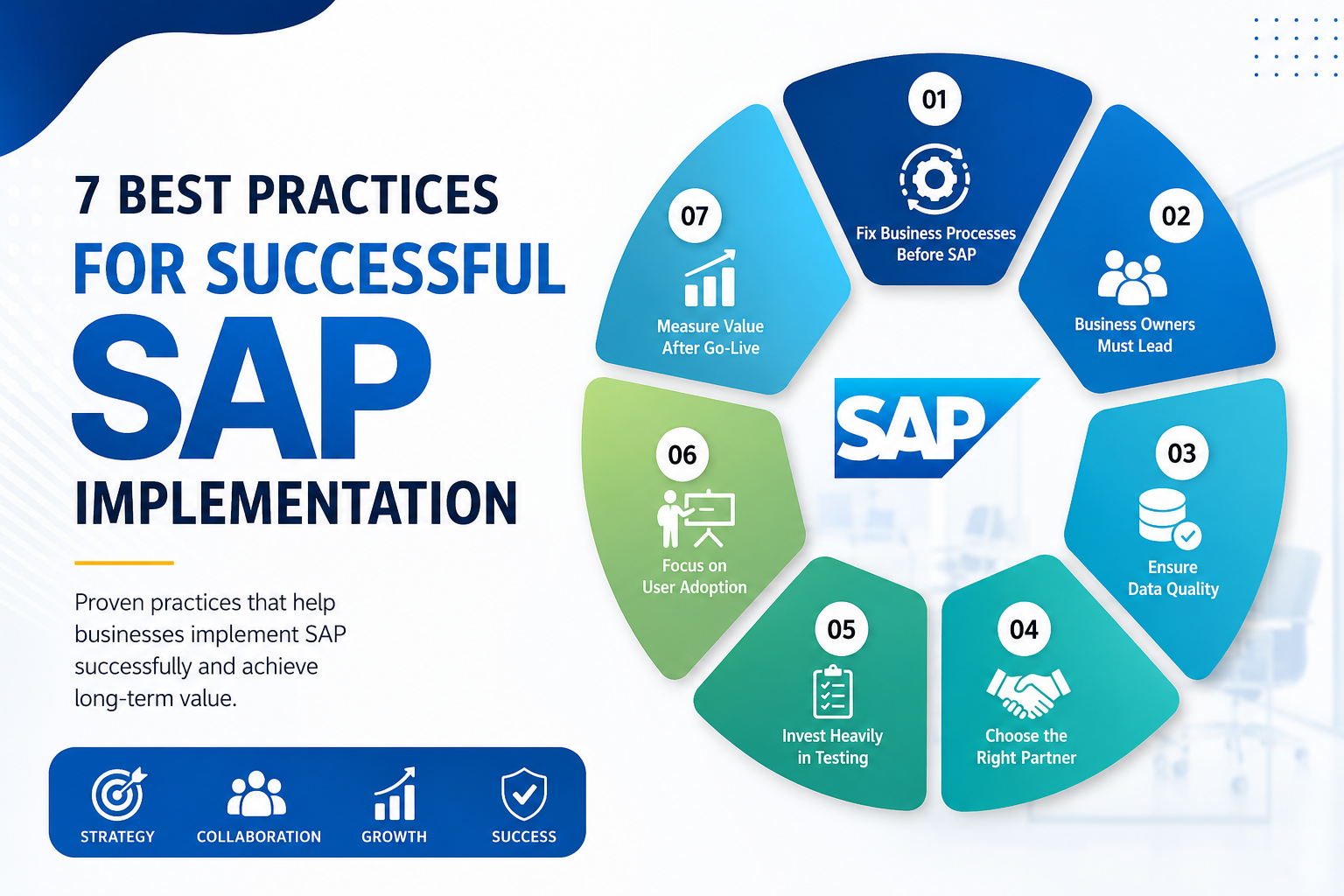
Why SAP Success Requires Strategic Planning
SAP implementation best practices have become a critical focus for organizations looking to improve efficiency, unify operations, and support long-term growth. While SAP offers powerful capabilities across finance, supply chain, procurement, manufacturing, and customer management, the success of any implementation depends on how well the project is planned and executed.
Many organizations assume that deploying SAP is primarily a technology project. In reality, it is a business transformation initiative. The organizations that achieve the strongest results are those that align implementation goals with operational priorities, involve stakeholders early, and establish realistic expectations before the project begins.
Establishing Clear Business Objectives Early
One of the most overlooked SAP implementation best practices is defining measurable business outcomes before selecting modules, configuring processes, or allocating resources.
Organizations often rush into technical discussions without first answering important questions. What operational challenges need to be solved? Which business processes require improvement? How will success be measured after deployment?
When objectives are clearly defined, implementation teams can make informed decisions throughout the project lifecycle. This approach reduces scope creep and ensures that every configuration decision supports broader business goals.
Assessing Existing Processes Before Migration
Before implementing SAP, organizations must understand their current workflows and operational bottlenecks.
Many businesses attempt to replicate inefficient legacy processes inside a new ERP environment. This often results in unnecessary customization, increased complexity, and higher implementation costs.
A thorough process assessment helps identify areas where standard SAP functionality can replace outdated practices. This not only accelerates implementation but also simplifies future upgrades and maintenance efforts.
Companies that prioritize process optimization before deployment often experience faster adoption and stronger returns on investment.
Managing Common Implementation Challenges
Even well-planned SAP projects encounter obstacles. Understanding these challenges early can help organizations prepare effective mitigation strategies.
Data Quality Issues
Poor data quality remains one of the most common reasons for implementation delays. Inaccurate customer records, duplicate entries, incomplete supplier information, and inconsistent financial data can create significant complications during migration.
Organizations should establish data cleansing initiatives long before migration activities begin.
Scope Expansion Risks
As stakeholders discover new possibilities within SAP, additional requirements frequently emerge. While innovation is valuable, uncontrolled expansion can affect budgets and timelines.
Strong governance structures help ensure that new requests are evaluated based on business impact rather than individual preferences.
User Adoption Concerns
Technology alone does not create business value. Employees must understand and embrace new processes for SAP investments to deliver meaningful results.
Training, communication, and change management should remain priorities throughout the implementation journey.
Building Strong Leadership Alignment
Executive sponsorship plays a decisive role in implementation outcomes.
SAP projects affect multiple departments, often requiring process changes that extend beyond technology teams. Without leadership support, resistance can increase and project momentum may slow.
Successful organizations create governance frameworks that encourage collaboration among executives, department leaders, project managers, and implementation partners. This alignment helps resolve conflicts quickly and keeps projects focused on strategic objectives.
Leaders should also communicate the broader purpose behind the transformation, helping employees understand how SAP supports future business growth.
Choosing The Right Implementation Partner
Selecting the right implementation partner is one of the most important business decisions during an SAP transformation.
The market includes numerous providers offering SAP consulting and implementation services, but expertise levels can vary significantly. Organizations should evaluate partners based on industry experience, project methodology, technical capabilities, and long-term support offerings.
Many businesses research the best SAP implementation companies by examining previous project outcomes, customer references, and specialization areas. The ideal partner should understand both SAP technology and the operational realities of the industry they serve.
Rather than focusing solely on implementation costs, decision-makers should consider overall business value, risk reduction, and future scalability.
Creating A Realistic Change Management Strategy
Technology transformation often succeeds or fails based on how effectively people adapt to change.
Employees may worry about new responsibilities, unfamiliar workflows, or disruptions to existing routines. Without proper guidance, resistance can emerge even when the technology itself performs well.
A comprehensive change management strategy should include:
• Regular communication, role-based training, leadership engagement, user support programs, and continuous feedback mechanisms.
Organizations that invest in change management often experience faster adoption rates and reduced productivity disruptions during go-live phases.
Balancing Standardization And Customization
One of the most important decisions during implementation involves determining how much customization is truly necessary.
SAP provides extensive functionality designed around industry best practices. Excessive customization may solve short-term challenges but can create long-term complexity.
Companies should carefully evaluate whether requested modifications provide meaningful business value. In many cases, adapting internal processes to align with standard SAP functionality delivers better long-term outcomes.
The implementation of SAP in companies becomes more sustainable when organizations prioritize simplicity, consistency, and maintainability over extensive custom development.
Leveraging Data For Better Decision Making
Modern businesses depend on accurate, real-time information to remain competitive.
SAP enables organizations to consolidate data across departments, creating greater visibility into financial performance, inventory levels, customer activity, procurement operations, and supply chain performance.
When implementation teams prioritize reporting requirements during project planning, organizations can unlock significant value immediately after deployment.
Executives gain access to actionable insights that support faster decision-making, improved forecasting accuracy, and more effective resource allocation.
Ensuring Scalability For Future Growth
An SAP implementation should not only address current requirements but also support future expansion.
Organizations often evolve through new product lines, geographic expansion, acquisitions, and changing customer demands. A scalable SAP environment allows businesses to adapt without requiring major system redesigns.
Many of the top SAP implementation companies in the world emphasize future readiness during project planning. This includes designing flexible architectures, establishing governance standards, and creating implementation roadmaps that support long-term growth objectives.
Scalability ensures that today's investment continues delivering value as business requirements evolve.
Measuring Success After Go-Live
Go-live should be viewed as the beginning of a continuous improvement journey rather than the finish line.
Organizations should establish performance metrics that align with original business objectives. These metrics may include process efficiency improvements, cost reductions, inventory accuracy, reporting speed, customer service performance, and employee productivity.
Regular reviews help identify opportunities for optimization and ensure that SAP capabilities continue supporting evolving business priorities.
The most successful organizations treat implementation as an ongoing transformation rather than a one-time technology deployment.
Final Thoughts
Following proven SAP implementation best practices helps organizations reduce risk, improve adoption, and maximize long-term value from their ERP investment. Success depends on careful planning, strong leadership, effective change management, and selecting the right implementation partner.
Businesses evaluating a trusted SAP Implementation Company should look beyond technical expertise and focus on strategic alignment, industry knowledge, and long-term support capabilities. As digital transformation accelerates, solutions such as GROW with SAP are helping organizations implement scalable ERP environments that support innovation, operational efficiency, and sustainable growth.
FAQs
1. What is the most important factor in a successful SAP implementation?
Clear business objectives and strong stakeholder alignment are often the most important factors. Organizations that define goals early typically achieve better outcomes.
2. How long does an SAP implementation usually take?
The timeline varies based on business size, project complexity, customization requirements, and data migration scope. Projects can range from several months to over a year.
3. Why is change management critical during SAP implementation?
Employees must adapt to new workflows and processes. Effective change management reduces resistance and improves user adoption rates.
4. How can organizations choose the right SAP implementation partner?
Businesses should evaluate industry expertise, implementation methodology, customer references, support capabilities, and long-term strategic fit.
5. Can SAP support future business expansion?
Yes. When designed correctly, SAP provides a scalable foundation that supports growth, operational changes, and evolving business requirements.


 English
 Arabic
 Français
 Español
 Português
 Deutsch
 Türkçe
 Italiano
 Russian
 Romaian