


STEM in Early Childhood: Why it Matters
Today’s complex and rapidly changing world demands more from children than basic literacy and numeracy skills. Kids require the creativity, curiosity and confidence to embrace new knowledge, solve problems and seek out new and exciting experiences.
This is where STEM education – science, technology, engineering and mathematics – takes centre stage, and it's no longer exclusively for primary schoolers. Children as young as preschoolers can benefit greatly from exposure to STEM principles.
Many may be unaware, but it’s possible to introduce STEM learning during their early years. In fact, young children naturally engage in STEM principles through play, experimentation, exploration, and various hands-on learning experiences throughout their day, leading many early learning centres to incorporate the approach.
STEM in Early Childhood
Early Years STEM doesn't involve trying to get children to recite difficult scientific formulas or perform algebraic calculations. In its early years it revolves around encouraging children to ask questions, probe their environment, solve problems and problem-solve. Every young child asks the question why.
They also wonder what causes things to happen and observe things moving around and the changes that occur in their immediate world.
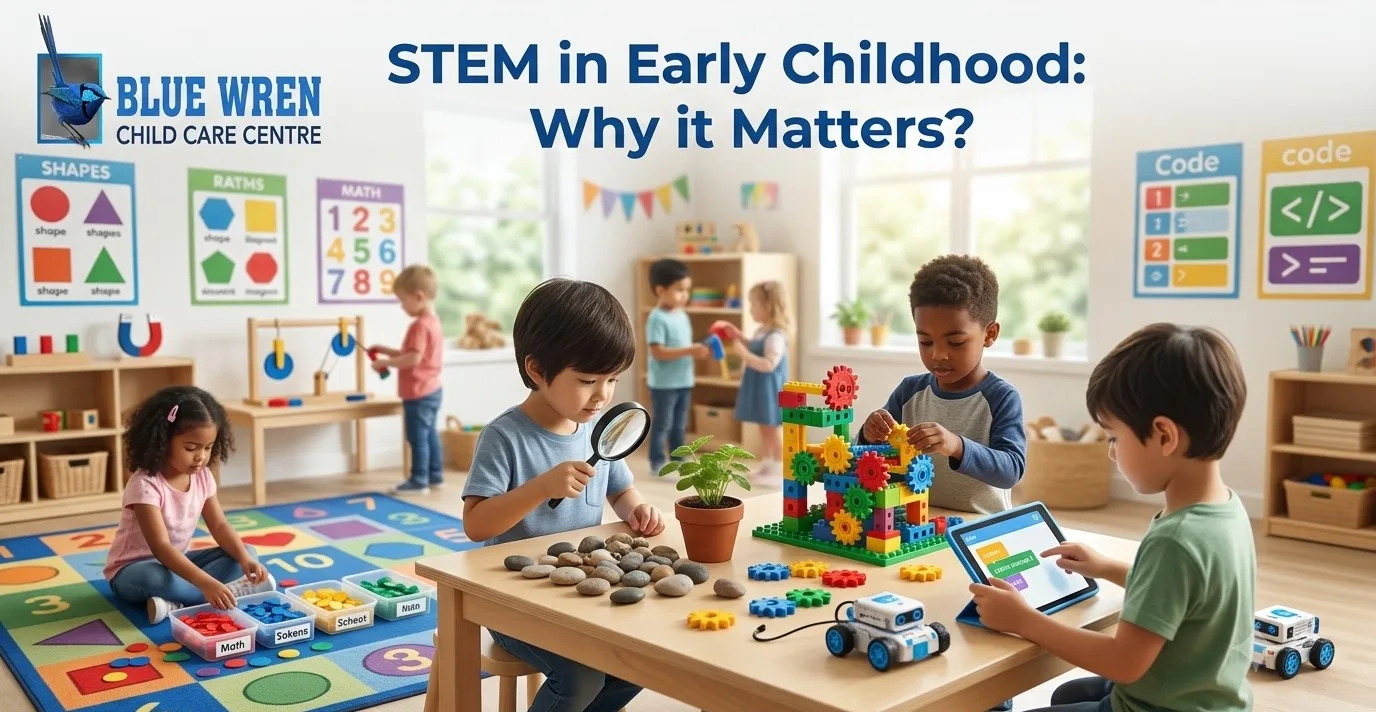
For instance, children in the class are building blocks of the Tower of London; they are practising fundamental engineering. The child is classifying and sorting various items by their colour and shape and also perhaps their size to see if they can put anything into order, so they are working with numbers. Getting children to count is a part of this so you begin to teach numbers through various activities in the play.
The Benefits of STEM Learning for Young Children
- Encourage Critical Thinking
These and many more challenges give children an opportunity to stretch their minds beyond simple answers and to test predictions and theories and to reflect on results, helping to create more resourceful children. Children will use the information gleaned in many forms when they attempt to construct, create and solve. Whether they are constructing bridges or experimenting with stream flow, they develop confidence and learn from their failures.
- Builds Problem-Solving Skills
The ability to solve problems is one of the crucial life skills that every child must possess. A child who gets exposed to STEM practices will learn to perceive and tackle problems individually or with friends. Activities, for instance, solving puzzles, building structures, and conducting basic science experiments, promote children’s perseverance and strength.
Moreover, they discover that a single problem might have different solutions, hence increasing their flexibility and creativity.
- Supports Language and Communication Development
These activities naturally promote communication. It gives children the opportunity to collaborate, to talk through their ideas and reasoning, to share discoveries with others, and listen to different perspectives. Children can be asked to talk about what is going on, to predict what might happen, and to reflect on what they found out. The discussions help to introduce new words and concepts to children and build understanding and meaning.
The Role of Play in STEM Education
Play-based learning childcare centre is one of the easiest and best ways to introduce young children to STEM concepts. Kids at a young age generally benefit the most from interactive and fun learning opportunities. Children are able to investigate, test theories and figure out their world during play time.
For instance, water play offers opportunities to learn about quantity, measurement and a range of other logical and mathematical skills, including cause and effect.
Building with blocks offers children an understanding of design, balance and support. Playing outdoors means observing and discovering various aspects of the weather, living things and plants. Playing with STEM concepts not only leads to fun learning but also a whole range of different skills for your kids to develop.
STEM and Future Readiness
Beyond science and maths: skills you gain through STEM learning, problem-solving, creativity and resilience. Nearly everyone needs those in all their walks of life. The rapid development of technology, changing how we work and live our lives, will make confident children open to exploring new ideas and adaptable to future work roles and positions.
STEM learning provides children with the foundation for lifelong learning and a healthy growth mindset, so they have no fear and want challenges and can use knowledge gained. Because many early learning centres now pay a greater deal of attention to providing a rich STEM program within their lesson program.
How a Childcare Environment Supports STEM Learning
Quality childcare centres are the perfect place for STEM It can be challenging for parents to come up with hands-on experiences at home, but the environment at a quality childcare centre supports the development of the enquiry cycle. It is a stimulating, child-led space with open-ended and varied resources such as natural materials, blocks, construction toys and sensory materials for children to explore, investigate and create.
In this environment children are motivated to experiment, investigate and extend the learning by asking questions about the world. Teachers facilitate children’s STEM journeys by extending their thinking and making relevant links for children to experiences.
Supporting STEM Learning at Home
Of course, parents have a great part in helping our kids develop these critical STEM skills through everyday play! When we cook together, children practice their sequencing and measurement skills. Our kids learn so much about science, plant life and the environment when gardening.
Through their block and building-toy efforts, our kids are engaged in science, engineering and design challenges. Make sure to let them know how amazing it is that they are so curious; encourage open-ended thinking by asking open-ended questions like “What do you think would happen if?" or “How else could we make it work?"
Conclusion
By planting seeds of curiosity and innovation early in childhood and creating opportunities for hands-on learning, exploration and enquiry, children gain tools and capabilities that serve them in all areas of their lives.
By embracing STEM early – in schools, homes and the outdoors – kids can begin to build skills and have a positive learning experience to set them up for a lifetime of learning and problem-solving. With family, educators and positive learning experiences around kids, they will grow in skills and confidence for a world that’s always transforming.

 Arabic
 Français
 Español
 Português
 Deutsch
 Türkçe
 Dutch
Dutch
 Italiano
 Russian
 Romaian