


Key Features Every Uber-Like App Must Have in 2026
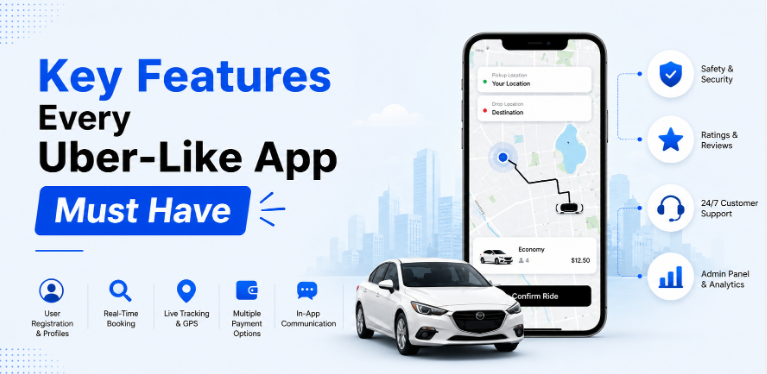
The ride-hailing industry has evolved from simple GPS-based taxi booking into a highly intelligent, data-driven mobility ecosystem. In 2026, users expect far more than just a way to book a ride they expect speed, safety, transparency, personalization, and reliability at scale.
Building an Uber-like app today is not about replicating existing platforms but about engineering a complete mobility experience that works seamlessly across devices, cities, and user needs.
Whether a business is exploring an Uber Clone, a custom app like Uber, or investing in taxi-like app development, success depends on selecting the right features, not adding everything, but adding the right things.
This article breaks down the 10 most essential features every modern ride-hailing platform must include, along with supporting systems required to make the product scalable and future-ready.
1. Intelligent User Onboarding and Identity Verification
User onboarding is the first critical touchpoint in any on-demand app. In 2026, frictionless access is expected as a standard.
A strong onboarding system includes:
-
OTP-based login with instant verification
-
Optional social or biometric login
-
Auto-detection of location permissions
-
Minimal signup steps for riders
-
Structured KYC process for drivers
For drivers, verification is more advanced, involving document uploads, license validation, and background checks. However, automation and AI-based document scanning now significantly reduce approval time.
A smooth onboarding flow directly impacts conversion rates and driver supply quality.
2. Smart Ride Booking System
The booking experience defines the usability of any uber-like app.
Key elements include:
-
Auto-suggested pickup and drop locations
-
Favorite and saved places
-
Ride category selection (economy, premium, shared, EV)
-
Fare estimation before confirmation
-
Scheduled ride booking
In advanced systems, booking is becoming predictive—apps suggest destinations based on routine behavior, calendar events, or frequent travel patterns.
This is a core differentiator in modern mobility platforms.
3. Real-Time GPS Tracking and ETA Accuracy
Live tracking is essential for trust and transparency.
A robust system includes:
-
Live driver and rider tracking
-
Real-time ETA updates
-
Traffic-aware routing
-
Dynamic rerouting during congestion
-
Trip sharing with contacts
Modern mapping systems integrate AI to continuously refine ETAs based on traffic density, road conditions, and driver behavior patterns.
Accurate tracking reduces anxiety for users and improves operational efficiency.
4. AI-Based Ride Matching and Dispatch System
The dispatch engine is the backbone of any ride-hailing platform.
A strong system considers:
-
Distance between rider and driver
-
Driver acceptance behavior
-
Vehicle type compatibility
-
Current traffic conditions
-
Demand-supply heatmaps
In 2026, ride matching is increasingly predictive rather than reactive. Platforms now anticipate demand spikes and pre-position drivers in high-demand zones before requests are even made.
This improves both wait times and driver earnings consistency.
5. Transparent Pricing and Dynamic Fare Engine
Pricing trust is essential for long-term user retention.
A modern fare system includes:
-
Upfront fare estimates
-
Surge pricing indicators
-
Time and distance breakdown
-
Cancellation fee transparency
-
Promotional discounts and credits
Dynamic pricing engines adjust fares based on demand, time, weather, and local events—but transparency ensures users always understand the cost logic.
Without this clarity, even advanced systems lose user trust.
6. Secure Multi-Mode Payment System
Cashless and frictionless payments are now standard expectations.
A complete payment system supports:
-
UPI, cards, wallets, and net banking
-
Auto-debit for completed rides
-
Split payments for shared rides
-
Refund and cancellation automation
-
Digital invoices and receipts
Security frameworks like tokenization and encryption ensure financial data protection, which is critical for platform credibility.
7. Safety, Emergency, and Trust Layer
Safety is one of the most important pillars of any Uber-like app.
Core safety features include:
-
SOS emergency button
-
Live ride tracking with trusted contacts
-
Masked phone numbers for privacy
-
Driver verification badges
-
AI-based anomaly detection (route deviation, unusual stops)
Modern systems continuously monitor trip behavior patterns and trigger automated safety checks when irregularities occur.
Trust is built through systems, not assumptions.
8. Ratings, Reputation, and Behavioral Scoring
Feedback systems ensure accountability across the platform.
Key components include:
-
Two-way rating system
-
Trip-based feedback prompts
-
Category-based ratings (cleanliness, behavior, punctuality)
-
Fraud detection in reviews
-
Driver incentive scoring system
Unlike older models that relied only on star ratings, modern systems use behavioral analytics to build more accurate reputation profiles.
This improves service quality and reduces bias.
9. In-App Communication and Privacy Controls
Communication must be secure and simple.
A well-designed system includes:
-
In-app chat between driver and rider
-
Masked calling functionality
-
Quick message templates
-
Multi-language support
-
Translation assistance (in global apps)
This ensures smooth coordination while protecting user privacy.
10. Scalable Backend and Operations Infrastructure
The backend determines whether the platform can grow.
A strong architecture includes:
-
Cloud-native infrastructure
-
Microservices-based design
-
Auto-scaling during peak demand
-
High availability systems (99.9% uptime or higher)
-
Fast API response handling
Without scalability, even a well-designed app like Uber fails during high-traffic events or city-wide demand spikes.
Supporting System Components
Admin Dashboard and Fleet Management
A centralized control system is required to manage:
-
Driver onboarding and verification
-
Trip monitoring in real time
-
Revenue and commission tracking
-
Fraud detection systems
-
Operational zone management
This is critical for managing large-scale operations efficiently.
Analytics and Business Intelligence Layer
Data is essential for decision-making in modern mobility platforms.
Key insights include:
-
Demand forecasting by region
-
Peak usage hours
-
Driver utilization rates
-
Revenue trends
-
Cancellation behavior analysis
AI-powered dashboards now help operators make real-time decisions rather than relying on historical reports.
Multi-Service Expansion Capability
A modern mobility platform is not limited to ride-hailing.
It can expand into:
-
Parcel and courier delivery
-
Bike taxi services
-
Car rentals
-
Corporate mobility programs
This modular design approach is common in modern taxi booking app solutions, enabling rapid expansion without rebuilding the core system.
Localization and Market Adaptability
Every market behaves differently, so localization is essential.
Key elements include:
-
Multi-language support
-
Local payment integrations
-
Region-specific ride categories
-
Regulatory compliance tools
This ensures smoother entry into new geographic markets.
Future of Uber-Like Apps in 2026 and Beyond
The future of mobility platforms is shaped by:
-
Electric vehicle integration
-
Carbon footprint tracking per ride
-
Subscription-based travel models
-
AI-based travel assistants
-
Early autonomous vehicle compatibility
Sustainability and intelligence will define the next generation of ride-hailing systems.
Conclusion
Building a successful Uber-like app in 2026 requires more than cloning existing platforms. It requires a thoughtful selection of features that improve usability, safety, scalability, and long-term adaptability.
The 10 core features discussed here form the foundation of any modern ride-hailing system. However, true success comes from how well these features are implemented and integrated into a seamless user experience.
Whether you are exploring an Uber Clone, investing in taxi-like app development, or evaluating a full-scale on-demand app, the focus should always be on building a reliable, scalable, and intelligent mobility ecosystem—not just a booking app.

 Arabic
 Français
 Español
 Português
 Deutsch
 Türkçe
 Dutch
Dutch
 Italiano
 Russian
 Romaian