


Battery Electrolyte: The Critical Component Driving Next-Generation Energy Storage Systems
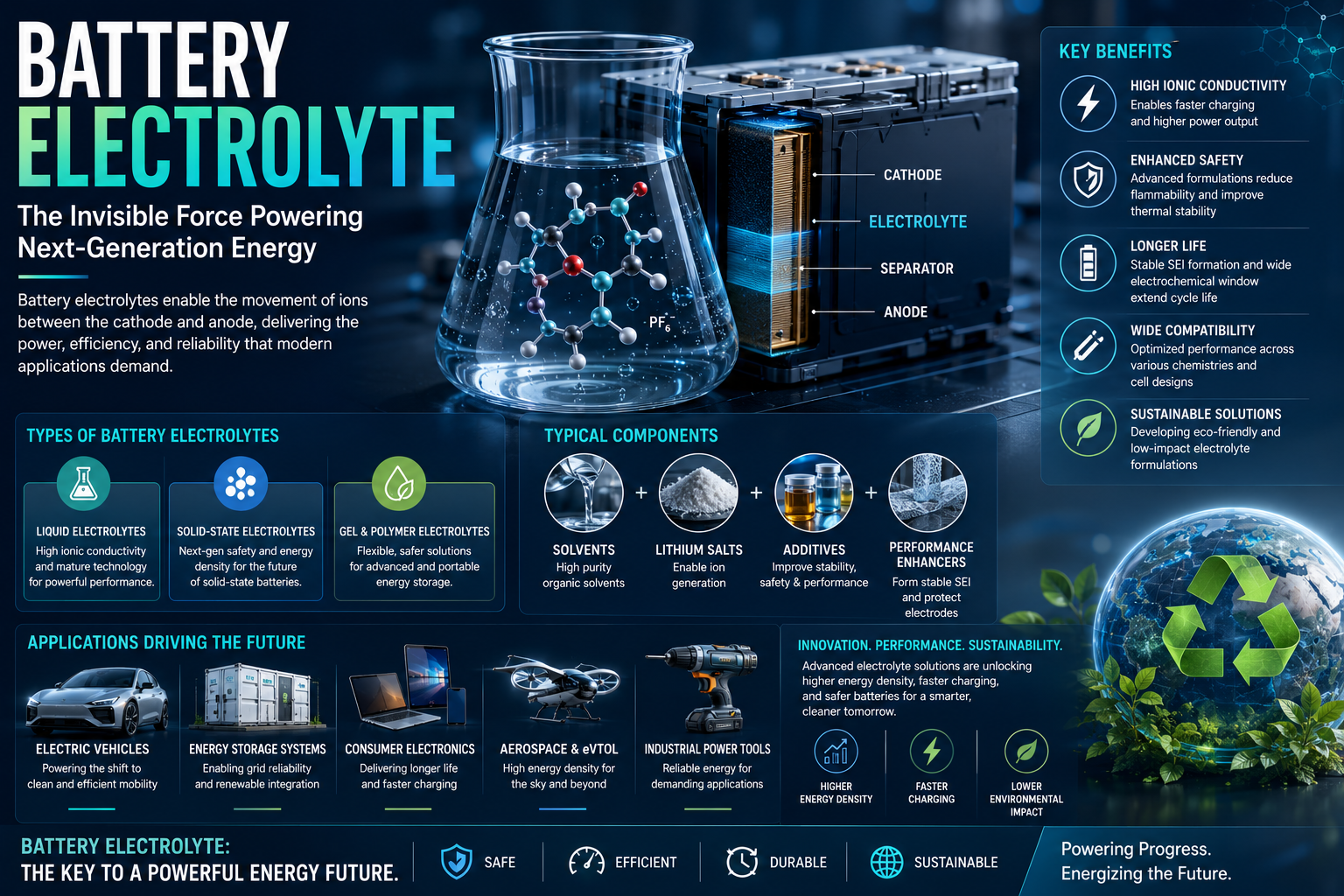
Battery electrolytes are among the most important components in rechargeable batteries, serving as the medium through which ions move between the positive and negative electrodes during charging and discharging processes. Although they do not directly store energy, electrolytes significantly influence battery efficiency, lifespan, safety, and operating temperature range.
Growing adoption of electric vehicles, renewable energy systems, portable electronics, and industrial energy storage solutions has increased interest in developing advanced electrolyte materials. Researchers and manufacturers continue to explore new formulations capable of delivering higher conductivity, improved thermal stability, and enhanced compatibility with emerging battery chemistries.
What is a Battery Electrolyte?
A battery electrolyte is a chemical substance that enables the transport of ions between electrodes while preventing electrons from passing through the medium.
Electrolytes can exist in different forms:
• Liquid electrolytes
• Gel polymer electrolytes
• Solid-state electrolytes
• Hybrid electrolytes
A typical lithium-ion battery electrolyte consists of lithium salts dissolved in organic solvents, providing high ionic conductivity required for efficient energy transfer.
Download Sample Here:-
https://www.datamintelligence.com/download-sample/battery-electrolyte-market
Major Types of Battery Electrolytes
Liquid Electrolytes
Liquid electrolytes dominate the current rechargeable battery market.
Characteristics include:
• High ionic conductivity
• Mature manufacturing processes
• Suitable for consumer electronics
• Relatively low production costs
Challenges include:
• Flammability risks
• Limited temperature tolerance
• Potential leakage issues
Solid-State Electrolytes
Solid-state electrolytes are gaining considerable attention because they offer improved safety and potentially higher energy densities.
Advantages include:
• Reduced fire hazards
• Improved mechanical stability
• Compatibility with lithium metal anodes
• Longer operational lifespan
Limitations include:
• Complex manufacturing methods
• Higher material costs
• Interface resistance challenges
Gel Polymer Electrolytes
Gel polymer systems combine properties of liquid and solid electrolytes.
Important features include:
• Better flexibility
• Lower leakage probability
• Enhanced safety
• Moderate ionic conductivity
Aqueous Electrolytes
These electrolytes contain water-based solutions and are commonly used in industrial battery systems.
Benefits include:
• Non-flammable composition
• Environmentally friendly materials
• Cost effectiveness
• High safety margins
Key Functions of Battery Electrolytes
Electrolytes perform several critical tasks inside batteries.
Ion Transport
The primary function of an electrolyte is transporting ions between electrodes.
Efficient ion movement supports:
• Faster charging
• Higher discharge rates
• Improved power delivery
• Better cycling performance
Formation of Protective Layers
Electrolytes participate in the formation of stable interfacial layers that protect electrodes from degradation.
These protective layers help maintain:
• Capacity retention
• Structural integrity
• Reduced side reactions
• Longer battery lifespan
Thermal Regulation
Advanced electrolytes contribute to battery performance under varying temperature conditions.
Desired characteristics include:
• Resistance to thermal decomposition
• Stable conductivity
• Reduced overheating risks
• Wider operating temperature windows
Applications of Battery Electrolytes
Battery electrolytes are essential across numerous industries.
Electric Vehicles
Electrolytes significantly affect vehicle range, charging speed, and overall battery safety.
Applications include:
• Passenger electric vehicles
• Commercial fleets
• Electric buses
• Two-wheeler mobility systems
Manufacturers seek electrolyte formulations capable of supporting ultra-fast charging without compromising long-term stability.
Consumer Electronics
Smartphones, tablets, laptops, and wearable devices rely heavily on efficient electrolyte technologies.
Desired properties include:
• High energy density
• Compact battery design
• Low self-discharge
• Reliable cycle life
Renewable Energy Storage
Energy generated from solar and wind installations often requires storage systems for balancing supply fluctuations.
Battery electrolytes assist in:
• Peak load management
• Grid stabilization
• Backup power systems
• Residential energy storage
Aerospace and Defense
Battery systems used in aerospace applications demand materials capable of operating under extreme environmental conditions.
Electrolytes help provide:
• High reliability
• Temperature resistance
• Reduced maintenance
• Consistent electrochemical performance
Emerging Concepts in Battery Electrolyte Development
Researchers continue investigating innovative electrolyte technologies to overcome limitations associated with conventional materials.
High-Concentration Electrolytes
High-concentration formulations contain increased lithium salt content.
Potential advantages include:
• Improved oxidation resistance
• Enhanced cycling stability
• Better compatibility with high-voltage cathodes
• Reduced solvent degradation
Fluorinated Electrolytes
Fluorinated solvents are increasingly studied because they improve battery safety and electrochemical stability.
Benefits include:
• Lower flammability
• Enhanced durability
• Superior high-voltage performance
• Better interfacial chemistry
Sulfide-Based Solid Electrolytes
Sulfide materials demonstrate exceptionally high ionic conductivity.
Important characteristics:
• Excellent lithium-ion transport
• Lower internal resistance
• Potential for compact battery architecture
• Improved energy density
Composite Electrolytes
Composite materials integrate multiple electrolyte types to optimize performance.
Expected outcomes include:
• Enhanced conductivity
• Improved mechanical properties
• Increased operational safety
• Better compatibility with electrode materials
Features of Advanced Battery Electrolytes
Modern electrolyte systems are designed to satisfy increasingly demanding performance requirements.
Key features include:
• High ionic conductivity
• Low viscosity
• Excellent thermal stability
• Broad electrochemical window
• Reduced flammability
• Strong electrode compatibility
• High oxidation resistance
• Long cycle durability
• Moisture resistance
• Chemical stability
Benefits of Improved Electrolyte Technologies
Developments in electrolyte chemistry can provide numerous technical and economic advantages.
Performance Benefits
• Faster charging capability
• Increased driving range for electric vehicles
• Higher battery capacity
• Improved power output
• Reduced internal resistance
Safety Benefits
• Lower risk of thermal runaway
• Enhanced structural stability
• Better tolerance to high temperatures
• Reduced gas generation
Environmental Benefits
• Longer battery service life
• Reduced material waste
• Lower replacement frequency
• Support for sustainable energy systems
Economic Opportunities and Industry Impact
Advanced electrolyte technologies are expected to influence several industrial sectors.
Potential opportunities include:
• Expansion of battery manufacturing facilities
• Increased investment in material science research
• Development of localized supply chains
• Improved competitiveness in electric mobility markets
• Growth in energy storage deployment
Electrolyte innovation also supports the transition toward cleaner transportation and more resilient electricity networks.
Challenges Facing Electrolyte Research
Despite substantial progress, several technical challenges remain.
Researchers are focusing on overcoming issues such as:
• Limited room-temperature conductivity in solid electrolytes
• High manufacturing expenses
• Material compatibility concerns
• Moisture sensitivity
• Interface instability
• Scale-up difficulties
Addressing these challenges is essential for enabling widespread commercialization of next-generation battery technologies.
Future Outlook
Battery electrolytes will remain a central focus of energy storage research over the coming decade. Increasing demand for safer electric vehicles, high-capacity portable electronics, and large-scale renewable energy storage systems will encourage further exploration of innovative electrolyte materials.
Advancements in solid-state batteries, lithium-metal technologies, and high-voltage battery systems are expected to depend heavily on improvements in electrolyte design. Continued collaboration among material scientists, battery manufacturers, and research institutions may accelerate the transition toward more efficient and durable energy storage solutions.
Conclusion
Battery electrolytes play a fundamental role in determining the efficiency, safety, and longevity of modern rechargeable batteries. Continuous innovation in liquid, polymer, and solid-state electrolyte technologies is expanding the possibilities for high-performance energy storage systems.
As industries pursue cleaner energy solutions and electrification strategies, electrolyte research is likely to become increasingly important for achieving reliable, sustainable, and high-capacity battery technologies. Understanding electrolyte properties, emerging concepts, and practical applications provides valuable insights into the future direction of global energy storage development.

 English
 Arabic
 Français
 Português
 Deutsch
 Türkçe
 Dutch
Dutch
 Italiano
 Russian
 Romaian