


Bespoke AI Software vs Off-the-shelf Platforms in 2026: A Decision Framework For UK Technical Leads Use
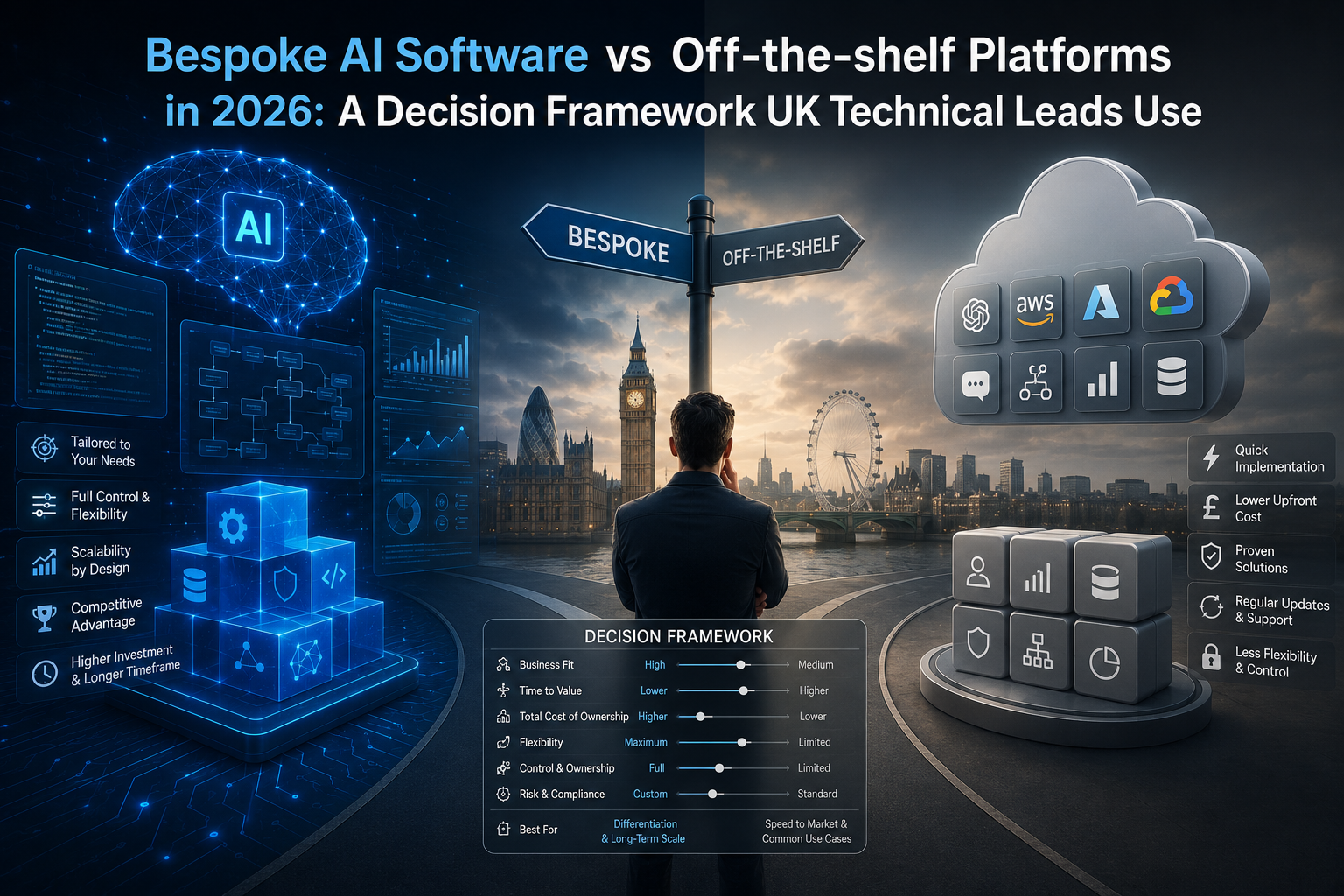
AI in 2026 is no longer a matter of experimentation, but a necessity for UK organisations – now it's all about how to do it right. The debate over bespoke software development UK capabilities versus the fast-changing landscape of off-the-shelf AI platforms is gaining momentum.
More than 70% of companies are increasingly taking a hybrid AI approach to blend speed and control, according to industry estimates. With increasing regulations, data sensitivity issues, and budgetary scrutiny, it's no longer easy to decide between build or buy.
This blog presents a practical decision framework used by actual technical leads in the UK to make informed investment decisions for the future of AI.
What Are the Two Approaches?
Most technical leaders in the UK will select one of the two main paths for implementing AI in 2026. Both have their own strengths and weaknesses, and suitable use cases.
1. Bespoke AI Software
Bespoke AI software is a custom-made solutions created specifically for an organisation's need, data, and processes. They are developed in-house or with bespoke software development UK partners and provide maximum flexibility and control.
This is often best used when:
· AI is the key to staying ahead of the curve in business
· Data sensitivity and compliance (e.g. GDPR, FCA) are a priority
· Existing tools are inadequate to meet complex needs
Custom-made solutions may take longer to develop and be more expensive, but they are highly scalable, well-integrated and valuable for the long term.
2. Off-the-Shelf AI Platforms
Off-the-shelf AI platforms are pre-built, readily available as SaaS, APIs or cloud-based services. These platforms allow companies to roll out AI capabilities with minimal development work.
This is often best used when:
· Covers standard business functions (e.g. chatbots, analytics)
· Suited to rapid prototyping or quick wins
· Ideal for organisations with limited AI engineering resources
They can be low cost and easily deployed, but may have restricted customisation, a dependency on vendors, and limited control over data and models.
Quick Comparison Overview
Here's a brief comparison to give technical leaders an overview of the trade-offs between custom-made AI software and pre-existing platforms.
|
Factor |
Bespoke AI Software |
Off-the-Shelf AI Platforms |
|
Deployment Speed |
Slower (requires development, testing, iteration) |
Fast (ready-to-use solutions) |
|
Upfront Cost |
High initial investment |
Lower initial cost (subscription-based) |
|
Long-Term Cost (TCO) |
Can be optimised over time |
Can increase with scale and licensing fees |
|
Flexibility & Customisation |
Very high (built around specific needs) |
Limited (restricted by vendor capabilities) |
|
Integration |
Deep integration with internal systems |
May face limitations with legacy/custom systems |
|
Control & Ownership |
Full ownership of models, data, and IP |
Vendor-controlled infrastructure and models |
|
Compliance & Data Governance |
Easier to tailor to UK regulations (GDPR, FCA) |
Dependent on vendor compliance policies |
|
Scalability |
Designed specifically for business growth |
Scalable but within platform constraints |
|
Vendor Dependency |
Low |
High (risk of vendor lock-in) |
|
Best For |
Core business functions, differentiation |
Standardised use cases, quick wins |
The Decision Framework
1. Use Case Criticality
Evaluate the use case for AI with respect to revenue or competitive advantage. High criticality functions may warrant custom development, while common or support functions may be more appropriate for off-the-shelf tools.
2. Data Sensitivity & Compliance
Evaluate data sensitivity and adherence to regulations (such as GDPR, FCA). For environments that are highly regulated, customisation may be necessary for greater data management control and regulatory compliance.
3. Time-to-Value
Consider how long it will take for the solution to be effective. Off-the-shelf platforms can be deployed quickly, but bespoke AI takes longer to build but will deliver more customised and enduring results.
4. Total Cost of Ownership (TCO)
Consider the full cost involved, including licensing, infrastructure, maintenance and scalability. While it may seem easier and less expensive in the short term, off-the-shelf solutions can be costly in the long run.
5. Integration Complexity
Assess how easy it is to integrate with the existing systems. For organisations with more complex or legacy infrastructures, custom solutions which are tailored to the internal architecture and workflows can be more appropriate.
6. Strategic Differentiation
Decide whether the AI capability will differentiate the business. Bespoke is best for functions that create a competitive edge; off-the-shelf is suitable for standardised, non-differentiating functions.
Decision Matrix
Choose Bespoke AI Software if:
· AI is integral to your main business processes or revenue generation
· It requires very strict data control and UK regulatory compliance (GDPR, FCA, NHS)
· Your workflows are highly specialised or unique
· The existing tools do not integrate or perform as required
· You have the time and funds to invest over the long term
Best suited for: Fintech, healthcare, advanced analytics, proprietary systems
Choose Off-the-Shelf AI Platforms if:
· You have a standard use case, and it is widely available (chatbots, content, analytics)
· You're looking for rapid deployment and immediate ROI
· Low initial investment is preferred due to budget restrictions
· Your systems are API-friendly, modern, and updated
· You want to test AI applications quickly and effectively
Best suited for: SMEs, marketing teams, operational efficiency use cases
Choose a Hybrid Approach (Most Common in 2026):
· You want speed initially and then to scale effectively
· Some functions are commoditised and others need to be differentiated
· You require off-the-shelf for productivity and bespoke for core systems
· You want to minimise vendor lock-in risk and still have flexibility
Best suited for: Growing enterprises and organisations scaling AI adoption
Key Trends in 2026 Influencing the Decision
1. Regulation Tightening
UK and European laws are tightening up and placing greater emphasis on data privacy, transparency, and accountability. This is driving organisations to a solution that provides increased governance and compliance control.
2. Vendor Lock-In Concerns
While the dependence on AI vendors is growing, organisations are also becoming wary on long-term vendor lock-in. Bespoke or more flexible, hybrid options are on the rise as the limitations of portability and cost increase.
3. Rise of Hybrid AI Architectures
To balance speed with control, many organisations are pairing an off-the-shelf platform with custom layers. The hybrid model is becoming a more favoured solution for building scalable and future-ready AI strategies.
4. Demand for Explainable AI
With growing regulatory and stakeholder scrutiny, businesses must rely on AI systems that can provide comprehensible explanations of their outputs and decisions. Bespoke solutions frequently provide a greater degree of transparency than black-box vendors.
5. Cost Optimisation Pressure
With the economic pressures on companies, they are required to demonstrate ROI on their AI spend. Leaders are looking to minimise the total cost of ownership and weigh the initial cost against that of ongoing efficiency.
Recommended Approach: Build, Buy, or Hybrid?
Adopting AI in 2026 doesn't have a one-size-fits-all solution. The best technical leaders in the UK don't view it as a binary choice, but one that is based on business goals, appetite for risk and long-term strategy.
1. Build (Bespoke AI):
Use bespoke AI when the feature is an essential part of your competitive advantage, it is deeply integrated into your solution, or when there are strict regulations and data governance requirements. It comes at a cost but offer for long-term control, flexibility and differentiation.
2. Buy (Off-the-Shelf):
Consider off-the-shelf platforms if speed, cost-efficiency and ease of deployment are paramount. They are ideal for standardised circumstances where customisation and ownership are not critical factors.
3. Hybrid (Best-of-Both):
Most organisations, in practice, take a hybrid approach: standard productivity tools for everyday tasks, and custom AI for more critical and valuable tasks. This model strikes the right balance between fast adoption and strategic control and scalability.
Final Takeaway:
Prioritise the areas where AI is adding value in a unique way. Build where it makes a difference to your business; Buy where it will speed up execution; and Hybrid for the maximum ROI and least risk.
Conclusion
Choosing to use a custom-made AI software versus an off-the-shelf solution is a strategic decision in 2026. UK organisations must carefully evaluate the speed, cost, fit, and long-term viability of their chosen approach. While there are off-the-shelf tools that can be implemented rapidly, custom tools provide greater integration and competitive advantage. A hybrid approach is becoming the most effective and preferred one.
Through collaboration with experienced bespoke software developers London, technical teams can develop scalable, compliant, and future-proof AI solutions that align closely with business goals, maximising return on investment and avoiding short-term compromises.

 English
 Arabic
 Español
 Português
 Deutsch
 Türkçe
 Dutch
Dutch
 Italiano
 Russian
 Romaian