


Designing for Innovation: Workplace Furniture Strategies That Support Creative Team Collaboration
Imagine a room where a dozen brilliant minds sit in absolute silence, staring at gray fabric panels, waiting for a groundbreaking idea to strike. It rarely does. Innovation is inherently loud, messy, and kinetic. It requires movement, spontaneous interaction, and an environment that physically supports the collision of different perspectives. Yet, many organizations still rely on rigid floor plans that actively discourage the very brainstorming they desperately want to cultivate.
Transforming a stagnant office into an incubator for fresh ideas does not necessarily require knocking down walls or relocating to a newly constructed building. Instead, it relies on strategic spatial planning and intelligent interior choices. By deploying targeted workplace furniture strategies, companies can fundamentally shift how their teams interact, iterate, and ultimately succeed. Designing a space that nurtures creativity requires a deliberate departure from one-size-fits-all solutions and an embrace of a diverse, adaptable ecosystem of furnishings.
The Intersection of Space and Creative Thought
The relationship between the physical environment and cognitive output is heavily documented in behavioral psychology. When employees are tethered to static, isolated desks, their communication patterns mirror that isolation. Conversely, environments that feature varied zones for different modes of work encourage a dynamic flow of information. Creative collaboration is not a single, uniform action; it is a complex, multi-stage process involving deep individual focus, rapid group brainstorming, and informal peer review.
To support this multifaceted workflow, a workspace must be highly adaptable. Industry-leading organizations understand that physical space dictates human behavior. If you provide a massive, immovable boardroom table, meetings will inherently become formal and hierarchical. If, however, you provide counter-height tables paired with drafting stools and mobile whiteboards, meetings become active, egalitarian, and results-driven. The primary goal is to remove physical barriers to communication so that sharing an idea is as frictionless and natural as possible.
Core Furniture Strategies for Collaborative Environments
Building a space that actively pulls people together requires specific, intentional furniture selections that cater to modern work habits.
Scalable Modular Workstations
The modern creative team expands, contracts, and reorganizes based on immediate project demands. Fixed, heavy cubicles cannot accommodate this vital fluidity. Scalable benching systems and modular desks allow teams to configure their pods based on exactly who they need to communicate with at any given moment. These user-friendly setups often feature lightweight dividers that can be attached, lowered, or removed entirely without the need for tools, allowing employees to instantly switch from private, heads-down work to open-plan brainstorming.
Furthermore, mobile storage units featuring cushioned tops that double as guest seating encourage spontaneous, comfortable check-ins at a colleague's desk. When furniture adapts to the people, rather than forcing people to adapt to the furniture, workflow bottlenecks rapidly disappear.
High-Performance Huddle Spaces
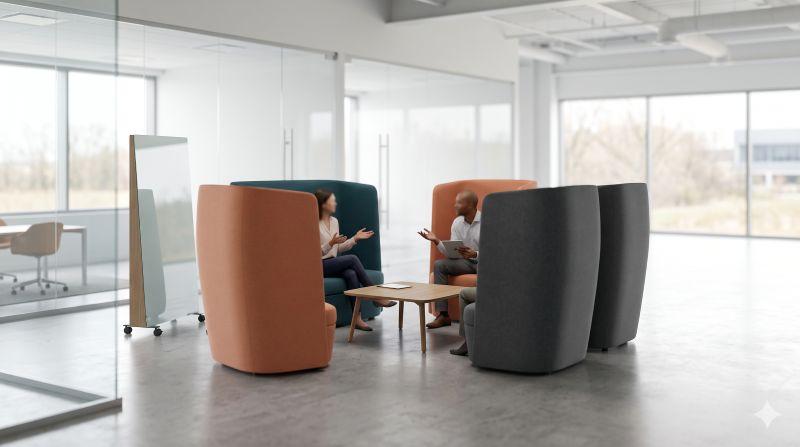
Not every collaborative session needs to be formally scheduled in a glass-enclosed conference room. In fact, some of the most innovative ideas happen in the brief, informal moments immediately following a rigid meeting. High-performance huddle spaces are critical for capturing this organic, fleeting energy. These are semi-enclosed areas strategically placed near main thoroughfares, equipped with acoustic lounge seating, small café tables, and easily accessible power outlets.
By using high-backed acoustic sofas or freestanding privacy pods, companies can create a functional room within a room, offering sound dampening without the expense or permanence of drywall. This cutting-edge approach to spatial division gives small groups a reliable destination to hash out complex concepts without disrupting the broader office environment.
Integrating Technology Seamlessly into Collaborative Furniture
In today's digital landscape, a brainstorming session is rarely just pen and paper. Teams need to share screens, pull up data, and video conference with remote members at a moment's notice. The best collaborative furniture anticipates these technological needs. Conference tables with integrated cable management and flush-mounted power hubs ensure that devices stay charged and cords do not clutter the creative workspace. Media lounges equipped with monitor mounts allow teams to cast their screens effortlessly. By weaving technology directly into the physical furniture, the friction of setting up a meeting is eliminated, keeping the momentum of the creative process intact.
Balancing Leadership and Team Dynamics
While open collaboration is essential for the bulk of a creative team, leadership roles often require a delicate balance between approachability and deep confidentiality. This is where strategic choices in private office layouts become pivotal for maintaining a cohesive company culture. When sourcing executive office furniture Lafayette IN businesses frequently look for pieces that project professional authority while simultaneously welcoming mentorship and open dialogue.
A well-designed executive suite might feature a classic, beautifully crafted primary desk for focused administrative tasks, paired directly with a small, round collaborative table for one-on-one reviews. This intentional layout prevents the intimidation factor of a manager sitting behind a massive, fortress-like desk while an employee sits opposite them in a subordinate position. By selecting affordable yet top-rated executive pieces that include secondary, casual seating zones, leaders can foster a genuine open-door policy that actively contributes to the creative culture of the entire firm.
Real-World Application: Restructuring for Idea Generation
Consider the case of a mid-sized marketing and design agency that noticed a significant drop in campaign originality. Their legacy layout consisted of high-walled cubicles and a single, constantly booked conference room. By consulting with a well-experienced design team, they initiated a total, strategic overhaul of their floor plan.
They replaced the isolating cubicles with 120-degree workstations that visually connected team members while maintaining a sense of personal territory. They installed mobile, double-sided markerboards that served as both visual privacy screens and immediate brainstorming canvases. Most importantly, they created a central collaborative space featuring varied, comfortable soft seating and bar-height tables.
The results were immediate and measurable. Project turnaround times decreased by twenty percent, and inter-departmental collaboration spiked simply because copywriters and graphic designers could naturally wheel their chairs together to review visual assets. This proven strategy of matching the physical environment to the desired collaborative workflow yielded a significant increase in both client satisfaction and internal team morale.
Ergonomics and Comfort as Catalysts for Innovation
Physical discomfort is the ultimate enemy of sustained creative thought. When an employee is actively battling lower back pain or neck strain, their cognitive resources are subconsciously diverted away from problem-solving. Investing in top-tier ergonomics is not just a basic human resources checkbox; it is a foundational strategy for maintaining high cognitive output and team focus.
Innovative seating solutions that encourage micro-movements throughout the day keep blood flowing and energy levels consistently high. Sit-to-stand desks are no longer a luxury; they are a standard requirement for an active, engaged workforce. When people feel physically supported by their environment, they are far more willing to engage in the rigorous, sustained mental labor that high-level creative collaboration demands.
Partnering with Trusted Design Professionals
Executing a seamless office transformation requires more than simply ordering desks and chairs from a catalog. It demands a holistic, expert understanding of how foot traffic flows, how natural light interacts with computer screen glare, and how entirely different departments interact with one another on a daily basis.
This is precisely why partnering with Indoff Office Interiors is a critical step for organizations looking to optimize their commercial real estate. As a trusted provider of comprehensive workplace solutions, Indoff Office Interiors brings a meticulous, analytical approach to space planning. From selecting the most effective acoustic materials to sourcing reliable, durable components that withstand the rigors of heavy daily use, their deep expertise ensures that your financial investment yields a highly functional, deeply inspiring environment.
Conclusion
The interior architecture of a workspace is a physical, tangible manifestation of a company's internal culture. If an organization truly values transparency, agility, and collective problem-solving, its furniture must reflect and actively enable those core values. By moving away from restrictive, outdated layouts and fully embracing modular, technologically integrated, and acoustically intelligent designs, businesses can create a highly fertile ground for innovation.
Whether the project involves completely reconfiguring an open floor plan to include quiet, comfortable huddle zones or upgrading to the most effective executive office furniture Lafayette IN has to offer, every single design choice should serve the ultimate goal of supporting the people doing the work. When a creative team is completely unhindered by their physical environment, their collaborative potential is virtually limitless.

 Arabic
 Français
 Español
 Português
 Deutsch
 Türkçe
 Dutch
Dutch
 Italiano
 Russian
 Romaian